- The Pre-Oxygen Planet: An Anaerobic World
- The Emergence of Cyanobacteria: The Precursors of Aerobic Life
- Oxygen Accumulation: The Shifting Moment
- Mass Extinction of Anaerobic Organisms
- Geological Impacts: The Formation of Iron Bands
- Climate Change: Global Cooling and Snowball Earth
- The Influence of the GOE on the Evolution of Complex Life
- The Legacy of the Great Oxidation Event on Earth Today
How the Accumulation of Oxygen in the Atmosphere 2.4 Billion Years Ago Forever Changed the Climate, Geology, and Life on Our Planet
By Marco Arezio
The Great Oxidation Event (GOE) is one of the pivotal moments in our planet’s history, marking an irreversible turning point in Earth's evolution and life as we know it today.
This event, which occurred around 2.4 billion years ago, radically transformed Earth's atmosphere, leading to the emergence of a significant amount of free oxygen.
Its importance is not limited to biology and geochemistry: it also influenced geology, climate, and the entire planetary ecosystem, paving the way for the evolution of complex life forms.
The Earth Before the GOE: A Planet Without Oxygen
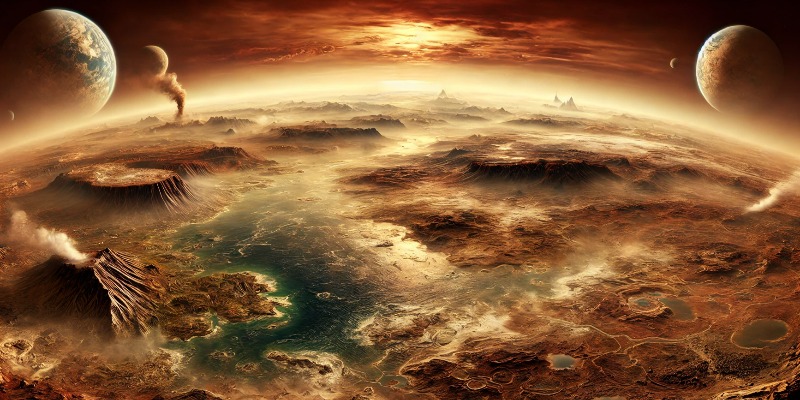
Before the Great Oxidation Event, Earth’s atmosphere was devoid of free oxygen (O₂). The primordial Earth had a reducing environment, dominated by gases like methane (CH₄), carbon dioxide (CO₂), and ammonia (NH₃), along with other gaseous compounds.
The earliest life forms on Earth were anaerobic organisms, bacteria that did not need oxygen to live and thrive.
These microorganisms included methanogenic bacteria, which metabolized methane, and sulfur bacteria, which used sulfur as an energy source. Life was confined to reducing environments, and the planet looked very different from what it does today, with murky oceans and skies due to the chemical reactions among gases in the atmosphere.
The Origin of Photosynthesis and the First Appearance of Oxygen
The atmospheric oxygen that today enables aerobic life did not form spontaneously; its origin is linked to the emergence of photosynthetic bacteria, particularly cyanobacteria (also known as blue-green algae), around 3.5 billion years ago.
These organisms used sunlight to convert water and carbon dioxide into glucose and oxygen through photosynthesis.
However, for millions of years, the oxygen produced by cyanobacteria did not accumulate in the atmosphere. This occurred because the oxygen was immediately consumed by chemical reactions with reducing elements, such as iron present in the seas.
During this period, the iron oxidized, forming vast deposits of banded iron formations, which can still be seen in ancient geological layers today.
The Turning Point: The Oxidation Event
Around 2.4 billion years ago, the situation changed. Reserves of reducing elements like iron began to decrease, no longer able to react with all the oxygen being produced. As a result, free oxygen began to accumulate in the atmosphere.
This transition period lasted hundreds of millions of years, but the outcome was the rise of an oxygen-rich atmosphere, a phenomenon known as the Great Oxidation Event.
The accumulation of oxygen in the atmosphere was catastrophic for many anaerobic organisms, for whom oxygen was toxic. This led to a major biological crisis, one of the first mass extinctions in Earth's history.
However, for other forms of life, oxygen became a crucial energy source, enabling the evolution of new aerobic organisms and eventually leading to the appearance of more complex life forms.
Geological and Climatic Impacts
The Great Oxidation Event did not only change life on Earth; it also profoundly impacted the planet’s geology and climate.
With the rise of oxygen, a series of geochemical processes were triggered, affecting the composition of Earth’s rocks and minerals. The banded iron formations in primordial seas ceased to form as there was no longer free iron to oxidize.
Additionally, the increase in atmospheric oxygen altered the composition of greenhouse gases. Methane, which was one of the main greenhouse gases in the reducing atmosphere, easily oxidized in the presence of oxygen, forming carbon dioxide and water.
Since methane is a much more potent greenhouse gas than CO₂, this transformation led to a reduction in the greenhouse effect and, consequently, global cooling.
This cooling period, known as "Snowball Earth", saw the planet go through one of its most severe ice ages, with glaciers extending even into equatorial regions.
Although it remains a topic of ongoing research, many scientists believe the GOE was one of the factors that contributed to this extreme cooling.
Long-Term Consequences
The GOE had a lasting impact on the evolution of life and Earth’s environment. The increase in oxygen made possible the development of aerobic respiration, a process far more efficient than anaerobic fermentation.
This allowed organisms to harness energy more efficiently, leading to the evolution of more complex organisms and, ultimately, multicellular life.
Around 600 million years ago, oxygen levels reached a critical point that enabled the explosion of biodiversity known as the Cambrian Explosion, when the first complex life forms, such as multicellular animals, appeared.
Today’s Earth and the Role of Oxygen
Today, oxygen makes up about 21% of Earth’s atmosphere, a vital element for most living organisms.
However, the GOE was not a singular, rapid event but rather a gradual process, with oscillations in oxygen levels over billions of years.
After the GOE, there was a further increase in oxygen, known as the Neoproterozoic Oxygenation Event, which further solidified the conditions necessary for the development of complex life forms.
Conclusions
The Great Oxidation Event was a revolutionary change in Earth’s history, transforming the atmosphere, climate, and biosphere.
Not only did it alter the chemical conditions of the atmosphere, but it also triggered one of the first great mass extinctions, paving the way for the evolution of new forms of life.
Thanks to this event, Earth transformed from an oxygen-deprived planet into an oxygen-rich environment, capable of sustaining an incredible variety of life forms, from simple algae to the complex multicellular organisms that populate the planet today.