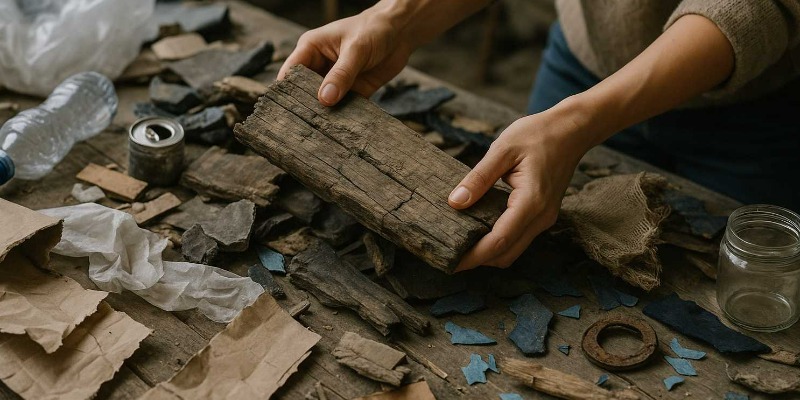
In an age where objects seem to lose meaning as quickly as they wear out, this chapter invites us to reconsider matter as a living medium, capable of telling stories and revealing who we are. Recycling emerges not as a technical practice, but as a cultural gesture that restores value to what society tends to erase.
Through a journey that intertwines memory, sensitivity, and aesthetic responsibility, the story shows how waste can become a language and a mirror of our times. The artist, collecting worn-out fragments, performs an act of resistance to the speed of consumption and transforms what was obsolete into new visibility. The chapter thus prepares the reader for a journey into materials, poetics, and hidden histories, revealing how the rebirth of matter is also a rebirth of the gaze.
Why reusing materials has become an identity-building, aesthetic, and emotional gesture in a society of excess
We live in an age where matter seems to slip through our fingers. Objects break, wear out, lose value, and are replaced with a speed that would have seemed unthinkable just two decades ago. Things don't last long, but above all, they mean little: we no longer stop to ask ourselves where they come from, what they mean, what history they carry with them.
It is in this material fragility, in this lightness of possession and oblivion, that the need to rethink our relationship with what surrounds us arises. And it is here, in this cultural rift, that the art of recycling fits in.
Recycling is not a technical gesture, nor a simple ecological practice. It is a cultural act: a declaration of value, a gesture of care, a way of resisting the indifferent speed with which the world discards and forgets. When an artist chooses to work with worn materials, fragments of everyday life, broken or functionless objects , he is not simply recovering a material: he is recovering a meaning. He is putting back into circulation not only the substance of things, but their memory, their time, their possibilities.

In an age marked by excess, constant production, and systematic replacement, speaking of a "crisis of material value" means looking at the world with disenchanted eyes. Objects were once meant to last; they were repaired, cared for, and shared. Today, by contrast, their loss of value is so rapid that it becomes invisible. Every product that breaks doesn't raise a question about its fate, but merely a gesture of distancing. The cycle of production and consumption is so rapid and automated that it leaves no room for awareness....