- Marie Curie: A Life Dedicated to Science
- Marie Curie's Beginnings: From Poland to the Sorbonne
- The Discovery of Radioactivity: An Epochal Change
- Working with Pierre Curie: An Extraordinary Scientific Collaboration
- The First Victory of the Nobel Prize and the Resistance of the Committee
- The Second Nobel: Recognition for Chemistry and New Controversies
- The Difficulties of Women in Science in Marie Curie's Time
- Marie Curie's Legacy: Inspiration for Future Generations
The Extraordinary Life of Marie Curie, Her Revolutionary Discoveries, and the Struggle Against Gender Bias in an Era That Refused to Acknowledge the Value of Women in Science
by Arezio Marco
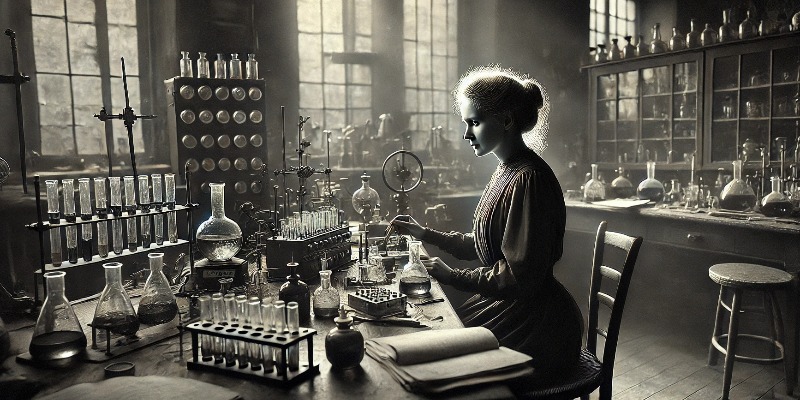
Marie Curie is one of the most famous names in the history of science, symbolizing not only scientific progress but also the struggle of women to establish themselves in a male-dominated world.
Her personal story is an extraordinary example of determination and genius in an era when women were constantly marginalized, especially in the academic and scientific worlds.
This article traces her life, her research, and the difficulties she had to face, including those related to the Nobel Prize controversy.
The Beginnings and Education
Born Maria Skłodowska on November 7, 1867, in Warsaw, Poland, Marie came from an intellectually stimulating family.
Her father was a teacher of mathematics and physics, instilling in her a love of learning. However, 19th-century Poland was under Russian rule, and access to higher education for women was severely limited.
Despite these obstacles, Marie distinguished herself early on with her extraordinary intelligence and desire to learn.
Unable to attend Polish universities due to her gender, she moved to Paris in 1891 to continue her studies at the Sorbonne, one of the few institutions in Europe that allowed women to study.
There, she earned degrees in physics and mathematics, not without economic hardships, living in extreme poverty and often sacrificing food and heat to afford books and study materials.
Marriage to Pierre Curie and Early Discoveries
In 1895, Marie married Pierre Curie, a renowned French physicist, with whom she shared a deep passion for scientific research. Together, they became one of the most influential couples in the history of science.
Their collaboration led to fundamental discoveries in the field of radioactivity, a term coined by Marie herself.
Marie’s interest in radioactivity began with the work of French physicist Henri Becquerel, who had discovered that uranium emitted radiation.
Fascinated by this discovery, Marie began studying the nature of these mysterious radiations, conducting experiments that led her to isolate new radioactive elements, such as polonium (which she named in honor of her homeland, Poland) and radium.
The Curies' work demonstrated that radioactivity was an intrinsic property of atoms and not the result of a chemical reaction, as previously thought. This discovery revolutionized physics and laid the groundwork for modern nuclear physics.
Challenges and Social Resistance
Despite the immense scientific value of her discoveries, Marie Curie faced enormous resistance from the scientific community, largely due to her being a woman.
Her candidacy for the Nobel Prize in Physics in 1903 was initially rejected, despite her fundamental contribution to the discovery of radioactivity.
It was only thanks to the intervention of Pierre and Swiss mathematician Charles Édouard Guillaume, who defended Marie’s role in the research, that the Nobel Committee agreed to include her name.
Thus, in 1903, Marie Curie became the first woman to win the Nobel Prize, sharing it with Pierre Curie and Henri Becquerel.
This episode is emblematic of the condition of women in the scientific world at the time: even when faced with extraordinary achievements, their abilities and roles were often diminished or ignored.
Women, both in education and scientific careers, were considered inferior to men and often relegated to subordinate roles.
Marie Curie had to overcome not only the challenge of pioneering research in an unexplored field but also the battle against gender prejudice.
The Second Nobel Prize and Universal Recognition
Marie Curie’s life was marked by personal tragedy, particularly the sudden death of Pierre in a road accident in 1906.
Despite her grief, Marie continued their work and won a second Nobel Prize in 1911, this time in Chemistry, for the discovery of radium and polonium and for her investigations into the chemical properties of radioactive compounds.
This second victory made her the only person in history to have won two Nobel Prizes in two different scientific fields, an achievement that is still admired and celebrated today.
However, even in this instance, Marie faced prejudice and criticism. Her private life came under scrutiny from the press, especially because of her relationship with physicist Paul Langevin, which caused a scandal in Parisian society.
Once again, the criticisms focused on her being a woman rather than on her undeniable scientific genius.
Marie Curie’s Legacy and the Push for Women in Science
Marie Curie continued working until her death in 1934, caused by prolonged exposure to radiation.
Despite the risks, she devoted her life to science and research. The legacy she left behind is incalculable: her work paved the way for fundamental developments in physics and medicine, such as the use of radiation in cancer treatment.
Moreover, Marie Curie has become a symbol for women scientists around the world. In an era when women were excluded from most academic and scientific institutions, Marie managed to break down these barriers and demonstrate that genius and dedication know no gender.
Her story continues to inspire generations of women scientists, who see her not only as a pioneer of radioactivity but also as a pioneer of gender equality in science.
Women in Science During Marie Curie’s Time
Marie Curie’s success must be understood in the context of the social conditions of the time. At the end of the 19th and the beginning of the 20th centuries, women who sought to enter traditionally male fields such as science, medicine, and engineering encountered enormous obstacles.
Many universities did not accept female students, and the few that did often relegated women to secondary roles, frequently failing to acknowledge their contributions.
Marie Curie’s achievements demonstrated that women were capable of excelling in fields that had been dominated by men. Her example encouraged other women to pursue scientific careers and led to a slow but gradual opening of academic institutions to women.
However, despite these advances, gender disparity in the scientific field is still a reality in many parts of the world.
Conclusion
Marie Curie is not only a key figure in the history of science but also an example of courage and perseverance in a world that often sought to exclude her because of her gender.
Her discoveries in the field of radioactivity revolutionized physics and medicine, but her struggle against prejudice and discrimination had an equally significant impact.
Marie Curie remains an icon of what can be achieved through hard work and dedication, regardless of obstacles.
Today, her name is synonymous with scientific excellence and female empowerment, an eternal symbol of a woman who, against all odds, changed the world.