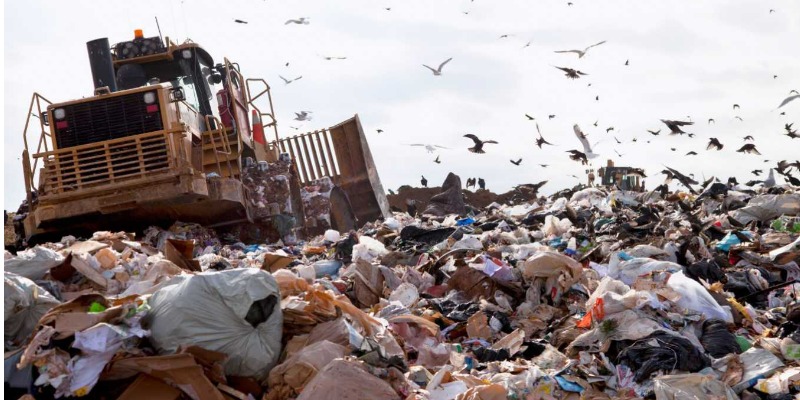
- What is a landfill
- The ATEX risk in a landfill
- When an explosion can occur in a landfill
- How the ATEX risk is formed
- How to eliminate potentially explosive gases to reduce the ATEX risk
Atmosphere Explosive (ATEX) is a dangerous and explosive mixture that forms inside landfills
Dumps, which host non-recyclable and biodegradable products, are not simple plants to manage due to of internal and external factors that it is good to know, in order to understand and evaluate the risk present in the area of the transfer site and that for the neighboring urban settlements.
In the past, before the mechanical recycling of waste took hold in a structured way, the landfill was the place where discarded products were forgotten, the solution to the disposal of any waste that was produced by man.
An indecipherable mass of heterogeneous waste that was stacked and covered when the landfill was full, without too much concern about the chemical action that the waste continued to produce over the years.
Even the soil and subsoil protection technologies, in order to avoid soil and groundwater pollution, left much to be desired, with situations of pollution discovered many years later.
Today, landfill construction and management technology has certainly made many steps forward, also taking into account the positive contribution to upstream of the waste recycling system, which has somewhat reduced and diversified the pressure of the material entering the landfill.
Furthermore, the coating technologies and containment of soil pollutants have allowed a more professional and more ecological approach to the problem of landfills.
Despite this, the waste that is deposited continues to have its own life within the stratified mass, by virtue of the processes that waste produces for many years, triggering problems to know and keep in mind.
One of these is the so-called ATEX (Atmosphere Explosive) phenomenon which represents the danger of explosion that is generated due to the formation of biogas in the internal layers of the waste.
The resulting biogas is mainly composed of Methane (CH4), and can even reach 65% according to the composition of the mix of deposited materials, the age and conditions of the landfill.
Another factor to keep in mind, when calculating the ATEX explosive risk, is the possible presence of flammable waste, such as plastic materials not recyclables or solid or liquid chemical residues, which can, in the event of an explosion, amplify the disruptive force of the released methane.
We have therefore developed capture systems for the gases produced inside a landfill which, based on the applied technologies and the degree of engineering of the plants, have the ability to extract from 50 to 90% of the explosive gases contained.
But when can an explosion occur in a landfill?
There are direct, and some indirect, triggering phenomena, which need to be monitored to minimize the problem.
Among the direct ones we can mention the self-combustion of materials in the presence of particular conditions, such as a high internal temperature of the deposit, a high presence of methane and a combination of waste suitable for the self-combustible phenomenon.
Among the indirect phenomena we can include work operations in the landfill area, such as the use of equipment that could cause sparks , such as grinding wheels, rotating hoses, welding actions, running heat engines, the presence of electric lines and vandalism phenomena.
How the ATEX risk is formed
To summarize, we can say that the main factors influencing the migration of gases from waste are diffusion, pressure and permeability
We therefore start from the assumption that biogas, which is formed inside landfills, has a specific weight similar to that of air and, for this reason, a migration from the inner layers to the outside of the landfill surface is created.
The main component of biogas, as we have seen, is made up of methane, a highly flammable and explosive gas if compressed in a closed environment, which in landfills can be found on average in a concentration of around 50%. In itself it is not an absolute high value but it cannot be excluded that it does not generate explosions.
Two other components to keep in mind for calculating the ATEX risk are oxygen and hydrogen sulphide b>, which could contribute to amplify the phenomenon.
As regards oxygen, this is necessary for the anaerobic phenomena of methane production, therefore, although it can be intercepted on the surface, free methane has no usually concentrations sufficient to create an explosion on contact with oxygen.
As regards hydrogen sulphide, a compound that is formed in the initial processes of biodegradation of waste, although usually in low quantities, not being captured in an instrumental way must be considered when assessing a hypothetical explosion risk.
How to eliminate potentially explosive gases to reduce ATEX risk
Landfills, which also include the disposal of organic waste, must be equipped with systems for the capture and extraction of explosive gases which are formed within the mass of waste, and their permanence in full efficiency must last for the entire time that the landfill will exist, even if it is no longer operational.
The collected gas can be used as an energy source, but, if there are no plants for its recycling, it must be disposed of in special combustion chambers.
Finally we must consider CO2, a gas heavier than air, which is also produced in the biodegradation of waste and which goes to settle in the lower layers of the cumulus.
Although not directly related to the ATEX risk, we report it as a suffocating gas, which can cause the death of men and animals, therefore it will be necessary to foresee the its capture and elimination.
Machine translation. We apologize for any inaccuracies. Original article in Italian.