- Home humidity: balancing comfort, health, and sustainability
- Differences between absolute and relative humidity in living environments
- Types of humidity in buildings: rising damp, condensation and infiltrations
- Rising damp: causes, effects, and technical solutions
- Superficial and interstitial condensation: diagnosis and prevention
- Impacts of humidity on health, materials and energy consumption
- Sustainable techniques for humidity control and prevention
- Ideal humidity values according to the science of living comfort
Technical and sustainable analysis of the causes of domestic humidity, from capillary rise to interstitial condensation
by Marco Arezio
In a home designed with sustainability in mind, comfort isn't limited to temperature management or energy savings. What truly makes the difference is the internal microclimate, a delicate balance between heat, ventilation, and humidity. The latter, often invisible, is one of the most complex variables to control: it affects health, the durability of materials, and the sense of well-being perceived in a space.
Humidity is a form of water suspended in the air in the form of vapor. Its presence is not inherently negative: a proper level of humidity is necessary for breathing, for the preservation of natural materials, and for thermal comfort. Problems arise when humidity exceeds or falls below certain equilibrium values, becoming a cause of degradation, nuisance, or energy inefficiency. Understanding its origin, how it moves, and how it interacts with building structures is key to designing healthy and long-lasting homes.
Absolute Humidity and Relative Humidity: Differences and Implications
The first step in understanding how to manage humidity in your home is to distinguish two fundamental concepts: absolute humidity and relative humidity. Absolute humidity represents the actual amount of water vapor contained in a cubic meter of air, regardless of temperature. Relative humidity, on the other hand, indicates how saturated the air is with vapor compared to the maximum amount it could hold at the same temperature.
This distinction is far from theoretical: it explains why, for example, in winter, the air often feels dry even when heated. Cold air coming from outside, once heated, does not increase its water vapor content (i.e., absolute humidity), but it can hold more. Consequently, the saturation percentage decreases, and the air becomes "relatively" drier. The same principle applies in reverse during summer, when hot, humid air can reach saturation levels approaching 100%, making rooms oppressive and encouraging condensation.
Understanding this dynamic means understanding the physics of comfort: humidity is not a simple annoyance, but a thermodynamic variable that interacts with temperature, ventilation, and materials.
The main types of humidity in buildings

Not all homes suffer from the same type of humidity.
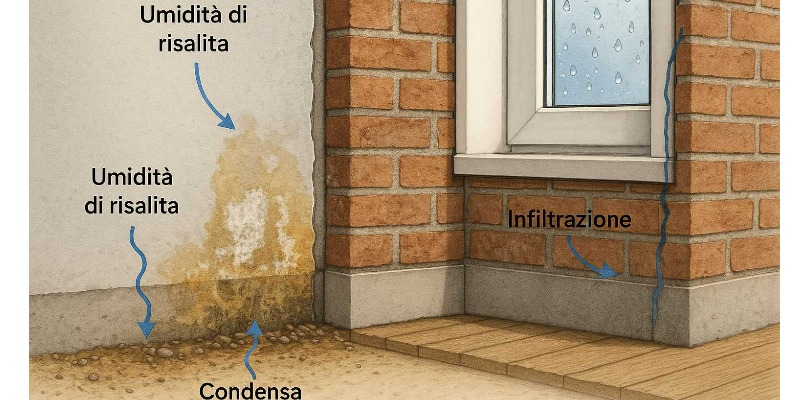
The phenomena can have very different origins, ranging from external infiltrations to the simple condensation of steam generated by daily activities. In any case, they are manifestations of the same physical principle: the migration of water in its various states, attracted by differences in temperature and pressure.Rising damp, for example, is typical of historic homes or walls in direct contact with the ground. Building materials, without waterproof barriers, act like sponges: groundwater penetrates the pores and rises by capillary action, leaving stains, salts, and flaking plaster. It's a slow but constant phenomenon, which can be combated with chemical sealants, breathable plaster, and perimeter drainage.
Surface condensation, visible as droplets on walls or glass, is a different matter. It forms when humid air encounters a colder surface and reaches the dew point. It's common in bathrooms, kitchens, or poorly insulated perimeter walls and is the main cause of mold growth.
Even more insidious is interstitial condensation, which develops inside wall units or insulation panels, where vapor migrates and condenses in hidden areas. This type of moisture, if not detected early, can compromise the insulating function of materials and damage the structure itself.
Finally, there are infiltrations, due to waterproofing defects or deteriorated seals, and accidental dampness, linked to occasional events such as system leaks or flooding. In any case, what all these conditions have in common is the need for a technical diagnosis: without understanding the water's path, it's impossible to define an effective intervention.
Effects of humidity on health, materials and energy consumption
The effects of humidity aren't limited to visual or tactile discomfort: they affect the body, materials, and energy consumption. An environment with excessively high relative humidity encourages the growth of mold and mites, which release spores and allergens into the air, causing respiratory problems and skin irritation. Conversely, air that's too dry dries out the mucous membranes, causing headaches, fatigue, and dehydration.
Materials are also profoundly affected by humidity. Wood warps, iron rusts, and concrete loses cohesion. A damp wall is a colder wall, as water reduces the material's thermal resistance. In energy terms, this means that achieving the same comfortable temperature requires more energy. Humidity, therefore, is not just a health or aesthetic issue, but a direct contributor to energy inefficiency.
In a modern home, where sustainability and efficiency are primary objectives, monitoring and controlling humidity becomes an integral part of the construction project, on a par with thermal insulation or natural lighting.
Sustainable prevention and control techniques

Preventing damp means working on multiple levels: structural, systems, and management. In cases of rising damp , the most long-lasting solution is to create a physical or chemical barrier at the base of the walls, preventing water from rising. Dehumidifying plasters, composed of macroporous mortars or natural limes, help the wall breathe, promoting evaporation.
Condensation, however, requires a different strategy. It's necessary to improve wall insulation, eliminate thermal bridges, and ensure proper ventilation. Controlled mechanical ventilation (CMV) systems are currently the most sustainable solution: they allow for constant air exchange, recover heat, and maintain relative humidity within ideal levels.
The use of breathable materials is equally important. Natural hydraulic limes, silicate paints, wood fibers, and plant-based insulation allow for natural vapor regulation, preventing buildup. In low-energy buildings, humidity management is also automated: sensors and digital control units measure temperature and humidity levels in real time, adjusting ventilation or window openings.
Ideal humidity levels and the science of living comfort
Each room in the home has its own ideal balance, which depends on the temperature, the room's function, and the amount of steam generated. According to UNI EN ISO 7730 standards and the World Health Organization's recommendations, optimal relative humidity levels are between 40% and 60%.
In living rooms and bedrooms, this threshold ensures thermal comfort and respiratory well-being; in kitchens and bathrooms, where steam production is high, it can reach up to 65%, provided the space is well ventilated. Basements and cellars, however, should remain below 70%, thus preventing the proliferation of mold and bacteria.
A sustainable home is one that maintains these balances naturally, with breathable materials and effective ventilation systems. Technology, in this sense, becomes biology's ally: digital hygrometers, data loggers, and humidity sensors integrated into home automation systems allow for constant monitoring, ensuring healthy environments and reduced energy consumption.
Managing humidity isn't a corrective action, but an invisible science of living comfort. It means recognizing that water, in all its forms, is part of the life cycle of the home. When we understand and manage it, rather than fight it, the home becomes a balanced organism: healthy for those who live in it, efficient for the environment, and long-lasting for those who build it.
© Reproduction Prohibited