- What is Industrial Symbiosis and How Does It Work Between Two Companies?
- Importance of Industrial Symbiosis in the Circular Economy
- Fundamental Elements of an Industrial Symbiosis Contract
- Legal Definition of Materials: Waste, By-Product or End-of-Waste
- Key Clauses in Industrial Symbiosis Contracts
- Transportation, Storage and Logistics Management
- Ownership and Transfer of Risk of Secondary Materials
- Environmental Constraints and Regulatory Compliance in Contracts
- Allocation of Responsibilities and Insurance Coverage
- Role of Legal Consulting and Internal Training in Companies
How to structure effective industrial symbiosis agreements, protecting the environment, business, and mutual responsibilities
by Marco Arezio
In the context of the transition to a circular economy, industrial symbiosis represents a fundamental lever for optimizing resources, reducing waste, and creating shared value between different companies.
Industrial symbiosis between two companies refers to a strategic collaboration in which waste, byproducts, residual energy, or other resources no longer useful to one company are used as production inputs by another, within a voluntary and regulated system. This isn't simply a matter of selling waste or providing disposal services, but rather a circular, structured, and lasting relationship where both parties derive concrete benefits: reduced costs, less waste, improved environmental performance, and new business opportunities.
However, the effectiveness and sustainability of these collaborations depend, to a large extent, on the precision with which the contracts governing them are negotiated and formalized. These are not simply supplies or transfers of waste, but actual production ecosystems in which flows of materials, energy, and information must be carefully regulated, considering both economic opportunities and stringent environmental regulations.
Drafting an industrial symbiosis contract therefore means anticipating critical issues, managing risks, and ensuring a clear division of rights and obligations, with particular attention to clauses, constraints, and responsibilities that are far from obvious.
Definition and peculiarities of industrial symbiosis in contractual relationships
Industrial symbiosis is based on the idea that the residue from one company's production process can become a raw material or useful resource for another. The complexity of these relationships goes far beyond traditional sales or supply agreements, requiring a complex and tailored contractual framework.
When drafting the agreement, it is essential to precisely identify the legal nature of the relationships (transfer, supply, joint venture, integrated services) and establish whether they are continuous or occasional exchanges, whether the secondary material is transferred for a fee or free of charge, and under what conditions compliance is guaranteed.
Another crucial aspect concerns the regulatory classification of the materials being traded: waste, by-products, or end-of-waste? This seemingly technical definition has enormous implications in terms of liability, authorization requirements, and potential penalties.
Key clauses: essential elements for the solidity of the contract
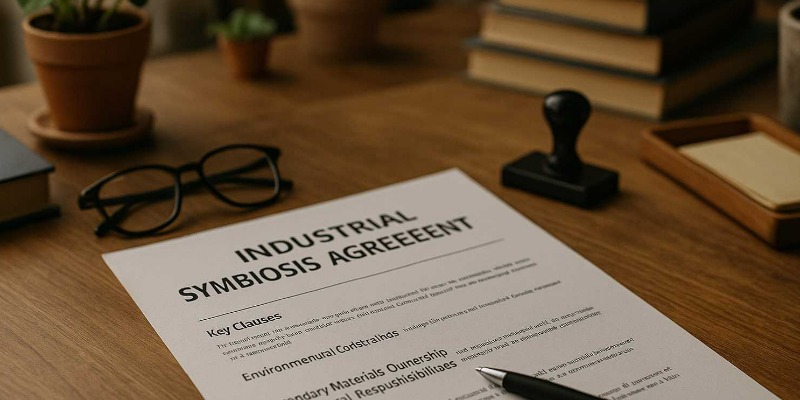
When drafting an industrial symbiosis contract, certain clauses are crucial not only for the protection of the parties but also for the overall sustainability of the transaction. Among these, the following stand out:
1. Object and detailed description of the flows:
It is essential to precisely define which materials or residues are being exchanged, specifying their chemical and physical characteristics, CER codes where applicable, origin, delivery conditions, and quantitative and qualitative limits. Vagueness can lead to disputes and unforeseen environmental risks.
2. Conditions and methods of transport and storage:
The logistics management of materials, often classified as hazardous or potentially polluting, requires detailed responsibilities and operating procedures, as well as any remediation or treatment costs.
The contract should always include clauses regarding who bears the costs and assumes the risks during transportation, who is responsible in the event of accidents or leaks, and what the emergency procedures are.
3. Ownership, title and transfer of risk of secondary materials:
Ownership of the materials involved in symbiosis represents one of the most delicate legal issues. It is necessary to precisely specify the moment at which risk and ownership pass from one party to the other: upon physical delivery, acceptance, or any processing.
In the case of materials that remain classified as waste, the original producer may remain liable even after the transfer, pursuant to Article 188 of Legislative Decree 152/2006.
Where material becomes a by-product or End-of-Waste, it must be expressly established who is responsible for demonstrating compliance with legal requirements and for retaining the relevant documentary evidence.
4. Verification, certification and control clauses:
To prevent risks and disputes, it is advisable to include requirements for periodic verification of material characteristics, the obligation to immediately report anomalies or non-conformities, and the possibility of cross-audits at plants.
Traceability here takes on not only a managerial value, but also a evidentiary one in the event of environmental inspections or disputes.
5. Warranties, indemnities and limitations of liability:
The contract must include specific guarantees regarding the quality of the materials supplied, the legality of the provenance processes, and compliance with regulations. In the event of defects, accidental contamination, or non-conformities, compensation, penalties, or early termination must be provided, avoiding generic exclusions of liability that could be declared null and void.
6. Duration, withdrawal and early termination:
Symbiosis agreements may be affected by production, market, or regulatory variables. Establishing procedures for withdrawal, renewal, or early termination allows the parties to protect their respective interests in the event of substantial changes.
Environmental constraints and regulatory compliance: the centrality of risk
Industrial symbiosis operations are part of a constantly evolving regulatory framework, with increasingly stringent rules on traceability, authorizations, emission limits, and controls.
A solid contract must expressly refer to applicable regulations (Consolidated Environmental Act, EU Regulations, sectoral directives), include the obligation to keep permits updated, and promptly communicate any changes.
Compliance with BAT (Best Available Techniques), emission limits, and rules for the management of manufacturing waste must be constantly monitored. Even partial failure to comply with these obligations can lead to administrative, criminal, and civil liability, sometimes involving administrators and technical managers.
Ownership of secondary materials: a question of law and strategy
Defining the ownership of secondary materials is not just a technical choice; it impacts industrial planning, the ability to valorize recovered materials, and the allocation of any tax breaks or environmental certifications.
Whoever becomes the owner of the materials also assumes the risk of managing and disposing of any unusable residues. Clarity in defining ownership and related responsibilities is essential to avoid disputes, especially when the materials being exchanged retain, at least in part, the nature of waste or require further treatment.
Mutual responsibilities and insurance coverage
Industrial symbiosis involves a close interconnection between the production cycles of the companies involved. Therefore, the contract must clearly allocate responsibilities, both for environmental damage and for personal injury or property damage resulting from the processing, transportation, or use of materials.
It is strongly recommended that insurance policies be in place to cover environmental and civil risks, as well as specific mutual indemnity clauses. This includes the obligation to promptly report any accidents, disputes with authorities, or third-party complaints.
Conclusion: the importance of specialist consultancy and internal training
Drafting an industrial symbiosis contract cannot be considered a formal obligation, but it represents a strategic lever for sustainability, competitiveness, and innovation.
For corporate managers and legal departments, engaging expert environmental consultants, process engineers, and environmental managers is essential to prevent risks and fully reap the benefits of symbiosis.
Equally important is the internal training of the personnel involved, from production to purchasing to the legal department, so that everyone is aware of their roles, obligations, and responsibilities.
Only in this way can industrial symbiosis be not only a virtuous practice, but also a safe, effective, and replicable business model.
© Reproduction Prohibited