- PMMA Properties and Advantages in CNC Machining
- Operational strategies for CNC milling of PMMA
- Critical issues and solutions in PMMA processing
- Industrial applications of PMMA parts
- Optical quality and tolerances in CNC machined PMMA
- Innovation and sustainability: the use of recycled PMMA
- Waste management and recycling of PMMA in the workshop
- Future of CNC Machining for Clear Plastics
Guide to the properties, processing techniques and applications of polymethyl methacrylate, with an eye on recycling and sustainability
by Marco Arezio
In the panorama of transparent plastics, PMMA – polymethyl methacrylate, better known by the commercial brands Plexiglas®, Perspex®, Acrylite® – has taken on a leading role over time, both for its optical qualities and for its workability. Today, market demands are not limited to technical performance alone: attention to sustainability and the recovery of raw materials is pushing more and more operators and designers to evaluate not only the properties of virgin material, but also the behavior of recycled polymers. And CNC machining, with its flexibility and precision, plays a decisive role both in the enhancement of the material and in the evolution towards more responsible production.
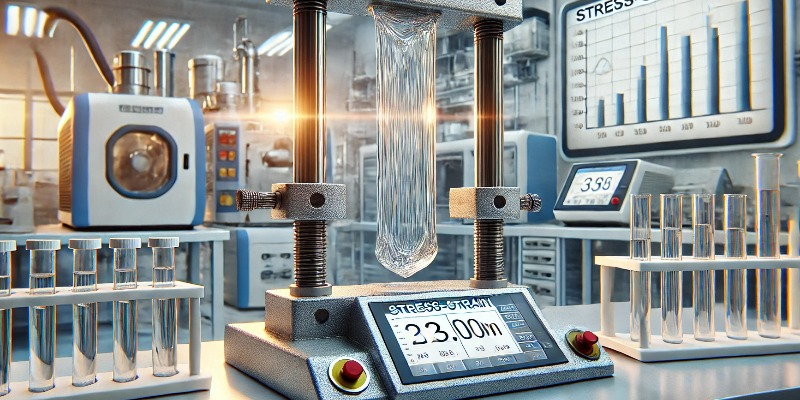
Polymethyl methacrylate is an amorphous thermoplastic polymer characterized by high transparency (up to 92% visible light transmission), good resistance to atmospheric agents and UV rays, as well as excellent dimensional stability. From a mechanical point of view, PMMA offers superior hardness compared to other transparent polymers (such as polycarbonate), but is more fragile, with low impact resistance.
- Density: approx. 1.19 g/cm³
- Elasticity modulus: 2,400-3,200 MPa
- Breaking load: 55-75 MPa
- Operating temperature: -40°C to +80°C
- Glass transition temperature (Tg): about 105°C
One of the main advantages of PMMA is the possibility of maintaining tight tolerances and optically perfect surfaces after CNC machining, a fundamental condition for applications in the optical and medical sectors.
The allure (and challenges) of working with PMMA
Those who approach CNC machining PMMA for the first time are often surprised by the ease with which it is possible to obtain clear surfaces, complex shapes and tight tolerances. Yet the real challenge is to maintain these qualities on an industrial scale, without compromising on optical quality and dimensional stability. PMMA, thanks to its amorphous structure, lends itself well to milling, drilling and turning, returning an almost crystalline transparency if the process is managed correctly. However, it is a sensitive material: it fears the heat generated by the friction of the tools, suffers from vibrations and can suffer from micro-cracks or clouding if the cutting parameters are incorrect.
For production managers, the first step is always choosing the sheet. The quality of the starting material, the presence of surface protections, even the type of aging undergone by the polymer (exposure to UV light or chemical agents) influence the final result. It's not about details: for the production of optical lenses, protective screens or medical components, even a small alteration in transparency or a tiny crack can determine the rejectability of the piece.
From the Workshop to the Metrology Room: Winning Operational Strategies
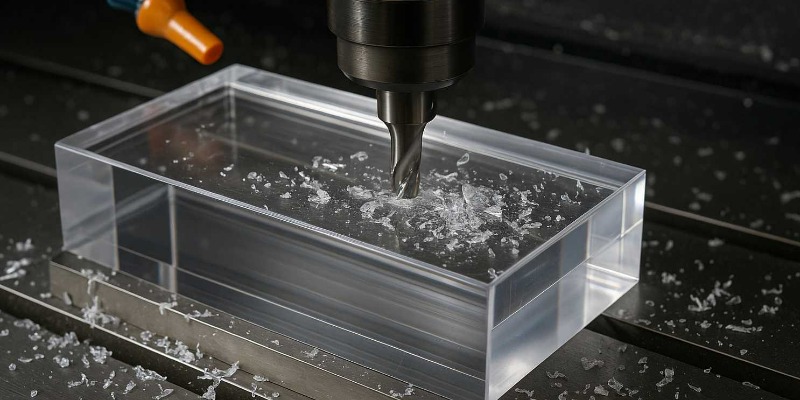
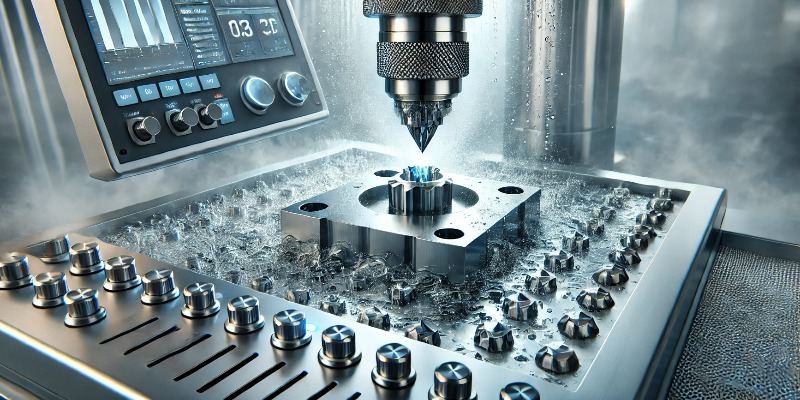
CNC machining of PMMA is based on some cornerstones, refined over the years by expert operators and research laboratories. The most suitable tools are those in hard metal, sharpened with geometries dedicated to plastics. The rotation speed is high, but the feed remains moderate: the goal is to cut the polymer without “kneading” it or making it melt. Light cooling, preferably with air, prevents overheating and allows the chip to be evacuated without deposits.
In everyday work, cutting tests, thorough cleaning of surfaces and maintenance of tools become an indispensable routine. Those who aim for excellence often integrate mechanical processes with a final polishing, sometimes even with a flame to restore shine and remove residual micro-opacities.
Good toolpath programming is equally crucial: avoiding sudden changes in direction, minimizing sudden accelerations and splitting the passes helps to maintain transparency and prevent internal stresses in the material.
Applications between innovation and precision
The versatility of CNC machining of PMMA is evident in many sectors. In scientific instrumentation and optics, the demand is often for extremely precise parts, such as lenses, light guides and sensor covers. Here, optical quality is not just a plus, but a functional necessity. In the medical field, clean, contaminant-free and easy-to-sterilize surfaces are required: PMMA, machined under controlled conditions, fully meets these requirements.
Even in design and furniture, the design freedom of CNC allows you to create unique objects, sometimes true pieces of industrial art. From displays to illuminated signs, from automotive components to architectural applications, the possibilities are virtually unlimited.
Recycled PMMA: A New Standard for Sustainability?
In recent years, the recovery and recycling of PMMA in production is becoming increasingly important, in line with the principles of the circular economy. PMMA recycling can occur both in mechanical form, by grinding waste and transforming it back into granules, and in chemical form, by depolymerizing the material to obtain the original monomer. From a practical point of view, recycled material often presents an additional challenge for those working at CNC.
Not all recycled PMMA is the same: the quality depends on the purity of the collection, the presence of additives, colorants and contaminants. The mechanical properties generally remain good, but a decrease in transparency or the appearance of slight internal defects, such as microbubbles or inclusions, may be recorded. For this reason, in applications where optical perfection is essential (for example in precision lenses or high-end display glazing) virgin material is still preferred, while recycled material is widely used in technical panels, protections, dividers, furniture and even in innovative eco-design solutions.
Working with recycled PMMA on CNC therefore requires a little more care: careful selection of the raw material, the use of less aggressive cutting strategies, and a particularly careful quality control phase. The advantages, however, are evident from both an environmental and economic point of view: landfill waste is reduced, procurement costs are lowered, new life is given to materials that would otherwise be destined for abandonment.
Towards responsible and high-precision production
For technicians, engineers and production managers, PMMA CNC machining represents a continuous laboratory of innovation, where precision, efficiency and sustainability intertwine every day. The arrival on the market of high-quality recycled materials, together with the development of new machining strategies and increasingly advanced simulation software, is changing the way of designing and producing PMMA parts.
The most attentive companies adopt waste recovery policies, implement digitalized metrological control systems and invest in operator training, aware that competitiveness depends on the ability to offer tailor-made, optimized and low environmental impact solutions.
Conclusions: PMMA, CNC and the Future of Clear Plastics
Processing PMMA on CNC machines is much more than a technical operation: it is an exercise in precision, a test bed for industrial innovation and, today more than ever, an opportunity to reduce environmental impact without sacrificing performance. The challenge of sustainability can also be won by choosing recycled raw materials, perfecting production processes and passing on these skills to new generations of engineers and technicians.
Experiment, evaluate, improve: CNC machining of PMMA, whether virgin or recycled, remains one of the most stimulating areas of modern plastic engineering, capable of combining creativity, technology and respect for the environment.
© Reproduction prohibited