- Additives for scratch resistance in polycarbonates: a general overview
- Surface properties and scratch mechanisms in polycarbonate
- Organic additives to improve scratch resistance in polycarbonates
- Micronized inorganic additives and scratch resistance in polycarbonates
- Functionalized nanoparticles to increase the scratch resistance of polycarbonate
- Integrated protective coatings and surface strategies in polycarbonates
- Optical compatibility of additives and transparency in polycarbonates
- Standards and laboratory tests on the scratch resistance of polycarbonates
- Industrial applications of polycarbonate with added scratch resistance
- Future prospects for scratch resistance additives in polycarbonates
Chemical and industrial strategies to increase scratch resistance in high-performance polycarbonates
by Marco Arezio
Polycarbonate is one of the most widely used polymers in the high-performance materials industry due to its unique combination of properties: high optical transparency, good mechanical strength, dimensional stability, and processability.
However, one of the most well-known critical issues is its poor resistance to surface scratches. This limitation limits its use in applications where aesthetics, transparency, and the durability of the exposed surface are crucial, such as in the automotive sector, consumer electronics, and optical devices. To overcome this problem, industrial and academic research has developed various strategies based on the use of specific additives capable of modifying the surface of polycarbonate without compromising its intrinsic properties.
Surface properties and scratching mechanisms
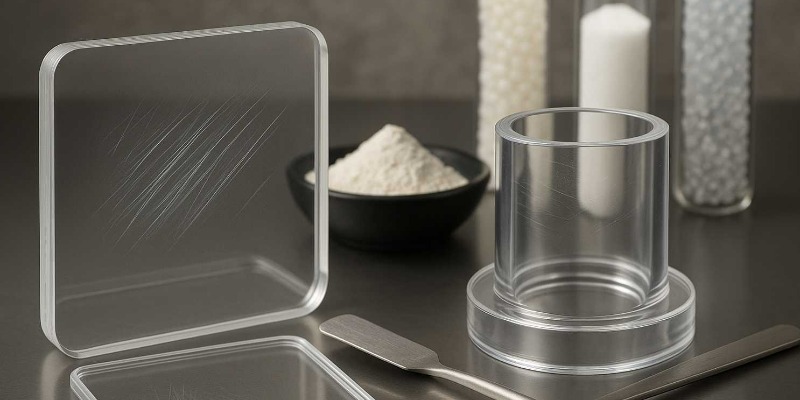
Scratching a polymer is not simply the result of local mechanical stress, but a complex phenomenon involving plastic deformations, microfractures, and surface alterations. In the case of polycarbonate, the strain energy is absorbed unevenly, resulting in the formation of microstriations visible to the naked eye. This sensitivity is linked to the amorphous nature of the material and the segmental mobility of the polymer chains, which tend to deform under stress.
The use of additives aims to limit this mobility, to strengthen the matrix and to create a more rigid surface, capable of better distributing stresses and reducing the formation of the groove.
Classification of additives
When it comes to scratch resistance in polycarbonates, there's no single solution: solutions are distributed across a map of chemical families that act through complementary mechanisms. The goal is always the same—to increase the load at which visible damage appears and prevent it from developing into a deep groove—but this can be achieved by making the surface more smooth, stiffening the subsurface layer, inserting "hard spots" invisible to light, or even creating a protective skin during the process.
The four most used families are:
- organic surface modifiers
- micronized inorganics
- functionalized nanoparticles
- integrated coatings
These categories are distinguished by their nature, processing behavior, and impact on optics and finishes.
Organic surface modifier additives
They work on two key levers. On the one hand, they reduce friction in dry contact; on the other, they stiffen the area immediately under the skin, so that the deformation is distributed and does not generate micro-grooves. The first group includes silicone-based systems, such as PDMS or PC-siloxane copolymers, designed to spontaneously enrich the surface during molding.
It's a controlled "bloom": a few tenths of a percentage point (typically up to 1%) are enough to build a thin, low-surface-energy film capable of lubricating the contact trail and attenuating micro-shearing. Excessive dosage, however, comes at the cost of haze, poorer wettability, and difficulty painting or printing. This is why the copolymer's "microarchitecture"—the length of the siloxane blocks and graft density—is carefully considered, which governs how quickly and stably the film organizes on the surface (verifiable, for example, with XPS or ToF-SIMS).
Fluorinated oligomers and high-temperature "slip" additives team up with silicones. These also reduce friction without external lubricants, but to function in PC, they must anchor themselves to the matrix with compatible moieties (aromatic or carbonate-like blocks), otherwise they risk migrating out (bleeding). Some high-temperature synthetic waxes (aromatic polyesters, high-melting polyamides) help control slip without volatilizing in the typical PC temperature range (about 290–320°C); generic waxes not designed for engineering polymers, however, tend to degrade or bloom.
The second pillar of organics is the gentle tightening of the skin through Very limited branching/crosslinking. Small amounts of multifunctional epoxy agents, oxazolines, or reactive methacrylates interact with the PC chain ends or with groups introduced by compatibilizers, creating a loose network or branched chains that increase the modulus and apparent hardness just below the surface. The result: shallower groove depth at the same load. Going too far, however, introduces gel, alters transparency, and can cause the material to yellow.
A less obvious but crucial role is played by photothermal stabilizers: they don't harden the surface, but preserve it. They maintain the skin's chemistry and T_g after exposure to heat and UV rays, preventing the softening that facilitates scratching with aging. Targeted combinations of UV absorbers (benzotriazoles/benzophenones) and HALS, selected for PC, are the "insurance" for long-term durability.
From a process perspective, organic materials require discipline: their effectiveness depends on the cutting history and melting time. Excesses during extrusion or molding can degrade them or promote phase separations (flow marks). Pre-drying of the PC remains essential (≤0.02% H₂O) to avoid hydrolysis, a drop in M_w, and a loss of optical properties. Furthermore, each additive package must be verified with respect to the intended finishes (metallization, bonding, painting), as low surface energy can hinder them.
Micronized inorganic additives
They introduce hard anchoring points (silica, alumina, boehmite) that increase localized shear strength and distribute stress, preventing plastic accumulation. Effectiveness increases with the particle's hardness/modulus and with adhesion to the matrix.
In transparent PC, however, optics are the deciding factor : to contain haze, one works on true sub-50 nm dimensions (monomodal dispersion) or on better matching of the refractive index. Since n_PC ≈ 1.58 and silica is ≈ 1.46, the most common approach is true nanoscale supported by silane treatments (epoxysilanes/aminosilanes) that consolidate the interface and reduce pull-out white marking.
Alumina, which is harder, can work at low doses if well-functionalized; particles that are too large become opaque and reduce gloss.On the formulation/process side, 0.5–3% nanometer filler is often sufficient for a clear gain; above this level, viscosity and agglomeration increase. Ideal compounding uses long twin screws, alternating mixing elements (distributive/dissipative), and lateral/gravimetric feeding. Powders must be dried and free of acidity (acids catalyze carbonate hydrolysis). Expected side effects: decreased MFR, flow trails if the rheology is off-center, and increased mold wear with Al₂O₃. A double assessment is always necessary: haze/clarity at the target thickness and residual scratch depth (3D profilometry) at the same load.
Functionalized nanoparticles
Here, the lever is the interphase: a layer (tens of nm) forms around the nanoparticle where segmental mobility decreases. This viscoelastic zone increases the stress at which the mark appears. Functionalization governs the thickness and cohesion of the interphase.
Colloidal silica with epoxy or amino groups is the typical choice when transparency needs to be preserved: truly nano-dispersion (confirmed by DLS/TEM) and 0.3–1.5% dosages often achieve the desired hardness/optical balance. Nano-lamellar alumina/boehmite adds hardness and thermal stability, but requires careful compatibilization to avoid flocculations that ruin the gloss; they are effective in abrasive environments (e.g., car exteriors) if aesthetics are key.
POSS (polyhedral oligomeric silsesquioxanes) are 1–3 nm "filler molecules": they remain optically invisible, act as hard nano-nodes, and can locally stiffen the chain, increasing the perceived T_g in the skin. Ideal when hardness + transparency without scattering are needed. Exfoliated nanoclays increase G′ and groove resistance, but impair transparency: best used in opaque PCs or blends (PC/ABS) for automotive interiors.
High-index oxides (TiO₂, ZnO) are extremely hard but optically "heavy" (and anatase TiO₂ is photoactive): they are used only in ultra-thin doses, coated, and with D<20 nm; more often, they are used in hard coatings, not in bulk. Carbon-based systems (CNTs, graphene) offer excellent mechanical properties but absorb in the visible light and introduce conductivity: suitable for non-transparent PCs or where dark color is not a concern.
For any nanofiller, the formulation process passes through three filters: thermal stability >320°C, surface compatibility with the matrix, and an adequate toxicological/regulatory profile (fine powders require rigorous management). Validation uses "skin" tools: DMA (small deformation stiffening), nanoindentation (local hardness/modulus), and nanoscratch (transition from a slight mark to a groove).
Integrated protective coatings
Two approaches. The first uses amphiphilic migrating additives (PC-affine segments + siloxane/fluorinated compounds) that, during molding, self-organize into a very thin skin (tens of nm) with low surface energy, reducing abrasive flow. The kinetics depend on the solubility distance, M_w, T_melt, and cooling. If the anchoring is good, the skin hardens; if it is weak, it surfaces and disappears, causing finger-marking and wettability problems.
The second is in-mold coating (IMC) or in-cell hardcoat: a prepolymer (polysiloxane acrylate or organo-silica hybrid) is deposited and UV/thermal cross-linked, creating an almost "glassy" network; nanoparticles (e.g., silica) can be dispersed to raise the modulus and contain deep grooves. This is a coating "sewn" onto the part, ideal for lenses/headlights, provided that adhesion to the PC (primer or reactive groups) and end-of-life recyclability are taken care of.
A cross-cutting aspect : very low surface energy systems offer good scratch protection, but can hinder hot stamping, painting, and gluing. It's best to define the performance hierarchy in advance: if finishes are planned, bondable migrant additives or IMC alone are better, as they balance strength and adhesion of subsequent layers.
The nanocomposite approach remains among the most effective for increasing scratch resistance while maintaining transparency; the key is controlling concentration and particle size to remain optically "neutral."
Optical compatibility and transparent additives
One of the most critical aspects in developing additives for transparent polycarbonates is optical compatibility. In applications such as lenses, displays, and protective covers, additives must have a refractive index close to that of PC or be dispersed at the nanometer scale to prevent light scattering. In this regard, colloidal silica and functionalized oxides represent credible solutions because they increase hardness without compromising clarity.
Standards and laboratory tests
Scratch resistance assessment is based on standardized tests that measure the depth and visibility of scratches after controlled stresses. Tools such as Taber Abraser and progressive penetration/nanoscratch tests allow for reliable comparisons between formulations. In high-responsibility sectors (automotive, electronics), specific standards are applied for the characterization of plastic surfaces.
Industrial applications
Where polycarbonate must combine mechanical strength, aesthetics, and transparency, scratch-resistant additives are now standard. Automotive headlights must remain transparent despite environmental abrasion; consumer electronics screens and covers require surfaces that resist easy marking; helmets, optical lenses, and architectural components benefit from durable and visually clean surfaces.
Future prospects
The evolution of scratch resistance additives is increasingly intertwined with sustainability and the circular economy. Beyond performance, safe and recyclable solutions are being sought: bio-based additives, nanofillers from natural sources, and self-healing coatings. The challenge is to improve scratch resistance without compromising compatibility with recycling streams, thus keeping polycarbonate in line with the goals of a greener economy.
© Reproduction Prohibited