- How bulletproof glass is made materials and production processes
- Standard bulletproof glass resistance tests and procedures
- Protection classes of bulletproof glass such as weapons and ammunition can stop
- International standards on bulletproof glass EN 1063 NIJ and STANAG NATO
- History of bulletproof glass from its origins to modern technologies
- The fundamental characteristics of bulletproof glass are transparency and durability
- Recycling of bulletproof glass techniques and challenges for sustainability
- Bulletproof glass and sustainability the environmental impact of composite materials
Discover How Bulletproof Glass is Made, Resistance Tests, International Standards, and Challenges in Sustainable Recycling
by Marco Arezio
Bulletproof glass is one of the most advanced and indispensable solutions in the field of security. Designed to protect both people and assets in high-risk contexts, these materials have found applications in civil, military, and industrial sectors, becoming a cornerstone of personal and infrastructural protection. Their history, from early rudimentary prototypes to modern production technologies, highlights a continuous pursuit of efficiency and sustainability. But how are they made? What standards regulate their effectiveness? And what challenges are associated with their recycling?
Composition and Manufacturing of Bulletproof Glass
Bulletproof glass is not simply a layer of reinforced glass but a combination of different materials, engineered to create a product that is strong, transparent, and safe. These materials primarily include tempered glass, polycarbonate, and intermediate layers of polyvinyl butyral (PVB). Each component plays a critical role: tempered glass provides rigidity and transparency, polycarbonate absorbs the kinetic energy of bullets, while PVB binds the layers together, preventing fragmentation.
The production process follows rigorous steps. It begins with cutting and shaping the materials, which are then laminated together under pressure and heat, forming a strong and durable bond. Finally, the glass is thermally treated to enhance its resistance. This process, while seemingly straightforward, requires sophisticated technology and precise control to meet high safety standards.
Conformity Tests for Bulletproof Glass
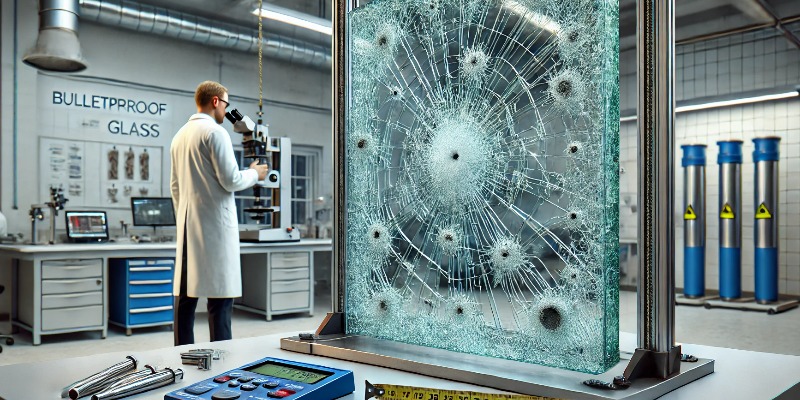
To be effective, bulletproof glass must pass a series of rigorous ballistic tests that simulate real-life impact scenarios. The primary goal is to ensure that the glass can withstand direct hits without penetration or dangerous fragmentation.
The tests involve bullets of varying calibers and velocities, replicating the use of handguns, rifles, and even military weapons. In addition to withstanding the first impact, the glass must endure multiple hits at the same point, demonstrating exceptional durability. For every weapon and bullet category, there are specific resistance classes, each indicating the guaranteed level of protection.
Protection Classes: Which Weapons Can Bulletproof Glass Stop?
Bulletproof glass is designed to resist a wide range of weapons and ammunition, with its protection level categorized into classes. Lower classes protect against common handguns and hunting rifles, while higher classes can stop assault rifles like the AK-47 or AR-15. At even more advanced levels, glass can resist armor-piercing bullets or even light artillery rounds used in military contexts.
Each class is defined based on the caliber, velocity, and type of projectile used in the tests. This classification allows for the selection of the appropriate glass for specific needs, whether for civilian or military applications.
International Standards for Bulletproof Glass
The regulation of bulletproof glass is managed by international standards, ensuring uniformity and safety worldwide. In Europe, the EN 1063 standard defines protection classes, ranging from BR1, which protects against light bullets, to BR7, designed to withstand armor-piercing rounds. In the United States, the National Institute of Justice (NIJ) uses a similar classification, focusing on the most common threats in the American context.
For military applications, NATO’s STANAG 4569 standard specifies requirements for armored vehicles, demanding extreme resistance to automatic cannon fire. These standards not only certify product safety but also facilitate their use in international contexts.
The History of Bulletproof Glass: From Origins to Modern Times
The concept of bulletproof glass dates back to the early 20th century when solutions were sought to protect vehicles and banking infrastructures. Early models, consisting simply of thick glass layers, were heavy and impractical. The real revolution came in the 1960s with the introduction of polymers and lamination technology.
Since then, bulletproof glass has become lighter, stronger, and more versatile, finding applications in sectors such as aviation, government buildings, and even luxury private vehicles.
The Recycling Challenge of Bulletproof Glass
One of the biggest challenges associated with bulletproof glass is its recycling. Made of composite materials like glass and polycarbonate, separating the components is a complex and costly process. Currently, available techniques include thermal separation, which uses high temperatures to divide the layers, and crushing, which allows for the recovery of some glass for other uses.
Another option is chemical recycling, which processes polymers like polycarbonate for reuse in new products. However, these solutions are not yet economically viable on a large scale, leaving the issue of environmental impact unresolved.
Conclusions: A Technology in Constant Evolution
Bulletproof glass is an extraordinary example of how material science can address critical safety needs. However, as applications increase, it is essential to tackle sustainability challenges. Ongoing research is crucial to develop materials that are easier to recycle while maintaining high safety standards and reducing environmental impact.
© Reproduction Prohibited