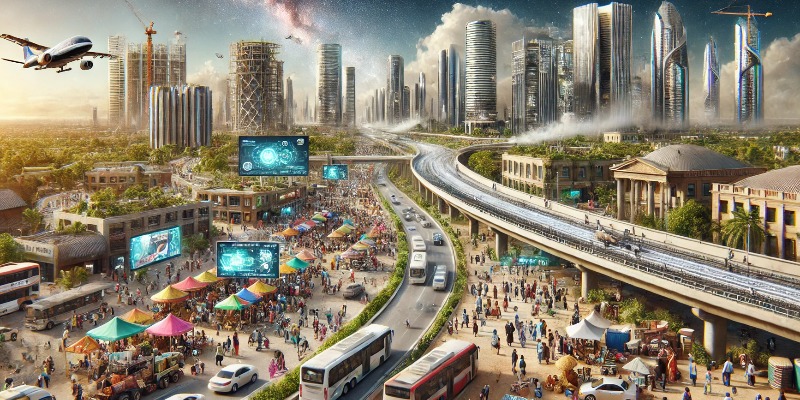
This article analyzes Africa's growth prospects by exploring five key sectors: economy, education, industry, agriculture, and digitalization. Finally, we will examine the causes of political instability and violence, which could hinder the continent's progress.
- Africa's Future: Opportunities and Challenges for the Next 20 Years
- Economic Growth in Africa: Projections and Investments to 2044
- Education in Africa: The Role of Technology and New Educational Strategies
- Industry and Manufacturing in Africa: The Rise of a New Production Hub
- Agriculture in Africa: Technological Innovations and Sustainability
- Digitizing Africa: How the Internet and Startups Are Revolutionizing the Continent
- Political Instability in Africa: Causes, Conflicts and Impacts on Development
- Conclusion: Will Africa 2044 Be the Engine of Global Growth?
Discover How Africa is Transforming: Economic Growth, Digitalization, Industrial and Agricultural Development, Education, and the Challenges of Political Instability by 2044
By Marco Arezio
Africa is set to become one of the key drivers of global growth over the next two decades. With a rapidly expanding population, abundant natural resources, and increasing digital connectivity, the continent has the potential to emerge as one of the most dynamic regions in the world. However, its development is closely tied to critical challenges such as governance, political stability, and structural reforms.
This article analyzes Africa's growth prospects by exploring five key sectors: economy, education, industry, agriculture, and digitalization. Finally, we will examine the causes of political instability and violence, which could hinder the continent's progress.
Africa’s Economic Growth: A $29 Trillion Opportunity
According to the African Development Bank, Africa’s economy is expected to grow at an average annual rate of 4-5% by 2044, with a combined GDP potentially reaching $29 trillion by 2050.
This growth will be driven by:
✅ Demographic growth: Africa’s population will increase from 1.3 billion to 2.5 billion by 2050, creating a young and dynamic workforce.
✅ Expansion of the internal market: Private consumption will exceed $2.5 trillion by 2030, fueled by a growing middle class.
✅ Foreign direct investments (FDI): A projected 50% increase by 2030, with China, the USA, and Europe as major investors.
✅ Economic integration: The African Continental Free Trade Area (AfCFTA), covering 54 countries and over 1.2 billion people, will facilitate intra-African trade.
Challenges to overcome: Corruption (estimated economic loss of $148 billion annually) and political instability in certain regions.
Education in Africa: Investing in the Next Generation
Education is key to the continent’s development. Currently, 80% of African children are enrolled in primary school, but only 40% continue to secondary education.
To bridge this gap, projections include:
📌 An increase in secondary school enrollment rates up to 60% by 2040.
📌 Growth in digital education: Today, only 30% of African schools have Internet access, but this figure is expected to rise to 70% by 2030.
📌 Investment in technical and vocational training: By 2040, 50% of African youth will be engaged in specialized training programs.
The goal is to prepare millions of young people for the evolving global job market and reduce youth unemployment, which currently stands at 12.7%.
Industrial Development in Africa: From Raw Materials to Manufacturing
Industrialization is essential for Africa’s sustainable economic growth. Today, the manufacturing sector accounts for only 10% of GDP, but it is projected to reach 20% by 2040.
🔹 Emerging countries as industrial hubs: Ethiopia, Nigeria, and Kenya are becoming major centers for textile, electronics, and automotive manufacturing.
🔹 Rising urbanization: By 2035, 60% of Africa’s population will live in cities, increasing the demand for goods and services.
🔹 Automation and robotics: Africa will invest in advanced technologies to improve factory productivity.
With the right industrial strategy, the continent could become one of the world's leading manufacturing powerhouses by 2050.
African Agriculture: From Subsistence to Technological Revolution
Agriculture still contributes 23% of Africa’s GDP and employs over 50% of the population. However, productivity levels remain lower than in other regions.
By 2040, Africa will adopt new technologies to transform the sector:
- Precision farming using drones and AI for crop monitoring.
- Expansion of irrigated land: Today, only 6% of Africa's farmland is irrigated, but this will increase to 20% by 2040.
- Growth in exports: By 2030, 30% of African agricultural production will be destined for international markets.
The goal is to make Africa self-sufficient and a major global exporter of agricultural products.
Digitalization in Africa: The Future is Online
Digitalization is revolutionizing the continent. Today, only 40% of Africans have Internet access, but by 2040, this number will rise to 75%.
🚀 Tech startup boom: African companies are developing fintech and e-commerce solutions.
💳 Digital payment revolution: Currently, only 34% of African adults have a bank account, but this percentage will reach 60% by 2035.
📡 Expansion of 5G networks: Mobile coverage will grow exponentially, improving connectivity in rural areas.
The African digital market is expected to be worth $75 billion by 2040.
Political Instability and Violence in Africa: The Root Causes
Despite positive growth prospects, the continent is plagued by political instability and conflicts. The main causes include:
🛑 Artificial post-colonial borders, which have led to ethnic tensions and civil wars.
💰 Corruption: Sub-Saharan Africa is the most corrupt region in the world (average Corruption Perception Index score: 32 out of 100).
💣 Terrorism and armed groups, which exploit poverty to recruit young people.
🌍 Resource conflicts: Minerals, water, and land are often the cause of territorial disputes.
Stabilizing the continent is essential for ensuring sustainable growth.
Conclusion
Over the next twenty years, Africa will play a central role in the global economy. With political reforms, investments in education and technology, and greater economic integration, the continent could transform into an economic powerhouse. However, without political stability and transparent governance, the risk of setbacks remains high.
Will Africa in 2044 become the symbol of the new global growth era? The answer depends on the decisions made today.
© All Rights Reserved