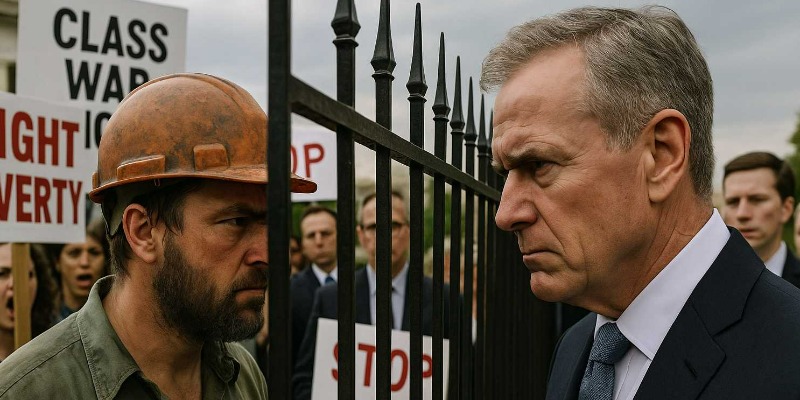
- What is the reversal of the class struggle in the current context?
- From Vertical Social Conflict to Asymmetric Economic Warfare
- How Technology Helps Control the Ruling Classes
- The role of the gig economy in the fragmentation of work
- Taxation and inequalities: the class struggle in public budgets
- Tax Havens and Lobbying: Tools of Global Economic Power
- Cultural narrative as a weapon in the reversed class struggle
- Strategies to recognize and counter the new social conflict
Reflect on how social conflict has been reversed in the neoliberal era, with the ruling classes on the offensive and subtle strategies to consolidate economic, technological, and cultural inequalities
by Marco Arezio
In classical Marxist thought, class struggle is the engine of history. Workers versus bosses, proletariat versus bourgeoisie: a confrontation rooted in the structural inequality of the means of production.
However, in an era marked by the financialization of the economy, the digitalization of labor relations, and the crisis of the welfare state, this paradigm has shifted—sometimes even inverted. Today we speak of a reversal of class struggle, a concept that implies a dramatic inversion of roles and strategies: no longer the subalterns fighting for equality, but the elites battling to maintain and expand their privileges. This article explores the origin, dynamics, and implications of this inversion.
From vertical conflict to asymmetric warfare
In the traditional view, class struggle is structured as a vertical conflict: from the bottom up. Workers, exploited and marginalized, demand rights, fair wages, security, and dignity, often organizing into unions or political movements. Today, this vertical axis has tilted—if not entirely reversed.
Historian Thomas Piketty has shown that in the last forty years, wealth distribution has returned to Belle Époque levels, with 1% of the global population owning more than half of the world’s assets. But the most alarming aspect is not mere accumulation—it’s strategy. The ruling classes no longer wait passively for demands to rise; they pre-empt them, neutralize them, criminalize them. They invest in lobbying, storytelling, and surveillance technologies to defuse dissent at the root.
Noam Chomsky once described neoliberalism as a “top-down counterrevolution”: a process whereby the constraints on capital are steadily removed while those on labor are multiplied. This is class struggle in reverse—where those in power fight to weaken those without it.
Technology, labor, and new forms of control
In the workplace, the reversal of class struggle manifests in increasingly subtle forms. The gig economy, for example, has transformed the worker from a collective subject into an atomized individual. A delivery platform driver has no colleagues—only competitors. The algorithm becomes his boss, his evaluator, his source of stress.
This model dissolves the very concept of class, fragments the social body, and disarms solidarity. The Fordist worker could go on strike; the platform worker can only log off. This too is a product of the reversal: the dominant class has learned to pre-empt organization, to isolate, and to encourage self-exploitation under the guise of “freedom of choice.”
At the same time, digital technologies—from social media to geolocation—don’t just collect data; they construct narratives.
Platforms are not neutral: they reward influencers who echo dominant values and silence or marginalize dissenting voices. Control is no longer merely economic—it is cognitive, ideological, emotional.Finance and taxation: class warfare in public budgets
The reversal is also visible in fiscal mechanisms. Today, class conflict unfolds in the crevices of tax reforms, offshore havens, and privatizations. While the average citizen is subject to strict controls, major capital flows navigate through loopholes and favorable regulations.
According to economist Gabriel Zucman, the richest 10% legally (and often illegally) evade billions in taxes every year. This is not only a matter of fiscal justice—it’s a political strategy: stripping resources from the welfare state starves public institutions, renders them inefficient, and justifies their privatization. Once again, a war from above—coldly planned and propped up by meritocratic rhetoric that legitimizes every inequality.
Culture and narrative: when conflict is denied
One of the most insidious traits of this reversal is its invisibility. Today’s power is not asserted through force but through consent. It does not impose—it seduces. Dominant values—competitiveness, growth, individual success—are internalized, celebrated, and reproduced even by the subaltern classes.
In this framework, talking about “class struggle” seems outdated—almost vulgar. And yet, as Warren Buffett, one of the world’s richest men, once said: “There’s class warfare all right, but it’s my class, the rich class, that’s making war, and we’re winning.” A phrase that encapsulates the essence of the reversal: it is not the proletariat in revolt—it is the bourgeoisie on the offensive.
Culture, media, even education contribute to this narrative. Inequalities are portrayed as “personal failures,” poverty as a “lack of entrepreneurial spirit.” Thus, those most affected by the system end up unconsciously defending it.
Conclusion: from awareness to resistance
The reversal of class struggle is not an inescapable fate. It is a historical, social, and cultural construction. Understanding it is the first step toward opposing it. Reclaiming the language of conflict, recognizing the structural nature of inequality, and reorganizing collective solidarity are all acts of resistance.
Now more than ever, the struggle is not simply between rich and poor—but between those who want a world based on dignity, and those defending a system rooted in inequality. The conflict exists, even if disguised, reversed, or manipulated. It is up to us to expose it—with clarity and resolve.
© Reproduction Prohibited