




- Aberfan before the disaster: a village between mines and hopes
- What was the debris hill: Coal's dangerous legacy?
- October 21, 1966: The day the earth shook in Aberfan
- Tragedy at Pantglas Junior School: Children buried in mud
- Desperate rescue: bare hands against tons of black mud
- The National Coal Board's responsibilities: negligence and silence
- The Wounds of Aberfan: Memory, Mourning, and Justice Denied
- Aberfan Today: The Resilience of a Village and the Voice of Memory
A historical and human investigation into the mining tragedy that struck Wales, when a landslide of coal waste engulfed a primary school
by Marco Arezio
Aberfan was a small Welsh village located in the Merthyr Valley in south Wales, nestled among the dark green slopes of a land long linked to coal. In the 1960s, it lived in symbiosis with the Merthyr Vale mine, an industrial behemoth that employed hundreds of men but quietly accumulated dangers. The surrounding hills were no longer made of just rock and earth, but of slag: piles of mining waste, called "tips," built over veins of underground water.
The community was close-knit, proud, and hard-working. The children attended Pantglas Junior School, a modern facility for the time, where the smell of chalk mingled with the hopes of parents dreaming of a future far from the dark mine tunnels.
What Was the Scrap Hill: Coal's Dangerous Legacy?
Above the village, a few minutes' walk from the first houses, rose Tip No. 7, a huge man-made mountain made of sludge and mining waste. For years, that black hill had been unstable. Residents had repeatedly expressed concerns: cracks were visible, and small landslides were observed after rains. But the heads of the National Coal Board (NCB) reassured everyone: there was no danger.
What they didn't want to admit was that the mound sat atop a layer of water. With the heavy rains of the previous weeks, the top of the hill was soaked like a sponge. It was ready to collapse.
October 21, 1966: The day the earth shook at Aberfan
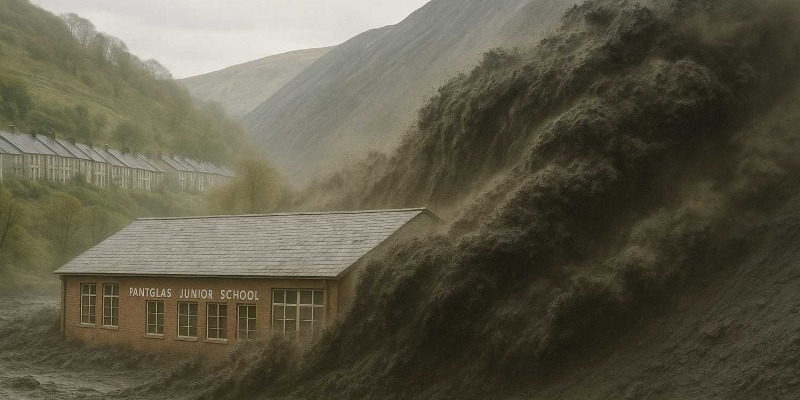
It was a Friday, and the day had just begun in Aberfan. At 9:15 a.m., a dull, deep, and unnatural sound pierced the silence. In less than thirty seconds, 140,000 cubic meters of debris slid down the valley. A black, sticky avalanche of mud and coal slammed into Aberfan at a speed of approximately 30 kilometers per hour.
It swept away everything: houses, roads, trees. But above all, it engulfed the school. The children had just entered the classroom. The teachers were taking roll call. The landslide hit the building full-thrust, destroying entire classrooms in an instant. Roofs buckled, walls collapsed. Mud poured in through the windows like a tidal wave. 116 children and 28 adults died, many of them buried alive.
Tragedy at Pantglas Junior School: Children buried in mud
Witnesses described a dark shadow approaching, and a sound like a thousand galloping horses. Some children were found sitting at their desks, crushed by the weight of the collapsed roof. Others had tried to escape, but in vain.
An entire generation was wiped out in a matter of seconds. Entire families lost their only children.
In some cases, their bodies were found side by side, embracing. An entire class was erased from history, without a single survivor.Desperate rescue: bare hands against tons of black mud
The first to arrive were the miners. With their bare hands, they dug through the mud, hoping for a miracle. Every now and then, a cry of "I found one!" But almost always it was too late. The ground was still unstable, and the bulldozers didn't arrive until hours later.
Some bodies were never identified. The parents waited in silence, huddled together, their eyes fixed on the hill, hoping to hear a cry, a blow, a sign of life. The village transformed into a field of mourning and despair. The white coffins, all identical, lined up in the church and then in the cemetery like silent little sarcophagi.
The National Coal Board's responsibilities: negligence and silence
The official investigation was swift, but the pain was not. The National Coal Board was accused of gross negligence, but no one was convicted. No executive lost their jobs. The final report spoke of "clear negligence" and "disregard for public safety," but there was no immediate compensation or real apology.
Queen Elizabeth visited the site days after the tragedy. But what remained was the bitter taste of a community that had screamed unheard. Aberfan wasn't a natural disaster: it was a social crime disguised as fate.
The Wounds of Aberfan: Memory, Mourning, and Justice Denied
The pain in Aberfan was measured not only in lives lost, but in shattered trust. The villagers felt betrayed by the state, by the authorities, by those who were supposed to protect them. The psychological trauma was devastating.
Many parents never recovered. There were cases of chronic depression, suicide, and social isolation. The school was never rebuilt. The site was converted into a memorial garden. Each flower planted represented a lost child.
Aberfan Today: The Resilience of a Village and the Voice of Memory
Today, Aberfan is a place of silence and reflection. Every year, on October 21st, the village comes to a halt. A bell tolls 144 times. The children's names are carved on simple but indelible headstones.
The community has chosen to transform the tragedy into testimony. Survivors and their descendants speak in schools, attend conferences, and write books. So that what happened in Aberfan may never happen again, anywhere.
© Reproduction Prohibited