Nicolò is a boy who lives in a large, quiet house, often alone because his mother works all day. School is the only place where he feels truly at peace, surrounded by friends. When he doesn't show up for class one day, his worried classmates decide to visit him and discover that something profound has caused him to fall into a mysterious sleep.
Determined to stay by his side, his friends imagine an incredible way to reach him in the most hidden and precious place of all: his heart. Thus begins an extraordinary journey that combines courage, friendship, and imagination, demonstrating the power of the bond between children and the lengths they can go to help those they love.
The story of a group of friends who embark on an extraordinary adventure to save their most fragile companion
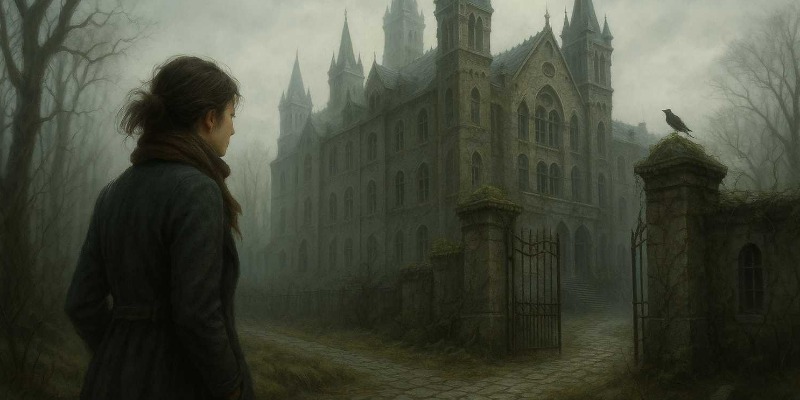
His name was Nicolò, and he lived in an old house whose creaking floors and whispering window frames made every room feel even emptier. He had never met his father; his mother worked all day and often into the evening just to get by. And so, Nicolò’s life was made of precise routines and long stretches of silence: he woke up while the sky was still pale blue, poured himself a cup of warm milk, grabbed his backpack, and walked to school.
There, among the desks, he found a warmth that felt like spring: his classmates, their jokes, the rustling of pages, the smell of freshly sharpened pencils. When he returned home, however, the house greeted him with the cold light of the solitary lamp above the table. Nicolò warmed up some soup, ate in silence, did his homework, and when night came again, he went to bed. Alone. Always.
At school, though, things were different. With Marta, Elia, Samira, and Gioele, there was always something to laugh about: the briscola tournaments the teacher pretended not to see, the contests to draw the funniest dinosaur, the whispered secrets during recess when the courtyard smelled of bread and orange soda. There, Nicolò forgot about the big empty house. There, at least, he wasn’t alone.
One Monday, the air still carried the smell of last night’s rain. The teacher took attendance, and the name “Nicolò” echoed through the classroom like a stone falling into a pond without making any ripples. “Absent,” she said, moving on. “It happens,” Marta thought, “maybe he caught a cold.”
On Tuesday, Nicolò’s chair was still empty. On Wednesday, when even his denim jacket hanging on the coat rack looked sadder than usual, the four friends exchanged a look that said: we must do something. After school, without needing many words, they took the path toward the old house, the one with wisteria curled like a lilac cloud around the entrance.
A small grandmother with white hair tied back and a face full of gentle wrinkles opened the door. “Are you Nico’s friends?” she asked in a trembling voice. They nodded together. “Come in.”
The house smelled of winter soups and lavender. She invited them to sit and spoke softly: “Nicolò is very ill. It’s not a normal sickness… he fell asleep from sadness. The doctor says there’s nothing wrong with his body, but his heart is cold and refuses to wake up.” Her eyes grew glossy. “I call him, I tell him the beautiful things from when he was little, but he… just sleeps.”
The four friends climbed the stairs on tiptoe. Nicolò was lying on the bed, his face pale, his eyelashes resting like two small leaves. His breathing was slow. Marta whispered in his ear: “Yesterday we won the relay race! And the teacher said your essay about the sea was wonderful.” Elia told him how he almost burst the ball, Samira played him a recording of the class laughing, Gioele placed on the nightstand the rare trading card he had been promising Nicolò for months. Nothing. Nicolò didn’t move.
Then Samira, whose mind was always ready to take flight, whispered: “If he can’t hear us from outside, we have to reach him from inside.” The others stared, confused. Samira pulled from her backpack a notebook full of doodles and formulas. “I read about it in a science-fiction book: a potion that shrinks things until they become microscopic. If we could get inside him… we might reach his heart and hug it. Warm it up, the way you warm your hands after being out in the snow.”
“A potion?” Elia said, his eyes as round as buttons. “And where do we get that?”
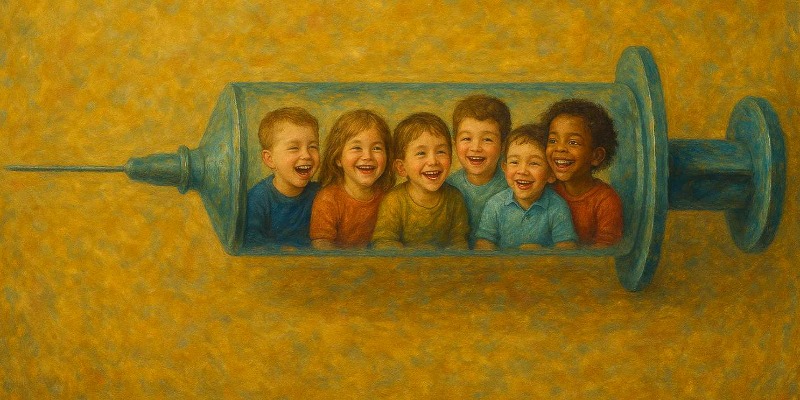
The grandmother, who had been listening silently, smiled the kind of smile that seems to make small miracles possible. “Come to the kitchen.” From a cupboard, she took a jar labeled “Magic Sugar.” “I used to make this for Nicolò when he was little and couldn’t fall asleep: hot water, a teaspoon of honey, a touch of ginger, and a pinch of courage. You’ll have to add the courage yourselves.” Then she opened a small wooden box: inside was a toy syringe, the kind used by children playing doctor. “If you really become tiny… you’ll need a safe ride.”
Marta grabbed a sheet of paper and drew a big heart, with arrows and vessels and arteries branching off like city streets. “Blood flows in a circuit. If we enter a vein, we’ll reach the right side of the heart, then the lungs to collect air, and then the left side of the heart which pumps blood through the whole body. That’s where we stop.” Her voice, usually very quiet, had become steady. “We’ll need to keep our eyes open: there will be red blood cells carrying oxygen, white blood cells guarding the body, and platelets like tiny builders. And the heart valves: doors that open and close with the thump-thump rhythm.”
The potion steamed in the cup, smelling of honey and ginger. The four friends drank it in small sips. The world around them began to grow: the wood grains of the table turned into canyons, a drop of water became a crystal lake, the fabric of the tablecloth a forest of threads. The grandmother picked them up gently, as light as sparkling crumbs, and placed them inside the toy syringe, which now looked like a crystal ship.
“I will inject you into Nico’s arm,” she whispered. “May your love reach where it’s needed.” The four children squeezed each other’s hands, both frightened and excited. The needle brushed the skin, and a warm current carried them away.
Suddenly, they were in a red and golden stream. Around them danced billions of red discs like confetti: the red blood cells carrying oxygen. One came closer; it looked like a shining gummy drop. “Welcome to the cephalic vein!” it chirped. “I’m Emò. Hold onto me, and I’ll take you to the heart!” The children clung to its soft edges as it whisked them along the current.
The vessel walls were smooth, lined with cells like mosaic tiles. Sometimes little doors—capillaries—opened and closed, letting nutrients pass. A whirlpool swept them into a wider, darker tube. “Superior vena cava,” Emò announced. “We’re almost at the right heart!” The distant thump-thump grew louder, like a giant drum.
They entered the right atrium, a wide chamber where the river slowed. Overhead stood a huge white blood cell with curly arms: “I am Neutro, guardian of the body.
Friends or foes?” Marta spoke up: “Friends! We’re here to warm Nicolò’s heart.” Neutro studied them, then smiled like a cloud parting. “Then pass—but beware the valves: they slam shut like great gates.”The tricuspid valve opened and closed, and the children slipped into the right ventricle, a muscular room that squeezed and thrust them like a powerful oar stroke into the pulmonary artery. “Time to catch our breath!” cried Emò. The tube split into two, then a thousand, then millions of tiny capillaries wrapped around soft sacs: the alveoli of the lungs.
Air flowed in and out, pushed by the diaphragm rising and falling like an elevator. A small, shy oxygen molecule, tinted blue, touched the red blood cell. “May I come with you?” it asked. “Of course!” said Emò. More molecules arrived, and in exchange released sleepy grey carbon dioxide to be carried out with the breath.
With oxygen on board, Emò glowed. “Now we return to the left heart!” Back they went through the pulmonary veins, into the left atrium (bright and elegant like a softly pulsing cradle), past the mitral valve, and into the strong left ventricle that pushed them into the aorta, the body’s great highway. “We need the right exit,” Marta said, tracing her mental map. “The coronary artery!”
They passed a tiny construction site: yellow platelets working like little builders to fix a micro-crack. “Excuse us!” Gioele said. The platelets waved their spatulas and made room.
Soon they were on a road that wrapped around the heart like an embrace. “Here we are,” Emò said, stopping by a tiny exchange valve. “I release oxygen here. You can get off.”
The children found themselves on a living square—the inner surface of the heart. Each cell looked like a tiny pink house, contracting all together like dancers following the same music. But the rhythm was slow, slower than normal, and the air felt cold. “He’s freezing,” Marta whispered. “His heart is freezing.”
They clasped hands, approached a cluster of sluggish cells, and hugged them. Their warmth spread like a spark through the tissue—an electrical impulse, the heart’s depolarization.
The signal traveled through invisible pathways, atrium to atrium, then the atrioventricular node, then down the fibers of His and Purkinje, until the ventricles followed with a fuller, stronger thump… THUMP.
“Do it again,” Samira said. They tightened the hug and thought as loudly as they could: play with us, finish your drawing, we’re waiting for you, you’re not alone.
The heart remembered. It responded.
Warmth returned.
The coronaries opened.
Emò spun in delight. “It’s working!”
A gentle warm wind swept through everything—the sound of Nicolò taking a deep, cleansing breath. Somewhere far away, his grandmother whispered, “Well done, my little one.”
And the heart answered with the strength of a huge embrace.
“We must go,” Elia said. Marta nodded. “Upwards. From the left heart to the carotid artery, then to the mouth’s capillaries. If we’re lucky, we’ll ride out with the saliva.”
They followed the current toward the face. The red cells here were busy delivering oxygen to the muscles of smiles, the cheeks, the eyes. In the tongue’s tiny capillaries, the flow slowed. A wise white blood cell wearing little glasses greeted them. “Leaving already?”
“Yes,” said Gioele. “We made a promise.”
The monocyted pointed to a small, moist doorway. “That’s a salivary gland. Follow it.”
They walked across a slippery, shining bridge—a tunnel of sugar-like glass—until they reached a waterfall of saliva that flowed into the mouth. The scent of mint lingered from the toothpaste.
“Now!” Elia cried.
As Nicolò yawned gently, they let themselves fall into the stream and landed on the soft edge of his lips, then onto the palm of his hand—its fingers towering like trees.
There, the potion ended its effect.
They grew back—legs first, then arms, then noses and smiles—until they were real children again, sitting on the blanket.
Nicolò opened his eyes. It took a moment that felt as long as a whole day, then a smile rose from somewhere deep inside him.
“Marta? Elia? Samira? Gioele?”
His grandmother cried tears like clear spring water.
Nicolò placed his hand—the same hand on which his friends had reappeared—over his heart. “I felt you,” he whispered. “In there. It was cold, but then… something warm came, like sitting near the heater after coming in from the snow.”
They spent the whole afternoon together, retelling the adventure as if it were a dream: the syringe-spaceship, Emò the red cell, Neutro the guardian, the platelets, the wind of the lungs, the dance of the heart.
That night, Nicolò fell asleep with his hand still resting on his chest. He felt the heart beating like a gentle drum. He imagined red cells cycling like bicycles in a glowing city, lungs opening like tents, platelets building tiny bridges.
And in the middle of everything—a hug.
The next morning, the house no longer felt so big.
And if you walk near the school on a spring afternoon, you might hear laughter mixing with the sound of ping-pong balls and rustling pages. One laugh will ring a little louder, as if someone had just discovered they have a warm heart.
It’s Nicolò. Running, falling, standing up, and—before kicking the ball—touching his chest as if to say: thank you.
The ball flies.
And somehow, always finds the center.
Where every road of the body—and the classroom—leads in the end.
To the heart.
© Reproduction Prohibited