In Roccachiara, after days of renewed serenity, a small, unexpected signal upsets the balance: a shell appears in the river, like a message from afar. Nico and Amina realize the water is telling a story, and during a trip to Lago Piccolo, they discover a problem that can no longer be ignored.
What appears to be simple trash reveals itself to be the symptom of an invisible chain that connects careless gestures, nature, and community. Through observation, dialogue, and shared action, the children learn that protecting a place isn't just about cleaning it, but understanding its connections. The tale takes the reader on a delicate and concrete journey, where caring for the environment comes from knowledge, collaboration, and the choice not to look the other way.
An ecological tale for children and young adults about the connection between rivers, the sea, and daily responsibility
Children's storybook. The Lights of Roccachiara. Chapter 4: The Little Sea of Plastic
The day after the second True Stories Festival, the colors in Roccachiara hadn't fully returned, but a difference could be felt: as if the town had begun to breathe easier again. Amina's house had regained a gentle yellow near the windows, and the blue of the library door had deepened, like a slowly filling lake.
Nico and Amina, who by now had learned to look for signs as one searches for a trail in the woods, immediately noticed something else: the river was carrying something new.
It wasn't a branch drifting by the current. It wasn't a stone. It was a shell.
The shell was nestled between two pebbles near the shore, shiny and white. In Roccachiara, no one owned shells, except those in their memory drawers, brought from the sea during vacations.
Amina picked it up delicately. "This... it shouldn't be here."
Nico nodded. "It's from the sea."
Amina looked at the river, then at the shell. "So that means..."
“That something from the sea came here?” Nico tried, confused.
Amina shook her head. "That something from the sea is calling us."
It seemed like a strange sentence, but Nico, ever since he'd passed through the door of memory and seen Cromavia, hadn't been quick to laugh. Unusual things had a way of becoming important.
That same morning, teacher Claudia announced a trip: "We're going to Lago Piccolo."
The Little Lake was a body of water not far from the village, a kind of natural pond fed by a canal that, further downstream, flowed into the river. It wasn't large, but in the summer it became a place for walking, fishing, and picnicking.
"We'll do a scientific observation," said the teacher. "And collect data: plants, insects, water quality. Nature is a book, and you've already started reading it."
Nico and Amina looked at each other. A book. Again. Always the same idea: if you want to save something, you must first know how to read it.
They arrived at Little Lake in the late morning. The sky was clear, and the water, seen from afar, looked like a blue cloth spread out in the sun.
But as they approached the shore, Nico felt an immediate unease. The water wasn't really blue. It was… stained. Shiny patches floated like oil, but they didn't smell like oil. They had a subtle, unpleasant odor, like heated plastic.
Amina bent down and picked up something transparent with a twig. It was a fragment of a bag. Then another. And another.

“Look,” he said, his voice firm but alarmed.
The classmates approached. Some said, "That's disgusting." Some laughed to cheer themselves up. Someone said, "It's just a bit of garbage."
Then Teacher Claudia pointed to a spot further away, near the reeds. "It's not just a little bit."
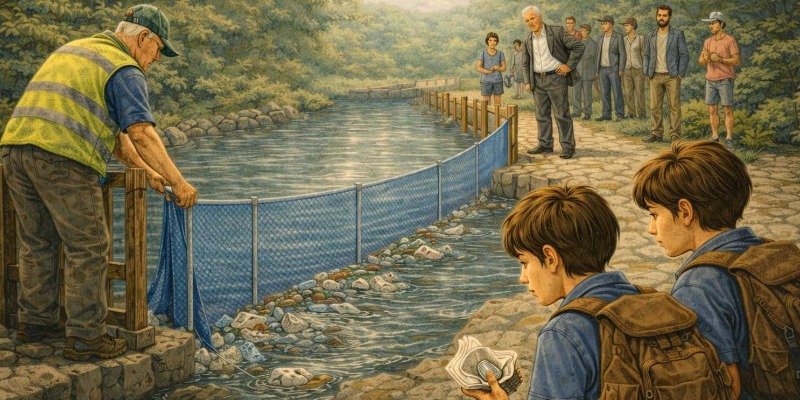
There, as if someone had overturned a whole bag, a mass of lightweight plastics floated: bottles, bottle caps, wrappers, pieces of Styrofoam, even an old deflated balloon. The lake's internal current always pushed them toward the same corner, forming a kind of small sea of plastic.
Samuel, who had also come, swallowed. "It looks like… an island."
Nico stared at that mass and felt a pang of anger. Not a generic anger: a specific anger, like a sting. Because that place was beautiful. And someone had made it ugly without thinking.
The teacher spoke clearly: "This lake is connected to the river. If plastic enters the lake, it then passes into the river. And the river, further down, reaches the sea."
Amina clutched the shell she had carried in her backpack.
Nico noticed her. "That's why the shell," he murmured.
Amina nodded. "It's like a message."