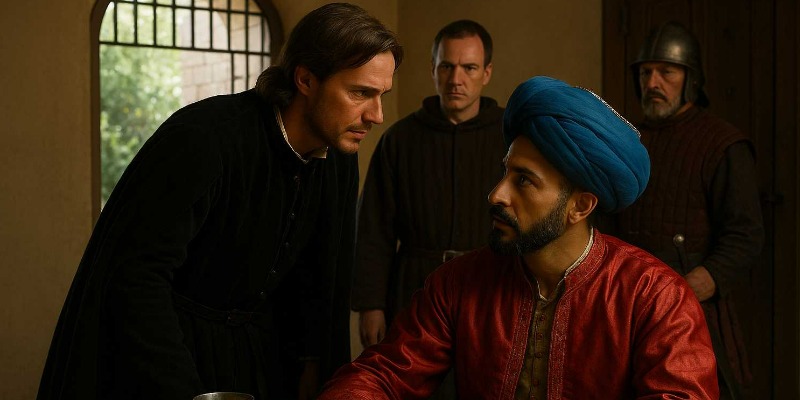
In the heart of the Ducal Palace in Mantua, the prisons reveal a world of contrasts: light and privilege for the few, darkness and fear for the many. In this setting of tension and silence, Lorenzo Vendramin meets Karim Al-Safir, an oriental merchant with an ambiguous charm, whose cell seems more like a court chamber than a place of punishment.
Between measured words and sharp glances, the two men face each other like chess players: one seeking the truth about the Morosini ring, the other guarding secrets reeking of the sea, fire, and deception. From Mantua to Murano, the plot thread tightens, intertwining murders, debts, and the powers hidden behind the glow of Venetian glass. And when Lorenzo leaves the city with the precious ring clutched to his chest, the road to Venice becomes a journey of suspicion and regret. But one name, more than any other, continues to haunt him: Corner—the man who could be the key to everything.
Intrigues, Power, and Shadows between Venice and Mantua: Lorenzo Meets the Mysterious Karim Al-Safir
Tales. 1572 – Carnival of Blood. Chapter 19: The Merchant of Mantua and the Secret of the Murano Glassmakers
The cells of the Ducal Palace in Mantua were a world unto themselves, a mirror of social hierarchy even in punishment. Those on the upper floor, where “distinguished” prisoners were kept, had wide windows, barred yet open to the light. Air flowed freely, carrying the scent of the River Mincio and the ducal gardens. The lime-washed walls were clean, and the wooden bunks, though spartan, were covered with rough but fresh linens. These inmates were brought food twice a day; they could write letters, receive visits and, if fortune smiled, even stroll in the inner garden. They were not true convicts, but men suspended: awaiting justice either to redeem them or to condemn them definitively.
A very different fate awaited those who, as Karim might have feared, ended up in the basement. There, beneath damp vaults and stones blackened by time, the sun never entered. The only light came from flickering torches that spread smoke and a suffocating penumbra. The floors were strewn with old straw that stank of mold and sweat, and rainwater filtered through ceiling cracks, pooling into little puddles where rats and insects nested. The air was heavy, laden with fear and despair. In those subterranean cells, days were not counted—breaths were.

Karim Al-Safir, however, was hosted on the upper floor.
When Lorenzo entered his room, accompanied by Pietro and a ducal guard, his first impression was of unreal quiet. A large window, protected by slender bars, let in the golden afternoon light, illuminating a table with the remains of a generous meal: white bread, spiced mutton, and a copper cup half-full of a honeyed drink. On the floor, a worn yet precious carpet—likely a gift from Karim himself to curry the Duke’s favor—muffled their steps....