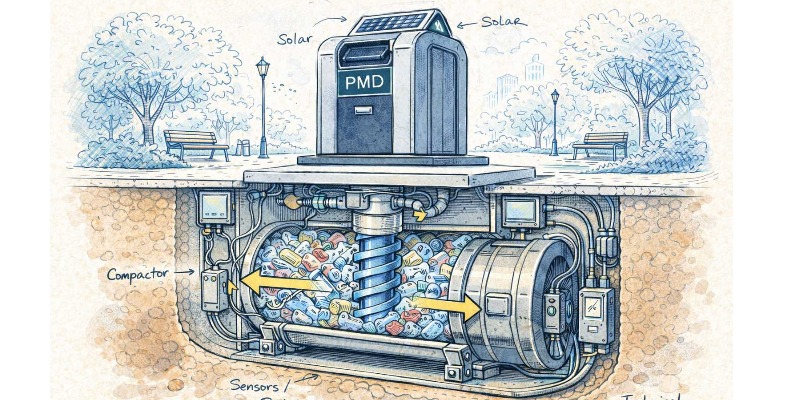
We produce an underground waste compaction system capable of increasing collection capacity, reducing collections, containing operating costs and improving urban decorum
Code: 11738. With our underground press container we address one of the most concrete problems of urban waste collection: managing growing quantities of waste without multiplying containers, collections, and the impact on public spaces.
The principle behind the system is simple yet highly effective: thanks to a compaction mechanism, the usable capacity increases significantly compared to a traditional underground container, reaching indicative values 6 to 10 times greater depending on the fraction collected and the composition of the material delivered. This increased capacity translates into fewer visible containers, fewer collection vehicle trips, lower emissions, and lower operating costs.
How the compaction mechanism works
The heart of the product is a screw system that compresses the waste, expelling the air from the collected mass and gradually transferring the material to the container below. As the internal volume fills, the pushing force also increases, allowing for a much more efficient use of the available space. In practical terms, we don't just store the waste: we densify it at the collection point, improving the system's capacity without increasing the urban footprint of the recycling center.
We adapt the press container to the type of waste to reduce jams and stoppages
The performance of a compaction system depends not only on the strength of the mechanism, but also on its ability to operate reliably with different flows. For this reason, we adapt the press container configuration to the type of waste collected. The technical documentation specifies three dedicated versions: PMD, i.e., plastics, metals, and beverage packaging; paper and cardboard; and residual waste. This customization helps promote free-fall of the material and limits the risk of blockages, while the pressing mechanism and control sensors help keep the system efficient and monitored.
Fewer emptyings means lower costs and greater continuity of service
The most immediate advantage of the underground press container is the drastic reduction in emptying frequency. The technical pages and case studies published on the official website demonstrate that, compared to conventional collection, the increased capacity allows for a reduction in both the number of vehicles required and the personnel involved in collection operations.
In some application cases, critical sites that previously required daily emptying have gone down to just a few weekly collections; in others, collections have gone from seven times a day to just once every two weeks. These results naturally vary based on the location and composition of the waste, but they clearly demonstrate the magnitude of the benefits that can be achieved.
More capacity doesn't just mean efficiency: it also means more quality urban space
When we increase collection capacity at a single point, we're not simply optimizing a cost item. We're also freeing up urban space. The documentation describes this effect very clearly: fewer containers required means less pressure on public space, less heavy vehicle traffic, and more opportunities to dedicate the area to greenery, pedestrian walkways, play areas, or street furniture. In densely populated or touristy areas, this makes a difference not only aesthetically, but also in terms of safety and the perceived quality of the neighborhood.
A system also designed for urban decor
Another key aspect is reducing waste left outside containers. When capacity is insufficient and collections don't keep pace with regular deliveries, this leads to lateral accumulation, disorder, and conflicts with residents and operators. The underground press container was designed specifically to reduce this phenomenon: by increasing the usable volume and reducing the risk of saturation, we help keep the collection point cleaner and more orderly. Published materials also indicate that all models are equipped with a fill level measurement system, useful for scheduling collections more efficiently and limiting overflow situations.
Digital control, sensors and portal management
The digital component is not an accessory, but an integral part of the product. Integrated sensors provide information on the status of the press container, and the online portal allows for daily monitoring of fill levels and any anomalies. According to service documentation, this approach allows for rapid identification of problems, in some cases even preventing or resolving them remotely, and for more efficient organization of both collection and maintenance. For public and private operators, this means having not only a mechanical but also an informational infrastructure capable of transforming collection into a more measurable and manageable process.
When is it really worth choosing this solution?
From an economic perspective, we propose a very concrete guideline: switching to an underground press container becomes particularly attractive when there are at least three containers in a row or an emptying frequency of at least three times a week. This is a practical threshold that helps understand when the increased capacity can repay the initial investment through savings on fuel, equipment, maintenance, and labor. In our applications, for example, 750 users who would have required approximately 30 standard underground containers were served with five press containers, maintaining a single weekly collection.
Service life, maintenance and operational reliability
A thorough presentation couldn't ignore the topic of service life. The sustainability and service documentation states that the first models installed in 2008 are still in operation at some sites, that the current generation is presented with an estimated lifespan of 12 to 15 years, and that from 2023, refurbishment programs can be implemented to further extend the system's lifespan.
On the maintenance front, a scheduled annual check is indicated, a support network with continuous monitoring via portal and an average failure frequency of approximately one event per year per machine on a basis of 1,350 monitored presses, including even minor problems.
An environmental advantage that comes from logistics, not just the container
The sustainability of underground press containers doesn't depend solely on their presence underground or improved decor. It depends above all on the logistics they enable. If we reduce collections, we reduce vehicle traffic, fuel consumption, wear and tear on the vehicle fleet, and emissions associated with collection.
Furthermore, if we can replace more traditional containers with fewer high-capacity units, we'll also reduce the need for equipment in production and the occupation of public space. The sustainability page presents this sum of effects as one of the system's main contributions to reducing CO2 emissions per kilogram of waste collected.
Our idea of product value