






- Vegetables grown near roads: what are the real risks?
- Heavy metals and particulate matter in urban vegetables
- How leaves trap traffic pollution
- Roots and underground vegetables: the problem of absorption
- Health consequences of consuming contaminated vegetables
- The role of urban gardens between sustainability and environmental risk
- Strategies to reduce crop contamination
- How to avoid food problems for men
Vegetables grown in urban and peri-urban areas can accumulate heavy metals, particulate matter and hydrocarbons derived from vehicular traffic
by Marco Arezio
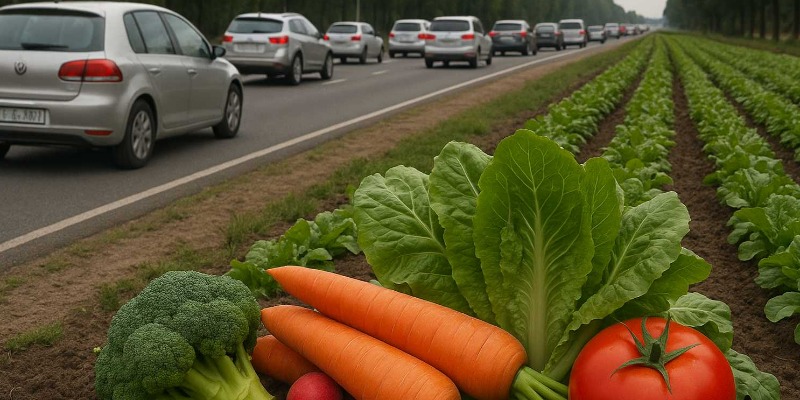
Fresh vegetables are a symbol of health, but when they're grown in areas with heavy traffic, this image of purity is tarnished. Plants exposed to urban pollution not only retain fine particles and harmful gases on the surface of their leaves, but also absorb heavy metals through their roots, accumulating them in their edible tissues.
Vehicle traffic is a major source of widespread pollution in cities: exhaust fumes contain nitrogen oxides and volatile organic compounds, while brake and tire wear releases dust rich in lead, cadmium, zinc, and copper.
Heavy metals and particulate matter in urban vegetables
A study published in 2021 in Environmental Pollution analyzed lettuce, spinach, and Swiss chard grown near busy roads in Poland. Lead (Pb) levels ranged from 0.3 to 1.5 mg/kg fresh weight, well above the limits recommended by EFSA for safe daily consumption. In 2022, a study conducted in China on carrots and cabbage grown in urban areas found cadmium (Cd) concentrations of 0.2 to 0.5 mg/kg, amounts sufficient, if chronically ingested, to increase the risk of kidney damage.
Fine particulate matter (PM2.5 and PM10) is another critical contaminant. It doesn't just settle on leaf surfaces: it can penetrate tissues through the leaves' stomata, carrying with it metals and toxic organic compounds. In 2020, an Italian study conducted in Milan showed that vegetables grown within 30 meters of roadsides had up to 70% higher heavy metal accumulation than samples grown in rural areas.
How leaves trap traffic pollution
Leafy greens—lettuce, spinach, and kale—act as veritable biological filters, intercepting dust and microparticles. The "blotting paper" effect of their rough surfaces allows polycyclic aromatic hydrocarbons (PAHs) to accumulate easily, even resisting household washing. According to a 2019 study published in Food Additives & Contaminants, up to 40% of PAHs detected in urban greens remain present even after washing with running water, a sign that they penetrate deeply into plant tissue.
Roots and underground vegetables: the problem of absorption
It's not just leaves: roots and underground vegetables like carrots, potatoes, and radishes can accumulate contaminants directly from the soil. Urban soil, exposed to traffic for years, is often enriched with lead, copper, and zinc, which the roots absorb through their root hairs. In 2023, a study by the University of Barcelona showed that carrots grown along urban ring roads had average lead levels of 0.8 mg/kg, compared to 0.1 mg/kg found in rural control areas. This seemingly minimal difference becomes significant when considering daily consumption.
Health consequences of eating contaminated vegetables
Chronic consumption of contaminated vegetables does not lead to immediate symptoms, but rather to a silent accumulation of toxic substances. Lead impairs neurological development in children, interfering with memory and cognitive abilities. Cadmium has been associated with an increased risk of lung cancer and chronic kidney disease.
Polycyclic aromatic hydrocarbons, on the other hand, have documented mutagenic and carcinogenic effects, particularly with regard to gastrointestinal cancers.A critical aspect is the synergistic effect: the body is not exposed to a single contaminant, but to a complex mixture of substances that interact, amplifying the risks. Epidemiological studies suggest that urban populations who regularly consume vegetables grown near roads have a higher incidence of cardiovascular and respiratory diseases, not only because of the air they breathe, but also because of the food they eat.
The role of urban gardens between sustainability and environmental risk
Urban gardens are often presented as symbols of sustainability and community resilience. Growing vegetables in cities means reducing transportation, strengthening food sovereignty, and reclaiming green spaces. However, without adequate controls, the risk is that a virtuous practice can become a silent threat.
Contamination isn't limited to main roads: even internal courtyards and balconies exposed to vehicular traffic can experience significant levels of pollution. Research conducted in London in 2021 found that vegetables grown within 20 meters of urban roads had heavy metal concentrations 50% higher than the same species grown more than 100 meters away.
Strategies to reduce crop contamination
Some solutions can reduce the risk without completely abandoning urban farming. These include:
- Plant barriers: Hedges and trees placed between the road and the vegetable garden reduce the accumulation of fine dust on leaves by up to 60%, according to a study published in 2020 in Science of the Total Environment.
- Use of clean substrates: growing in raised beds filled with controlled soil reduces the uptake of metals from contaminated soil.
- Species selection: Some plants accumulate fewer contaminants. Tomatoes and peppers, for example, have lower concentrations than lettuce and spinach.
- Thorough washing: Washing with running water isn't enough to remove heavy metals, but it can reduce surface particulate matter by 30-40%. Using a weak solution of vinegar or baking soda improves effectiveness.
How to avoid food problems for men
To protect public health, the problem must be addressed on multiple levels: agricultural, urban, and political. From an agricultural perspective, choosing to grow in areas less exposed to traffic remains the most effective strategy. Consumers can reduce the risk by favoring certified, organic, and rural supply chains and limiting their consumption of uncontrolled urban vegetables.
Local governments, on the other hand, must support the creation of community gardens in safe areas, institute periodic inspections of urban land, and disseminate practical guidelines for citizens. Urban planning also plays a crucial role: reducing traffic, promoting electric mobility, and expanding green spaces not only improves air quality but also ensures safer cultivation.
Finally, awareness remains the most powerful tool: knowing that the risk exists and can be mitigated with informed choices allows us to enjoy the freshness of vegetables, without unknowingly exposing ourselves to invisible contaminants.
© Reproduction Prohibited