- How underwater turbines work: hydrokinetic technology
- Marine energy is the most reliable of renewables
- History and development of submarine turbines around the world
- The environmental and structural advantages of ocean turbines
- Expanding international projects and applications
- Continuous energy: the key to energy security
- Towards the ecological transition with marine currents
- The future prospects of submarine energy
Hydrokinetic technologies to harness the energy of ocean currents: underwater turbines revolutionize renewable generation
by Marco Arezio
A crucial technological transformation is taking place in the heart of the oceans, one crucial to the future of renewable energy. It's a silent revolution, however. It doesn't produce any noise or impact the landscape, but it's powerful and constant. Underwater turbines are emerging as one of the most promising solutions for producing clean, stable, and environmentally friendly energy.
They exploit the constant force of ocean and river currents to generate electricity, making them particularly suitable for geographical areas where marine conditions are favorable and where energy needs require non-intermittent solutions.
How Underwater Turbines Work: Technology and Principles
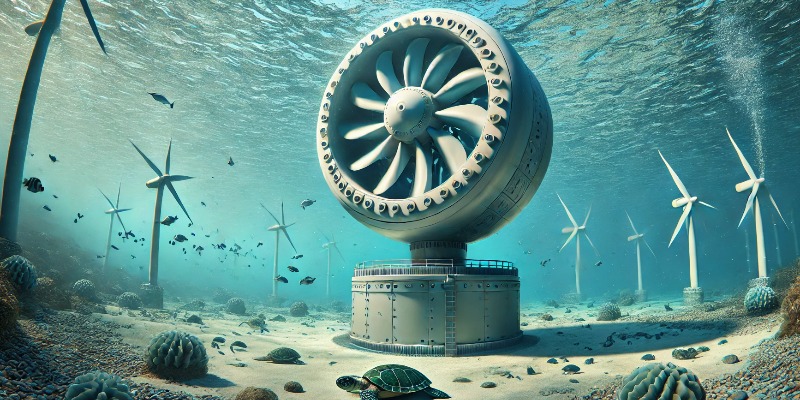
Hydrokinetic turbines (sometimes also called marine current turbines or tidal turbines) are devices installed on the sea or riverbed, where water currents flow with sufficient speed to generate mechanical energy. This energy is then converted into electricity by integrated generators.
The operating principle is similar to that of wind turbines: the movement of a fluid rotates blades, which in turn drive a rotor connected to a generator. The big difference lies in the density of the fluid: water is about 800 times denser than air, allowing underwater turbines to produce energy with much smaller blades and at lower speeds.
This feature allows for high energy production even in limited spaces, with less invasive infrastructures that are better integrated with the surrounding environment.
A constant and predictable source: advantages of marine energy
Ocean and river currents are predictable and continuous phenomena, unlike wind and solar currents, which are subject to daily and seasonal variations. This makes underwater turbines ideal for ensuring energy stability and continuity, contributing to a safer and more resilient grid.
For example, a well-positioned hydrokinetic turbine can operate up to 90% of the time per year, compared to 30-35% for wind turbines and 15-20% for photovoltaic systems. This makes the technology investment extremely advantageous in the long run.
Furthermore, an underwater turbine just 3 meters in diameter can produce up to 5 MW under ideal conditions, equivalent to a wind turbine with a diameter of over 180 meters. And all this without altering the landscape.
History of underwater turbines: from the first experiments to the present
The idea of harnessing the power of water to generate energy has ancient roots. The first watermills, which used river flow to grind grain, date back to Greco-Roman antiquity. But it was only in the 20th century that the modern vision of marine turbines to generate electricity began to take shape.
The first real experiments date back to the 1950s and 1960s, especially in Europe, where the potential of tides and ocean currents began to be studied. The first large-scale operational project was the La Rance tidal power plant in France, inaugurated in 1966 and still in operation, which exploits the difference between high and low tide in a specially constructed dam.
However, underwater hydrokinetic turbines, which are completely immersed and not dependent on the vertical movement of the tides, are a more recent technology. Since the 2000s, with the evolution of materials and underwater engineering techniques, the first prototypes installed in real environments have emerged.
Pioneering projects have been launched in the United Kingdom, Norway, Canada, and France, where tidal and current conditions are particularly favorable. More recently, countries such as Brazil, South Africa, and South Korea have also begun developing pilot projects to test the efficiency of these technologies in different climatic and oceanographic conditions.
Today, we are moving from an experimental phase to a commercial implementation phase, with increasingly efficient, safe and economically competitive devices.
Reduced environmental impact and natural integration
One of the main advantages of underwater turbines is their extremely low environmental impact compared to other energy infrastructures. They don't make significant noise, release pollutants, or impede navigation.
Furthermore, unlike dams or nuclear power plants, they do not irreversibly alter the ecosystem. Some studies indicate that turbines, once installed, can even serve as refuges for marine life, transforming into artificial reefs that promote biodiversity.
Thanks to the low blade speed, the risk of harming fish or turtles is limited. Furthermore, their compact and stable structure makes them resistant to storms, tsunamis, and geological activity, provided that careful site assessments are carried out.
Ongoing projects around the world: an expanding global network
Around the world, several companies are investing in pilot plants and commercial projects for submarine turbines:
- In Scotland, the Orkney archipelago is home to a major marine energy testing center, with over 30 experimental devices installed in the last 10 years.
- In Brittany, France, an offshore platform hosts hydrokinetic turbines that exploit the strong currents of the English Channel.
- In Canada, in the Bay of Fundy, some of the most powerful devices in the world are being tested, thanks to some of the strongest currents ever recorded.
- In Brazil, a commercial plant with compact turbines was recently installed to provide power to isolated coastal communities.
These projects are contributing to the creation of a new industrial sector dedicated to marine energy, with technical expertise, research and development, underwater maintenance, and systems digitalization.
An opportunity for ecological transition
In the context of global energy decarbonization, underwater turbines offer a concrete solution to the need for continuous and reliable renewable energy. They can be combined with other sources, such as solar or wind, to create balanced and resilient energy mixes, especially for coastal or island areas.
The possibility of installing turbines close to the coast also allows for logistical savings and simplified management, promoting energy independence and reducing dependence on fossil fuels.
Furthermore, these technologies could revolutionize energy supplies in developing countries, where complex land-based infrastructure is often too expensive to build.
Conclusion: Beneath the Surface, the Energy of the Future
Submarine turbines represent a natural and necessary evolution in the approach to renewable energy. They are born from the combination of ancient principles (harnessing the power of water) and cutting-edge technologies (composite materials, hydrodynamics, artificial intelligence for remote management).
Their potential impact is enormous: energy security, emissions reduction, enhancement of local resources, and respect for the environment. The ocean, until now seen only as a food reserve or transport route, is now becoming a central player in the new global energy paradigm.
And if it's true that the future of energy will be sustainable, then it will also be underwater.
© Reproduction Prohibited