




- Bifacial solar: how it works and how it differs from traditional photovoltaics
- Increasing efficiency in bifacial modules: key parameters
- Innovative materials for photovoltaics: perovskites and tandem cells
- Monocrystalline silicon, TOPCon and HJT: the evolution of solar technologies
- Durability of bifacial modules: resistance to atmospheric agents
- Strategies to optimize large-scale energy production
- Urban and industrial applications of new photovoltaic materials
- Architectural integration of new generation solar modules
- Costs, benefits and LCOE analysis of bifacial photovoltaics
- Future prospects for solar: innovation, standardization, and sustainability
A technical analysis of the evolution of bifacial modules and new photovoltaic materials: advantages, durability, and impact on industrial and urban installations
by Marco Arezio
Solar energy has undergone rapid evolution over the past two decades thanks to an unstoppable push for innovation in both materials and system architecture. Bifacial photovoltaics, one of the most advanced solutions for increasing solar energy conversion efficiency, is part of this technological revolution . At the same time, scientific research has produced a series of new materials that promise to overcome historical limitations in terms of performance, durability, and application versatility. The analysis of bifacial technologies and new photovoltaic materials therefore represents an essential step in understanding the real prospects for the diffusion of solar energy on an industrial and urban scale.
What is bifacial photovoltaics and how does it work?
Unlike traditional monofacial photovoltaic modules, which convert solar radiation incident only on the exposed surface, bifacial modules are designed to capture energy from both sides. This architecture allows for the exploitation of both direct light and the component reflected from the ground (albedo) or other nearby surfaces. The bifacial structure involves the use of solar cells inserted between two sheets of glass (glass-glass) or between a sheet of glass and a transparent film, with the back of the module left free of opaque materials.
The result is a significant increase in energy production, especially in environments where the background reflects a lot of light, such as deserts, white surfaces, or paved urban environments. On average, the increase in energy production ranges between 10% and 30% compared to traditional modules, with peaks that can exceed 40% under optimal conditions.
Efficiency: parameters, limits and growth factors
The efficiency of a photovoltaic module measures the fraction of solar energy converted into electricity. For bifacial modules, performance depends not only on the quality of the cells, but also on the ground's reflectivity, the installation height, and the panels' inclination.
Bifacial modules predominantly use PERC (Passivated Emitter and Rear Cell) monocrystalline silicon cells, which ensure high frontal efficiency and rear collection capacity. Recently, TOPCon (Tunnel Oxide Passivated Contact) technology has been gaining ground thanks to improved passivation and charge collection, with efficiency increases of over 24%.
Research is also moving towards composite materials and heterojunction (HJT) cells, capable of making even better use of reflected light and minimizing recombination losses.
In practical terms, bifacial systems require careful planning, both in terms of material selection and installation conditions. Shadow management, height from the ground, module spacing, and the choice of reflective surfaces are key factors in maximizing yields.
New photovoltaic materials: from perovskite to composite materials
The ongoing quest for efficiency and durability has driven the development of new materials capable of addressing silicon's historical limitations and enabling increasingly specific applications. Among the most promising materials are:
Perovskite cells
Perovskite-based solar cells have achieved efficiencies exceeding 25% in the laboratory, thanks to a flexible and easily modifiable crystalline structure. These materials, in addition to being inexpensive to produce, enable the creation of thin, lightweight cells that can be adapted to curved or movable surfaces. However, perovskites still suffer from problems related to chemical stability and long-term durability, especially in conditions of high humidity and temperatures. Current research is focused on protecting cells with innovative encapsulations and replacing lead with less toxic elements.
Composite materials and tandem cells
Composite materials combine multiple layers of different cell types, such as silicon combined with perovskites or III-V materials (such as GaAs, InP). Tandem cells combine the absorption capabilities of various materials to capture a broader portion of the solar spectrum.
These solutions make it possible to overcome the so-called Shockley-Queisser limit, bringing theoretical efficiencies above 30%. Tandem cells are already in the advanced testing phase in several pilot projects, and it is expected that they will find large-scale application in the next 5-10 years.Black silicon, CIGS, and organic materials
Black silicon, obtained through surface nanostructuring, increases light absorption while reducing reflection losses. CIGS (Copper Indium Gallium Selenide) modules and organic materials, on the other hand, focus on flexibility, lightness, and reduced production costs, while generally remaining less efficient than crystalline silicon. However, their adaptability makes them ideal for mobile applications, on vehicles, or on unconventional surfaces.
Durability and resistance over time
The durability of new photovoltaic modules, particularly bifacial modules and emerging materials, is one of the most debated aspects in the industry. Bifacial glass-glass modules, without polymer backsheets, ensure greater resistance to atmospheric agents, humidity, and temperature variations. Accelerated tests conducted on bifacial modules show an annual degradation of less than 0.5%, compared to 0.7%–1% for traditional modules.
For perovskite cells and tandem solutions, durability remains an open challenge, especially regarding photostability, humidity resistance, and UV degradation. The introduction of protective barriers and the use of advanced substrates (composite glasses, high-barrier polymers) are the main mitigation strategies currently under development.
Large-scale applications: industrial plants and urban integration
The main advantage of bifacial modules and new materials is the ability to design large-scale systems with a higher return on investment and improved environmental sustainability. Bifacial solar systems are now preferred for large photovoltaic parks, especially where soil albedo can be optimized, for example with light-colored gravel, grassy surfaces, or reflective membranes.
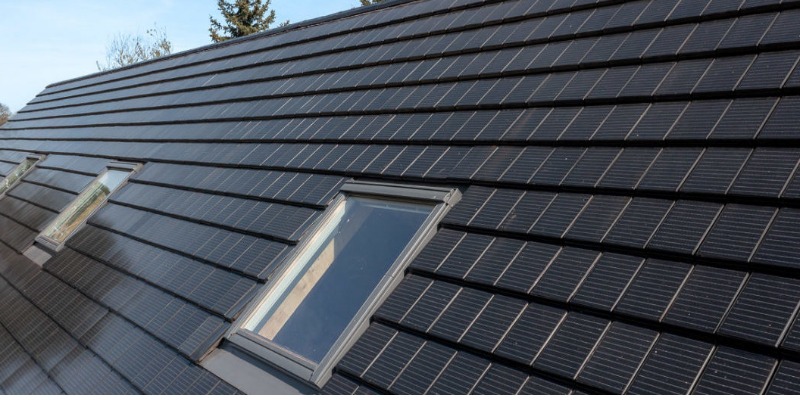
At the urban level, new materials enable increasingly advanced architectural integration: from glass facades with transparent double-sided modules, to lightweight roofs and shelters, to mobility applications on buses, cars, and light vehicles. Flexible materials and thin-film cells can be used to cover curved surfaces, technical fabrics, or street furniture, enabling a widespread and widespread energy generation model.
Economic benefits, current limitations and future prospects
The use of bifacial modules entails slightly higher investment costs than traditional modules, but they offer greater energy production and a longer lifespan. According to the latest international analyses, the Levelized Cost of Energy (LCOE) of bifacial systems can be 15-20% lower than conventional systems, especially in environments with favorable irradiance and ground reflectance.
The main limitations remain linked to the still relative scarcity of long-term data on new technologies (particularly for perovskites), the challenges of integration with existing systems and the need for shared technical standards for measuring bifacial efficiency.
Future prospects see a rapid convergence between increasingly efficient bifacial modules, high-strength composite materials, and urban integration solutions that favor decentralized, sustainable, and resilient energy generation.
Conclusion: towards intelligent, efficient and long-lasting solar energy
Bifacial photovoltaics and new materials represent one of the most promising developments in solar energy, combining high performance, long-term durability, and application versatility. Ongoing research suggests a future in which solar energy generation will be increasingly integrated into urban and industrial environments and mobile infrastructure, contributing to decarbonization and the transition to truly circular energy models. The key to success will be the ability to combine technological innovation, process standardization, and predictive maintenance strategies to simultaneously ensure reliability, safety, and environmental sustainability on a global scale.
© Reproduction Prohibited