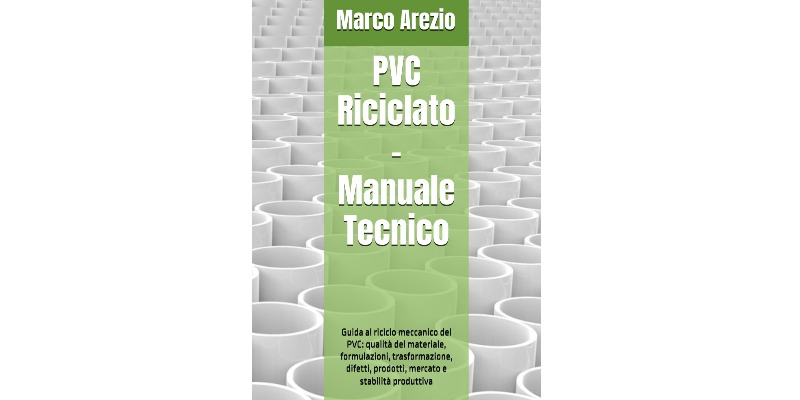
- Recycled PVC as an industrial raw material: technical principles and critical issues
- Origin of PVC waste and impact on the quality of recycled material
- Contamination, legacy additives and operating limits of reclaimed PVC
- Mechanical recycling technologies for rigid and plasticized PVC
- Thermal stabilization and degradation control in recycled PVC
- Process formulations and recipes for reliable recycled PVC
- Industrial transformation of recycled PVC: extrusion, molding and calendering
- Defects in recycled PVC products: causes, diagnosis, and solutions
- Technical comparison between virgin PVC and recycled PVC in industrial applications
- European recycled PVC market: expected quality, prices, and future prospects
Professional guide to the qualification, formulation and transformation of recycled PVC
Recycled PVC currently represents one of the most complex technical challenges and, at the same time, one of the most undervalued industrial opportunities in the recycled polymer landscape. Unlike other thermoplastics, polyvinyl chloride cannot be considered a simple regenerated resin, but rather a layered formulation system in which the material's history, legacy additives, thermal cycling, and processing conditions all play a key role in its final behavior.
This manual was born from the concrete need to bridge the gap between recycling theory and everyday industrial practice . It is neither a popular text nor an academic compendium, but rather a practical tool designed for those who actually work with recycled PVC and must ensure production continuity, finished product quality, and the economic sustainability of the process.
In the current context, recycled PVC can no longer be treated as a "secondary" raw material destined for marginal uses. The evolution of sorting, compounding, and extrusion technologies has demonstrated that recycled PVC, if properly interpreted and managed, can achieve levels of reliability compatible with structured technical applications. However, this possibility is not automatic: it requires technical expertise, method, and the ability to interpret the material.
The value of this manual lies precisely in its approach: recycled PVC is approached as a manageable industrial material, not as an unstable variable to be subjected to. Each chapter guides the reader through the entire supply chain, from the origin of waste to material qualification, from sustainable formulations to transformation, up to the systematic analysis of defects and their technical interpretation. Defects are never treated as random events, but as signs of an imbalance that can be recognized, understood, and corrected.
Particular attention is paid to the issue of production stability, the true dividing line between the occasional use of recycled PVC and its structural application. The manual explains why recycled PVC should not "imitate" virgin PVC, but rather be designed according to its own logic, based on realistic process windows, consistent formulations, and targeted controls. In this sense, the text aims to be a tool for reducing industrial risk: less improvisation, fewer late-stage corrections, and more informed technical decisions.
From a commercial perspective, the manual provides a fundamental understanding: it analyzes the factors that affect the actual cost of the material—waste, machine downtime, process instability, disputes—and demonstrates how qualified recycled PVC, even at a higher unit price, can be more competitive in the medium to long term. This approach makes the text particularly useful not only for technicians, but also for those who must make strategic procurement decisions.

The manual also addresses the international recycled PVC market , with a specific focus on the European context, analyzing the differences between the main countries, quality expectations, pricing dynamics, and the impact of regulations.
Recycled PVC is thus placed within a broad industrial vision, in which sustainability, production continuity, and competitiveness are not competing objectives, but rather interdependent.Another strength of the work is its non-ideological approach to sustainability . Recycled PVC is not presented as an "ethical" solution in and of itself, but as an industrial choice that must demonstrate its effectiveness. Sustainability is interpreted as a balance between performance, product durability, process efficiency, and regulatory compliance. From this perspective, recycled content is not an end in itself, but a design variable to be managed responsibly.
This manual is aimed at a demanding professional audience: recyclers, converters, process engineers, quality managers, technical directors, and entrepreneurs who want to use recycled PVC in a stable, predictable, and industrially viable manner. It offers no shortcuts or one-size-fits-all solutions, but builds a solid knowledge base for making informed operational decisions.
In an industry where recycled PVC is often subject to simplifications or unrealistic expectations, this text aims to provide clarity. Clarity about the material's limitations, its true potential, and the conditions required to transform it into a reliable industrial resource. It's a manual designed for those seeking repeatable results, not slogans.