In an all-too-perfect spring, at Cascina del Pellicano, a brilliant yet unlikely idea takes shape, capable of transforming centuries-old immobility into a sudden organizational frenzy. Between outdated nobility, peasant wisdom, and citizens searching for meaning, the line between authentic well-being and a well-sold story becomes increasingly blurred.
Nothing is quite what it seems, but everything is presented with impeccable care. The promises are vague, the prices are solid, the emotions are well-balanced. In this chapter, we laugh, observe, and suspect, while the reader realizes that behind the perfect order, something far more subtle may be lurking. Because when everyone is happy, someone—sooner or later—will have to pay the price.
Rural marketing, bespoke well-being, and packaged happiness amid decaying nobility and peasant intuition in Lomellina
Historical mystery novel. The Recipe of the Pelican Farmhouse. Chapter 7: The Gold of the Land and the Art of Selling It
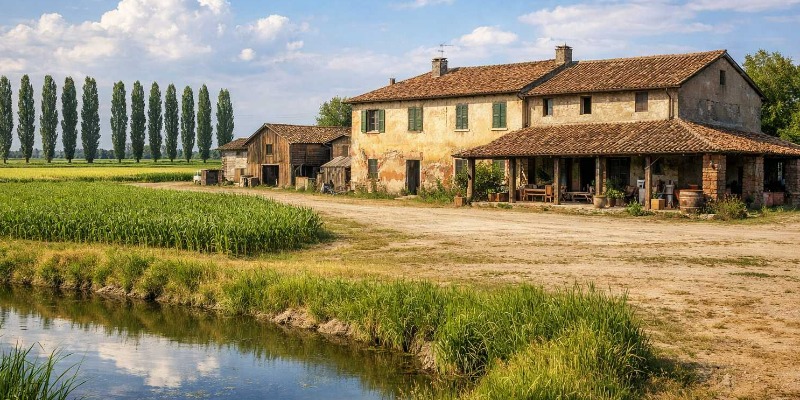
It was a splendid late-spring day in Sommo Lomellina, the kind that seems designed expressly to make people believe that life, after all, has some meaning. The countryside stretched out flat and stubborn like a perfectly ironed tablecloth: rice paddies nearly at full green, cornfields with rows as regular as lines in a notebook, glossy ditches reflecting the sky, and, farther on, poplars in formation—tall, slender, disciplined—like distracted guards set to watch the wind.
The Pelican Farmhouse stood there in its proud, slightly decrepit isolation, with walls the color of ancient dust and shutters that opened only when the house decided to pretend it was lively. The portico, with its dark beams and worn brick floor, was an open-air living room that knew only one true activity: stillness. The courtyard in front, wide and disproportionate, was a theater without an audience, and all around the perimeter the stables and storehouses spoke of a past in which that family had needed space to contain wealth, animals, voices, servants, banquets, and secrets.
That morning Count Gianalberto Marchetti rose early, his head buzzing with ideas. Not timid notions, not passing thoughts—real ideas, the kind that for him had always been a rare phenomenon, like icicles in August or punctual suppliers.
He did not know whether it was a consequence of that famous blade of grass from the manure heap he had chewed a few days earlier, or whether his life had truly taken a turn. But since it had all begun with that blade of grass, he was inclined to believe that the therapeutic properties of the “manure-heap drug” did not wear off in a few hours, as they had with the postman. To each his own therapeutic journey, he concluded mentally in a television-doctor tone—he, who at most had read the labels on digestive aids.
He dressed with his usual elegance, perpetually out of season: forest-green corduroy trousers, a light shirt a bit loose at the cuffs, a hunting vest that smelled of wardrobe and family history, and over it all a jacket that would have made sense at a hunting party in 1958. On his feet, worn leather slippers—the perfect compromise between nobility and laziness.
As he went down the wooden stairs he could already hear Ida busy in the kitchen. Her movements were recognizable even at a distance: steady rhythm, objects set down with precision, a low mutter that was half complaint and half prayer. When they saw each other they exchanged the usual nineteenth-century reverence, that rigid form of politeness which in that house survived more stubbornly than the walls themselves.
“Good morning, Count.”
“Good morning, Ida.”
The exchange lasted like a rite: brief, obligatory, unassailable.
Gianalberto entered the sitting room and sat at the long table—the one that once required twelve chairs for lavish dinners and today made do with two. The English ceramic cup, chipped at the rim like a tooth lost in youth, was already waiting for him. The silverware—polished by Ida with an almost vindictive perseverance—shone embarrassingly for such a modest use.
Ida brought in the steaming carafes: milk and coffee. Then, with the solemnity of someone delivering an official document, she set before him a small plate with toast, jam, and a piece of soft cheese that looked as if it wanted to become philosophy.
The Count poured his coffee, added milk, took the first sip, and sighed as if inaugurating a new era. Then, in a tone meant to sound practical but that came out professorial all the same, he said:
“Ida, I would like to ask your opinion.”
Ida looked at him the way one looks at a window that suddenly decides to open by itself.
“An opinion, Count?”
“Yes. On the galenic properties of manure-heap leachate absorbed by plants, and on how we might exploit it to make money.”
Ida stood still. Her eyes, usually quick and operational, fixed on him with a long stare. She had understood two words: manure heap and money. The rest sounded like a sermon in Latin.
After a few seconds, not wanting to remain silent—which she considered a social defeat—she said:
“Count… excuse me… but is the question about expired cheese, or something else?”
Gianalberto blinked. His enthusiasm cracked for a moment, like a thin crust.
“No, Ida. Not the cheese. I’m referring to… to that thing… that seems to make one feel good. The thing that… moved the animals. And also… the postman.”
Ida, with the delicacy of someone who has learned to handle other people’s follies without detonating them, nodded slowly and crossed herself.
“Ah. That thing.”
“Exactly. In your opinion… how can we make an activity out of it?”
Ida looked at him again, then made a rare decision: she sat down.
She almost never did during working hours; sitting meant granting the body a right she had never fully allowed herself. But that morning, with a Count speaking like a pharmacist and wanting to “make money,” she understood it was necessary to buy time. She sat slowly, giving her mind a few extra seconds to think.
Meanwhile Gianalberto plunged his spoon into the wild plum jam. He was focused, as if awaiting a verdict.
Ida inhaled.
Then she issued an edict.
Not an idea, not advice: an entire commercial strategy, a marketing symposium in the form of a peasant sentence, delivered with the calm of someone who had understood the world without ever studying it.
“Count,” she said, “you want to make money with that stuff? Fine. But let’s not do anything stupid.”
The Count’s spoon froze halfway between plate and mouth.
“We don’t give anything to drink to anyone,” Ida continued, “we don’t make Christians and foreigners eat grass from the manure heap, and above all we don’t call it a drug in front of anyone who might repeat it.”
The spoon dropped from his mouth. Literally. It made a small ting against the silver and then rolled onto the saucer.
Gianalberto stared at her, enraptured.
Ida did not flinch. She went on, ever more precise.
“You sell the story, Count. Not the stuff. The stuff, at most, you put in bottles for geraniums.”
The Count opened his mouth, but Ida forestalled him.
“Listen to me: that manure heap scares everyone. It stinks, it’s ugly, it’s indecent. And precisely because of that people pay to feel brave. You make a route out of it. An experience. A thing… what do they call it now… well-being.”
“Well-being… with a manure heap?” the Count tried.
“Yes,” said Ida, without laughing, because seriousness was the key to success. “Real well-being: country air, silence, walks, tastings of normal things—good cheeses, warm bread, wine—and then… the ‘Pelican Rite.’”
The Count’s eyes widened. “The rite…”
“A guided walk to the edge of the manure heap,” Ida continued, “without letting anyone step inside. You put up a fence, two nice signs, a lantern. And you tell them that here, for a hundred years, the earth has been doing its work, and that we have learned how to turn waste into a resource.”
Gianalberto stood motionless, as before an apparition.
Ida added, with a final blow: “And you sell the leachate as natural fertilizer for gardens and flowers. You call it ‘Pelican Elixir’ or ‘Green Tonic’ or whatever you like. But for plants, understood? Plants don’t sue.”
The Count made a strangled sound, halfway between admiration and panic.
“And then,” Ida said, now fully in her stride, “you bring the townsfolk on Saturdays. You seat them under the portico, give them a normal herbal tea, and tell them that here things slow down. That here the head empties. That here even a Count has started thinking again.”
Gianalberto looked at her the way one looks at someone who, for the first time, is clearer than oneself without even trying.
Ida concluded, dryly: “And if someone asks what that stuff is… you say: ‘It’s just nature.’ And you smile. People buy smiles, Count. Not laboratory analyses.”
Silence.
Gianalberto took a breath, as if resurfacing from water.
“Ida…” he said softly. “But… where did you learn these things?”
Ida shrugged.
“Count, I learned that hunger doesn’t wait. And that when someone has something others don’t, either they hide it or they sell it. You’re not good at hiding. So sell it. But sell it well.”
The Count remained still for a few seconds, then did the only sensible thing he could think of: he poured himself another coffee, as if to give himself time to accept that his illiterate maid had just built him a more solid business plan than his entire life.
Then, almost moved, he said:
“Ida… I believe you’re a genius.”
Ida stared at him and replied, as curt as ever:
“No, Count. I’m just someone who cleans. It’s you who until yesterday didn’t look at anything.”
And while outside the Lomellina spring continued to pretend to be eternal, at the Pelican Farmhouse something very rare happened: the Count understood that he truly had a future. And Ida understood that she had just signed, without meaning to, the heaviest contract of her life.
The days that followed were, for the Pelican Farmhouse, a historical event comparable to the arrival of electricity: sudden, incomprehensible, and above all exhausting. Count Gianalberto Marchetti and Ida, who for decades had practiced the noble art of waiting, suddenly found themselves operative. Truly operative. An activity that in that house had always been considered a curious habit of peasants and people without title.
And yet it happened.
The first thing they perfected was the route. Ida called it “the loop,” the Count “the experience,” but in the end they agreed on “Pelican Therapeutic Path,” because in modern times everything that costs must also cure something.
Ida laid down the basic rules, with the same voice she might once have used to manage the discipline of a convent:
no feet in the manure heap, ever
no “random” blades of grass
no townsfolk left alone near the leachate, because a citizen in search of happiness is capable of anything.
The Count, for his part, added the narrative component, because he had understood that people pay more willingly if they feel they are participating in a legend.
“Here,” he would say, in a grave tone worthy of a spiritual guide to Lomellina, “nature turns waste into a resource.”
And then he would leave a second of silence, because Ida had explained to him that silence, when well measured, is worth as much as a long sentence.
The route began at the portico, passed through the courtyard, skirted the old hayloft, and arrived at the embankment of the manure heap. There, thanks to Ida, appeared: a fence, a taut rope, and two handmade signs written in surprisingly neat handwriting, because the Count wanted “credible aesthetics.”
The first sign read:
“Respect the place. Here the earth works.”
The second, more practical, read:
“Do not lean. Do not taste. Do not improvise.”
Ida insisted on the last verb: improvising was the root of all evil.
Then came the manure heap. In its original form it looked like an agricultural sin not yet confessed. If they were going to show it to townsfolk, it had to at least look “natural” and not like a biological threat.
They cleaned the edges, cut the excess grass, moved the brushwood, and Ida imposed an iron rule: everything that smelled had to keep smelling, but in an orderly way. Disordered stink scares. Disciplined stink becomes an experience.
The Count, seized by entrepreneurial enthusiasm, proposed putting up a lantern “for evening visits at sunset.” Ida replied that if he brought people there at night, she would directly request political asylum from the Poor Clares.
The real masterpiece was the collection of the fertilizer. The Count wanted to call it “Therapeutic Leachate.” Ida shot him a look: no one buys a product that sounds like a diagnosis.
They returned, then, to the primordial idea and called it Pelican Elixir.
A perfect name: it sounded mysterious, natural, and above all did not immediately evoke manure.
The collection was a small domestic epic. The Count took part with touching seriousness: gloves too thin, a mask that kept slipping, and the air of a swamp surgeon. Ida, instead, did everything with the competence of someone who had seen real life: buckets, improvised filters, funnel, and the ability not to comment.
The fertilizer was decanted into small pharmaceutical-looking bottles: dark glass, screw cap, clean label. Ida wanted it to look like a serious product, almost herbalist-grade. The Count wanted to add “recommended dose” and “warning: happiness possible.” Ida removed the second phrase, because “then they sue us.”
The label bore a balanced formula:
Pelican Elixir – Natural concentrate for gardens and balconies.
Below, in small print: Dilute in water. Nourish. Observe. Slow down.
They soon realized they also needed someone who spoke the language of modern times. And the language of modern times, at the farmhouse, was an incomprehensible dialect made of videos, filters, and little tunes.
They called a kid from the village. Thin, quick, fingers always ready to scroll on the phone as if playing an invisible piano. The Count regarded him with suspicion: it was a kind of operativity he had never practiced.
“You,” said Gianalberto, “will open a profile on… what’s it called… Istagram.
”The boy smiled pityingly. “Instagram, Count.”
“And also on Tic Tac.”
“TikTok.”
Ida intervened: “As long as you bring people here and don’t make us ridiculous.”
In three days the kid built a world. Videos of the farmhouse at sunset, close-ups of very green grass, slow shots of the fence with “relaxing” music, and then the little bottle spinning on a table like a sacred object.
The Count, in one video, tried to say: “This elixir…” and stopped, because the word “elixir” already seemed too strenuous. In the end they replaced it with a caption: “Nature does the rest.”
Off-camera, Ida could be heard muttering: “Yes, and so do I.”
Then came the choice of the image. The Count wanted a “majestic” pelican, possibly against a backdrop of rice paddies. Ida wanted something simpler: a stylized pelican, almost a medical symbol, because the trick was to make everything look clean.
They chose a white pelican in vintage style, with a green circle around it and the words: Pelican Farmhouse – Sommo Lomellina.
Below, tiny: From the cycle of the earth.
The Count was moved. Ida reminded him it was just a label.
Then they wondered how everyone could use this elixir that looked more like a farmer’s product than a city one. That was precisely the crucial point. But Ida, who had understood the world better than anyone who had studied economics, had thought of everything.
During the guided visit, the Count explained—with almost mystical seriousness—that anyone could grow something on a balcony:
a strawberry plant
a bunch of aromatic herbs
a few potatoes
“You don’t need my father’s land,” said the Count in a noble tone, “you need constancy. And the right nourishment.”
And that’s where the Pelican Elixir entered the scene.
Ida had built a simple, irresistible promise: if you pamper plants, plants pamper you. And when the strawberries ripen, when basil smells fragrant, when a potato emerges from nothing in a balcony pot, you feel happy—but if you eat it, you’ll feel tremendously happy…
The Count added, with a half-smile:
“Everyone finds their own happiness. I, for instance, found it… with a blade of grass.”
Ida coughed loudly, to stop him from saying the dangerous part.
Within a week the farmhouse changed pace. It did not become modern, it did not become efficient. But it stopped sleeping altogether. There were people calling, asking about “the route,” wanting “the elixir,” asking if it was “also suitable for orchids.”
The Count answered with pride. Ida with suspicion. The kid with emojis.
And through all this, the manure heap stayed there, immobile and patient, like a secret too large to be told all the way through. A secret that, thanks to Ida, had found a sellable form: dark little bottles, the right words, and the oldest promise of all.
That from the earth, if you treat it well, something always comes back.
In Sommo Lomellina, on the first Saturday of May, something happened that the village had never experienced even in the days of the eel festival or the blessing of new tractors: the orderly invasion of townsfolk.
From eight in the morning the provincial road began to fill with shiny, clean cars, with license plates that made one’s head ring like a sentimental geography of Northern Italy: Pavia first, then Milan en masse, Voghera cautiously, Stradella curiously, Broni suspiciously, Melegnano enthusiastically, Vigevano competitively, Lodi already convinced, and even Bergamo and Monza, arriving like explorers of a new rural Eldorado.
All in line.
All patient.
All ready to enter the Pelican Farmhouse for the Tourist Happiness Loop.
Count Gianalberto Marchetti had organized everything with a discipline no one—not even Ida—had thought possible.
Ticket booth at the entrance to the courtyard, under a rented white gazebo “to give a sanitary air.”
Limited parking in the northern field, with lines traced in chalk and a hand-written sign: “Park slowly.”
Forty-five-minute guided visits, marked by a bicycle bell that signaled the start and end of each shift.
Immediate customer turnover, no emotional lingering: whoever had found enlightenment had to free the place for whoever was about to find it.
Ida observed everything with a look that mixed disbelief and survival instinct. For decades she had seen only lazy postmen, underpaid veterinarians, and a few distant relatives with bad intentions enter that farmhouse. Now she saw ladies with coordinated scarves, men with brand-new trekking shoes, young couples talking about slow life as if it were a recent discovery.
There were notable characters.
A couple from Milan, both architects, who kept repeating: “You can feel the energy here.” And Ida, behind them, thinking: it’s the manure heap, ma’am, not a chakra.
A widow from Monza, elegant, who during the tour took notes in a Moleskine notebook and said to the Count: “You know, I’ve always felt that happiness is a matter of roots.” The Count nodded gravely, as if he had always supported that thesis.
A clerk from Lodi, in an existential crisis, who became visibly emotional at the manure-heap fence. “It’s all so… authentic.” Ida handed him a tissue and whispered: “Careful not to slip.”
The visits were a triumph.
The Count, in vest and velvet jacket, spoke slowly, with short sentences, as Ida had taught him. He talked about the cycle of the earth, waste turning into resource, the pelican as a symbol of care. He never lied outright, but selected the truth with a finesse he himself did not know he possessed.
When they reached the climax—the manure heap—silence was absolute. The townsfolk leaned slightly forward, held back by the rope, breathed deeply, and nodded. No one asked what was really inside. They didn’t want to know. They wanted to feel it.
And then there was the final moment: the elixir counter.
Dark bottles, clean labels, the right light.
Ida stood behind the table like a pharmacist from another era.
“Ninety-nine euros,” she said without hesitation.
And no one objected.
Fifty euros per couple for the visit.
Ninety-nine euros for twenty-five milliliters of Pelican Elixir.
The Count, now and then, stepped away for a moment “to check the organization.” In reality he went to his father’s old study, where he had placed a tin box. Inside, banknotes. Many. Neatly folded, but still an amount of money he had never seen in his entire life.
He opened the box around noon.
He closed it.
He opened it again.
His hands trembled slightly.
Not out of greed.
Out of disbelief.
That pile of money—real, immediate money, without complicated invoices, without notaries, without inheritances—was the direct result of something he had done. Or, more precisely, of something he had decided not to obstruct.
Ida found him there, with the box open.
“Count,” she said dryly, “don’t count them too much. It brings bad luck.”
He nodded and closed the lid.
In Sommo Lomellina, on the first Saturday of May, something happened that no zoning plan, no town council, and no collective memory had ever foreseen: the village was invaded, but with order. A gentle invasion, at walking pace, made of hybrid compacts, SUVs shiny as new teeth, and the occasional old station wagon loaded with expectations. License plates followed one another like stickers in a sentimental Northern album: Pavia, Milan, Voghera, Stradella, Broni, Melegnano, Vigevano, Lodi. And then, to general surprise, Bergamo and Monza, arriving as if someone had passed the word in a secret chat: something’s happening there.
The entrance to the Pelican Farmhouse looked like the gate to a country fair with spiritual ambitions. Count Gianalberto Marchetti had organized everything with an almost military precision that surprised even him. Ticket booth under the gazebo, separate cash desk for the elixir, limited parking with a village boy tasked with telling everyone “slowly, slowly” as they got out of their cars as if about to run a marathon. Ida supervised everything with the gaze of someone who had seen famines, floods, and fallen counts: nothing impressed her anymore, but everything was under control.
The visits departed punctually. Forty-five minutes sharp, marked by a bicycle bell that Ida rang with the same solemnity as an Angelus. The Count guided the groups with a calm voice, telling the story of the farmhouse, the land, the pelican as a symbol of care and sacrifice. No one dared interrupt him. In the city no one listened to them anymore, but there, among ditches and poplars, every word finally seemed to have space.
The tourists were a human catalogue worthy of a sociological study.
There was a couple from Milan, both corporate consultants, who had left two teenage children at home to “reconnect.” He spoke little; she nodded a lot. At the manure-heap fence they held hands like they hadn’t in years. “It’s incredible,” she said, “how simple everything is.” Ida, passing behind with a crate of bottles, thought that simplicity cost ninety-nine euros plus VAT, but said nothing.
There was a literature teacher from Pavia, forced into early retirement, who had lost the rhythm of his days. During the visit he asked pointed, almost academic questions, but in the end he grew emotional. “I miss the sense of time,” he confessed to the Count. Gianalberto nodded knowingly: it was a subject he knew well.
There was a couple from Vigevano, artisans, marked hands and good shoes. They didn’t talk much. They watched. When they reached the elixir counter, the man said only: “If it works with plants, it works with us too.” They took two bottles without asking for a discount.
A woman from Monza, elegant and alone, told Ida as she paid that her husband had died three years earlier and she could no longer cultivate anything, not even habits. “I need to take care of something that responds,” she said. Ida put the bottle in the bag with a delicacy she didn’t even use with the silverware.
A thirty-year-old IT worker from Bergamo, arrived alone, admitted without shame that he was burned out. “I don’t know anymore why I do what I do,” he said to the Count, almost apologizing. Gianalberto spoke to him about balcony pots, about strawberries that grow slowly. The young man smiled as if someone had just given him permission.
And then there were the pure onlookers: failed influencers, couples in crisis, pensioners in search of novelty, women talking about “energy” and men photographing everything without quite understanding what. Everyone left with the same look: a mix of quiet enthusiasm and relief, as if someone had turned the world’s volume down for a moment.
The moment of selling the Pelican Elixir was almost sacral. Ida, behind the table, pronounced the price without trembling. Fifty euros per couple for the visit. Ninety-nine euros for twenty-five milliliters of concentrate. No one laughed. No one bargained. They paid and that was it, as one pays for a promise one does not dare diminish.
The Count, from time to time, withdrew to his father’s old study. There he had placed a tin box, one of those that once held Danish cookies and now held banknotes. Many. He counted them halfway, then stopped. Not out of greed, but out of a new respect: that money was not inheritance, not rent, not something that had slipped there by inertia. It had arrived because people had chosen to stop.
In the late afternoon, when the last group left and the courtyard returned to being just a courtyard, Ida sat down for the first time. The Count took off his jacket, tired as he had never been, but with a good, concrete tiredness.
“They’ll come back tomorrow,” he said, almost incredulous.
“If they come back,” Ida replied, “it means today we didn’t cheat them.”
They looked at each other, accomplices in a success neither of them could really explain. The Pelican Farmhouse remained there, unchanged, with the manure heap burbling silently and the poplars continuing to cast shade. But something had changed: not the land, not the manure, not the pelican on the label. What had changed was the way people looked at that place. And, without saying it aloud, also the way the Count looked at himself.
From some city balcony that evening, someone would water a plant with the elixir, expecting happiness. Perhaps they would find it. Perhaps not. But for one Saturday in May, in Sommo Lomellina, people had believed it was possible. And that, for Count Marchetti, was worth more than any inheritance.