- The labyrinth as a metaphor for the soul
- The faces of the Belle Époque and the loss of identity
- Black and White: Memory that Carves Silence
- Social masks and the illusion of progress
- Solitude and Belonging in the Age of Elegance
- Our reflection in the faces of the past
A symbolic journey into the depths of the collective consciousness, where the masks of progress and elegance hide the inner silence of an era searching for itself
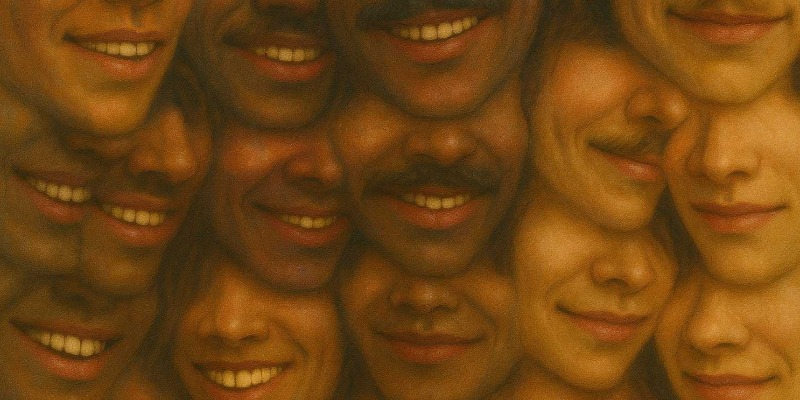
In the labyrinth of faces of the Belle Époque, every gaze seems to seek a way out. Not a physical opening, but a threshold of the soul. The work, constructed as a network of corridors and profiles, transforms the composition into a psychological investigation of identity and solitude, restoring to our era the fragility of a time believed to be eternal.
Black and white amplifies the silence. Each face, chiseled like a memory, appears suspended in a timeless dimension. The hairstyles, the carefully groomed moustaches, the starched collars evoke a world of order and decorum, but beneath that composure, a sense of uneasiness emerges: the suspicion of being trapped in a larger scheme, in a social labyrinth where role, rather than person, defines existence.
The labyrinth is not just space, it is also time. It represents the circular path of modern man, who races toward progress but ends up getting lost in his own reflections. The walls separating faces become mental barriers, the boundary between what we show and what we hide. Each section of the drawing, each shadow, speaks of the impossibility of escaping from oneself.

The artist invites us to a subtle reflection: who are we behind our social appearance? How much of our authentic self remains in the theater of appearances? The work offers no answers, but it opens a window of awareness.
Looking at these still figures, we sense that they resemble us. They are our ancestors and, at the same time, our mirrors.The labyrinth thus becomes a metaphor for memory: the roads that lead nowhere are our habits, our fears, the mental pathways that endlessly repeat the same detours. Each face, lost among the others, seems to demand recognition, not as a historical individual, but as a universal presence.
It's a work about limits and desire. About the tension between belonging and isolation. About the beauty born of composure, but which cracks when doubt surfaces. In this shadow-filled black and white, we sense an echo of nostalgia, as if the Belle Époque—an era of elegance and illusion—still speaks to us through its same labyrinth of lost faces.
And perhaps, ultimately, this is the most profound message: we have never truly escaped that labyrinth. We have only changed faces, but we continue to search for ourselves in the eyes of others, hoping to recognize in them the path to rediscovering ourselves.
The work is available for sale in a 24x36 cm format. To purchase, please write to info@arezio.it
© Reproduction Prohibited