- Fish as a symbol of environmental metamorphosis
- The use of electronic waste in contemporary art
- Recycled materials as a new skin for the marine world
- The impact of technological pollution on the oceans
- The narrative value of waste in modern sculpture
- Art and sustainability: a necessary dialogue
- Circular economy: from function to aesthetic meaning
- Ethical reflections on the relationship between nature and technology
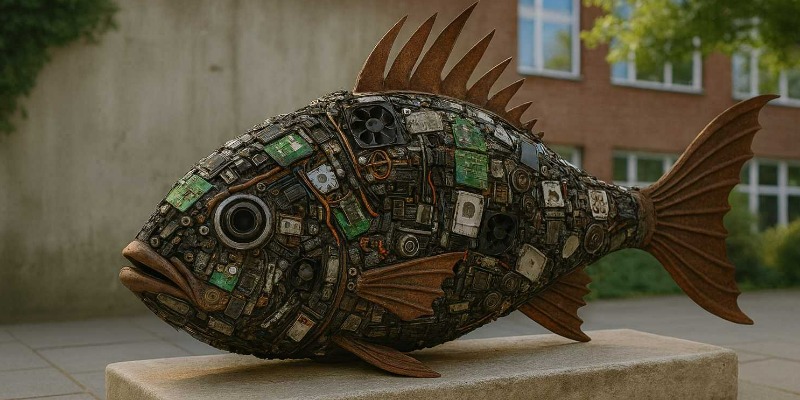
Contemporary sculpture made from recycled electronic materials that denounces marine pollution and celebrates the circular economy
The artwork depicting a large fish entirely composed of discarded electronic materials belongs to the field of contemporary art that uses waste and decommissioned components as a new expressive medium.
At first glance, it strikes the viewer with its monumentality: the creature seems to rise from stone, suspended between an industrial past and a natural world still struggling to preserve its place. Moving closer, the eye discovers a mosaic of objects—motherboards, fans, cables, processors, buttons, microchips, antennas, fragments of keyboards, and cooling units. Nothing is random; nothing is simply “placed.” Each element contributes to forming a technical and vibrant skin, a metallic shell that replaces scales, as though electronics had taken the place of organic tissue.
What the artist seeks to convey is a powerful, almost brutal reflection on how humanity is progressively replacing living beings with artificial substitutes. The fish, an ancestral symbol of biodiversity, becomes a post-modern hybrid, a creature seemingly born from the accumulation of what we discard. In this vision, nature does not disappear: it adapts, transforms, and absorbs technological waste until it becomes part of its body. It is a warning and at the same time a question: how much more can Earth absorb before its identity becomes irreversibly distorted?

The choice of materials is not only technical but narrative.
The green circuit boards evoke artificial forests, while the orange and black cables resemble veins and tendons of a biotechnological organism. The fans look like eyes and gills, suggesting a kind of mechanical survival. The rusted components speak of time, wear, and memory: what was once new, functional, and desirable has become useless debris—yet finds renewed value through art.The artwork also highlights a global issue: marine pollution caused by electronic waste. Fish, like many marine species, ingest plastic, microchips, and metallic fragments released into the waters due to illegal or improper disposal. Here, instead of appearing as victims, they take on a new form—a symbol of resistance, wounded yet alive. The fish’s metamorphosis—from living animal to sculpture of waste—is both a cry of alarm and an invitation to collective responsibility.
At the same time, the piece communicates a sense of repair and possibility. Recycling, understood as a social philosophy as well as an industrial practice, enables us to reinterpret the useless and restore its dignity. The fish thus becomes an ambassador of a new aesthetic: one that embraces the second life of materials, the circular economy, and creativity born from discarded objects. It is not a pessimistic artwork, but a bridge between what we destroy and what we can still save.

Its bright setting, with a modern architectural structure behind it and hints of greenery around, enhances the contrast among nature, urbanization, and waste. The fish—though immobile—appears to swim in a space that mirrors the human condition today: suspended between progress and loss, beauty and decay, potential and consequence.
Ultimately, the artist invites us to look closely not only at the sculpture but at what it signifies: a future in which animals and ecosystems may be forced to carry the burden of our choices. Yet also a future in which recycling, human ingenuity, and a renewed environmental ethic can generate beauty, awareness, and change.