- The first financial crises in the Roman Empire and in the Middle Ages
- The failure of the Florentine banks of the fourteenth century
- The Tulip Bubble: The First Speculative Crisis in History
- The Crises of 1720: Mississippi Company and South Sea Bubble
- The Panic of 1873 and the Economic Depression of the 19th Century
- The Wall Street Crash of 1929 and the Great Depression
- The 1973 oil crisis and global stagflation
- From the 2008 Crash to the 2020 Pandemic: The Crises of the 21st Century
The causes, development, and consequences of the major financial crises in history, from the Roman Empire to the 2020 pandemic
by Marco Arezio
The history of financial crises is a tale of excessive ambition, collective illusions, systemic fragility, and epochal transformations.
Every economic collapse, whether small or large, has left an indelible mark on the society of its time: reshaping institutions, toppling kingdoms, rewriting laws, and sparking revolutions. Tracing the great crises from the end of antiquity to the present day means exploring the very nature of economic systems and the unstable relationship between trust, wealth, and power.
The first financial crises: antiquity and the Middle Ages
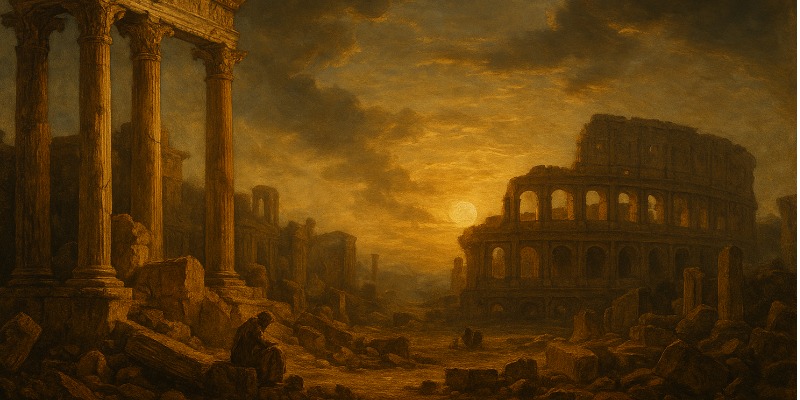
The crisis of the Roman Empire in the 3rd century AD is one of the earliest documented cases where a major global power was overwhelmed by a systemic economic collapse.
The Empire, by then vastly overstretched, could no longer sustain the growing costs of warfare and imperial bureaucracy. Its rulers began devaluing the denarius by steadily reducing its silver content. This maneuver triggered runaway inflation and eroded confidence in the Roman currency, leading to trade disruptions, the collapse of public finances, and a return to barter.
This crisis was not purely economic: it fueled political instability and territorial fragmentation. Merchants ceased traveling, cities depopulated, and the economy shrank dramatically. The Western Roman Empire never fully recovered from this shock — a clear example of how economic crises can extend well beyond financial matters.
In the Middle Ages, Florence experienced a catastrophic collapse in 1345 when three of the continent’s most powerful banks — the Bardi, Peruzzi, and Acciaiuoli — failed, sparking a crisis that rippled across Europe. The debts incurred by England’s Edward III to fund the Hundred Years' War proved unsustainable, and his default brought down the international credit system that had flourished in previous decades.
The fall of these key financial institutions crippled the Tuscan economy and shattered trust in banking for years. The Florentine crash illustrated how sovereign debt exposure could trigger widespread collapse, even in a pre-capitalist context.
The crises of the modern era: between colonialism and revolutions
In the 17th century, the Dutch Republic witnessed what is widely considered the first true speculative bubble in history. During the so-called “Tulip Mania,” tulip bulbs became the object of increasingly irrational investment. What started as a fashionable trend among the elite turned into a speculative frenzy: bulbs were traded at exorbitant prices, often through contracts that few ever intended to fulfill.
When the market suddenly realized the absurdity of these valuations, the bubble burst within weeks. Bourgeois families lost fortunes, confidence in commercial contracts eroded, and the Dutch government was forced to intervene to prevent a total collapse of the financial system. Though the economic damage was more limited than in other eras, the symbolic impact was immense: the market, when stripped of rationality, can become a self-destructive force.
In 1720, a double disaster shook the financial systems of France and England. In Paris, the Mississippi Company — created by economist John Law — promised enormous profits from colonial trade in the Americas. Share prices skyrocketed, supported by the continuous issuance of paper money. But the real economy could not support such promises, and when the illusion was exposed, the entire structure crumbled.
In London, the South Sea Company followed a similar trajectory. A speculative boom tied to colonial commerce imploded. Investors were ruined, ministers implicated, and public trust devastated. These twin crises permanently altered the relationship between governments, markets, and investors.
The 19th century: crises in the industrial age
With the Industrial Revolution, the nature of crises evolved. The capitalist system, now larger and more interconnected, became increasingly vulnerable to internal imbalances. The Panic of 1873 — often described as a prelude to the Great Depression — began in the United States but quickly spread to Europe.
The trigger was the collapse of Jay Cooke & Company, a major financier of American railroads. Panic followed: stock markets plummeted, thousands of companies failed, and millions lost their jobs.
Germany, Austria, and Britain all felt the impact, demonstrating how shattered confidence could cross oceans.
Industrial capitalism emerged from the crisis weakened and more regulated, while the role of the state in the economy began to slowly evolve.The 20th century: the century of global crises
The Wall Street Crash of 1929 was a turning point in modern economic history. The Roaring Twenties had been a decade of unrestrained growth, easy credit, and speculative investment. But that euphoria masked deep structural weaknesses: an unbalanced economy, deregulated finance, and an unstable banking system.
The stock market collapse, known as “Black Thursday,” was just the beginning. A cascade of bank failures followed, along with plummeting consumption, mass factory closures, and soaring unemployment.
The Great Depression marked the end of classical liberalism and gave rise to a new vision of public economic intervention through Roosevelt’s New Deal. In Europe, the consequences were equally severe: mass unemployment, poverty, disillusionment, and the rise of totalitarian regimes. The economy and politics fused into a dangerous spiral that would culminate in the Second World War.
In the 1970s, a new and disruptive crisis hit the industrialized world: the oil crisis of 1973, sparked by an embargo from Arab nations against Israel’s Western allies.
Oil prices quadrupled within months, crippling economies reliant on fossil fuels. The crisis revealed that growth was not infinite, and that natural resources — often taken for granted — could become geopolitical weapons.
This led to stagflation: the rare and destabilizing combination of high inflation and stagnant growth, which undermined dominant economic theories and paved the way for neoliberal policies in the 1980s.
The 21st century: increasingly interconnected crises
The 2008 financial crisis, often dubbed “the perfect storm,” epitomized modern financial capitalism. It began in the U.S. housing market but quickly spiraled into a global disaster. The mechanism was deceptively simple yet devastating: massive issuance of risky subprime mortgages, combined with complex financial instruments that repackaged these debts and sold them as safe securities.
When borrowers began to default, the house of cards collapsed. The fall of Lehman Brothers was merely the most visible symptom of a deeper disease: deregulation, unchecked financial engineering, and systemic interconnection.
The aftermath was global: deep recession, widespread unemployment, waves of bankruptcies. Central banks responded with unprecedented monetary stimulus, injecting massive liquidity to stabilize the system. But this came at a cost: ballooning public debt and widening inequality.
In Europe, the 2008 crisis morphed into a sovereign debt crisis, testing the cohesion of the Eurozone. Greece was forced to sign harsh bailout agreements, while austerity policies deepened recessions and fueled social unrest. The European project wavered, and only the decisive action of the ECB — encapsulated in Mario Draghi’s famous “whatever it takes” — prevented collapse.
The latest — and perhaps most unexpected — crisis arrived in 2020 with the COVID-19 pandemic. What began as a health emergency rapidly triggered global financial panic: lockdowns, supply chain disruptions, collapsing demand, and the paralysis of tourism and mobility. In mere weeks, the global GDP suffered one of the sharpest peacetime contractions ever recorded.
Governments and central banks reacted swiftly and massively: stimulus packages, expansive monetary policies, and forced digitalization. The crisis exposed the vulnerabilities of a hyperconnected global economy but also accelerated positive shifts like the green transition and the advancement of circular economy models.
Conclusion
Each financial crisis of the past has exposed an uncomfortable truth: the economy is never neutral, never separate from society and its choices. Crises stem from collective mistakes, shared illusions, and imbalances masked by superficial growth. Yet, each crisis has also been a catalyst for renewal — ushering in new rules, new institutions, and new paradigms.
Understanding the history of financial crises is a powerful tool for interpreting the present and anticipating the future. The next crisis will come — that is certain — but we might face it with greater wisdom, if only we truly learn from what has already happened.
© All rights reserved – Reproduction prohibited