- The symbolic meaning of the forest made of recycled paper
- Movement as a metaphor for the natural cycle of matter
- The visual dialogue between real landscape and recycled landscape
- How paper recycling becomes artistic storytelling
- The rebirth of words: from abandoned pages to new life
- The work as a manifesto of sustainability and circular creativity
A journey into a three-dimensional work that transforms recycled pages into a living ecosystem
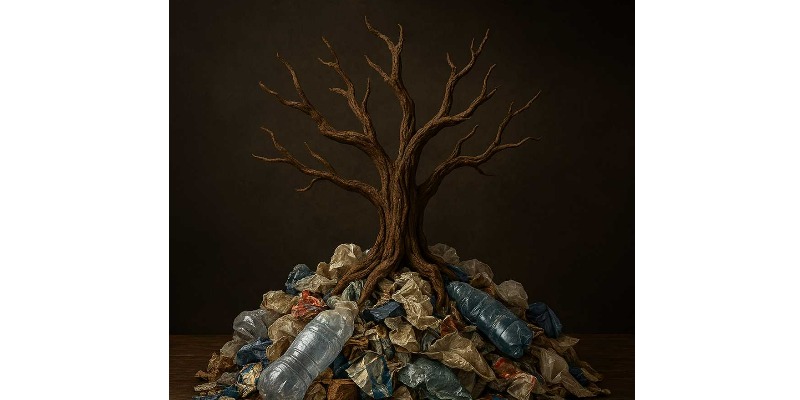
In this work, the forest is not just a natural place, but a living, breathing metaphor for collective memory attempting to regenerate itself through paper recycling. The artist constructs a three-dimensional landscape where trunks, branches, and roots emerge from recycled cardboard and novel pages, while the ground is a boundless carpet of overlapping pages, a sea of words moving to the rhythm of the wind.
It's an imaginary forest, yet extremely alive: not a static scene, but a constantly changing ecosystem, traversed by currents, vibrations, and breaths. The pages don't lie inert, but seem to take flight, transforming into dynamic elements that fill the air with movement, just like leaves carried by the breeze.
The contrast between the real landscape—the setting sun, distant mountains, a changing sky—and the forest made of recycled paper is a visual dialogue between what is natural and what has been transformed by man. This duality generates not conflict, but harmony: the paper, once torn from its original world of abandoned books, finds new life in a symbolic environment, where the artificial element becomes an integral part of the natural cycle. The choice to represent a living forest through a material born from trees is a powerful conceptual statement: every page, every fragment of paper is a piece of the forest that returns, a reunion between what has been lost and what can be reborn.

The movement that runs through the work—the pages rising, chasing each other, drifting in the wind—is a metaphor for the transformation process that recycling makes possible.
Nothing is ever definitively fixed or finished: paper can live many lives, take on many forms, tell many stories. Its visual lightness invites us to think of sustainability not as a technical gesture, but as a poetic and creative act, capable of restoring fluidity to the cycle of matter. In this imaginary forest, words are freed from forgotten books and transformed into new leaves, in a circular movement that harks back to the very rhythm of nature.The work therefore seeks to convey a message of hope and responsibility. It shows how what we often consider waste can become living matter, capable of evoking emotion, narrating stories, and building new worlds. Recycling is presented not as a simple industrial process, but as an act that preserves memory and delivers it to the future. Each page that makes the ground or flies through the air is a symbol of the possibility of rebirth, a fragment of knowledge that returns to being part of an ecosystem. There is no nostalgia, but dynamism: the past does not disappear, it transforms.
Ultimately, the work is an invitation to view paper not as waste but as an element with a second life. It is a hymn to the creative power of recycling, to circularity, to the beauty that can arise from regeneration. The paper forest thus becomes a meeting place between nature and culture, between memory and future, between what we have used and what we can still build. An imagery that, precisely because it is made of recycled material, speaks of care, responsibility, and possibility. A forest that breathes, vibrates, grows, and reminds us that even what we believe to be finished can come back to life if we know how to listen to its potential.
The work is available for sale in a 24x36 cm format. To purchase, please write to info@arezio.it
© Reproduction Prohibited
#marcoarezio #artofrecycling