- The visual tension between red and black: energy and abyss
- The language of geometry as psychological introspection
- From Structure to Chaos: Dissolution as a Creative Principle
- Impossible Perspectives and Optical Illusions in Abstract Art
- The mental labyrinth as a metaphor for contemporary thought
- Art as a mirror of modern perceptual instability
The fragile balance between order and chaos in contemporary abstract art
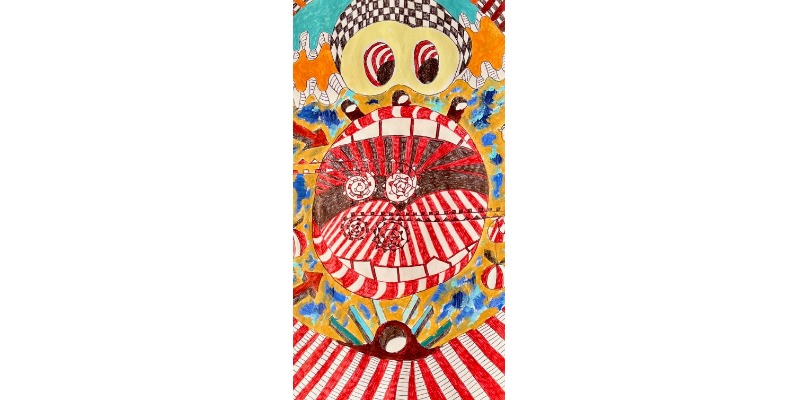
“Geometries of Dissolution” is a work born from an internal dialogue between precision and instinct, between structure and vertigo. Created exclusively with red and black ballpoint pens, the composition presents itself as a hypnotic interweaving of geometric shapes, spirals, and inclined planes that seem to converge and dissolve simultaneously. Each line is drawn with an almost obsessive rigor, yet beneath the apparent order lies an underlying restlessness, a constant movement that pushes the form toward fragmentation.
Red, the color of blood and vital energy, dialogues with black, a symbol of the abyss and dissolution. The result is a pulsating visual field, in which life and destruction coexist in unstable equilibrium. The work seems to breathe: it expands and contracts depending on the viewer's gaze, generating a sense of depth that transcends the two-dimensionality of the sheet.

The artist constructs a mental map of contemporary thought, in which every line represents a path, every weave a choice, every spiral a loss of direction.
There is no center, no definitive landing point: the eye is forced to wander, searching for an order that continually eludes it. It is an almost meditative experience, but also disturbing, because it forces the viewer to confront their own need for symmetry, balance, and control—and exposes their fragility.In this vision, geometry is no longer a language of perfection but an instrument of crisis . Forms seem to collapse upon themselves, generating impossible perspectives and volumes that overturn, as if space had folded within the mind. The artist thus reflects on the concept of dissolution: not an end, but a continuous transformation, a passage from an ordered state to a chaotic one, and vice versa.
The repetition of motifs—squares, triangles, spirals—recalls the cyclical nature of human thought and matter itself. Each element seems to contain the memory of the previous one and anticipate the next, in a process reminiscent of fractal structures or Escher's visionary architecture. However, here the construction does not obey mathematical logic, but an instinctive, emotional, almost primordial impulse. It is the mind designing itself, between precision and disorder, between lucidity and hallucination.
"Geometries of Dissolution" doesn't represent, but evokes. It's a work to be traversed, rather than observed. Each glance produces a new mental configuration, a different balance between perception and meaning.
The artist invites us to enter his visual labyrinth and lose ourselves without fear, because it is in the loss of orientation that the possibility of understanding arises. Art thus becomes a cognitive and sensorial experience, a form of visual thought that explores the complexity of contemporary existence—fragmented, in flux, constantly suspended between the search for order and the awareness of chaos.
The work is available for sale in a 24x36 cm format. To purchase, please write to info@arezio.it
#marcoarezio