- Legacy and Obsolescence: A Comparison of Art and Technology
- The Language of WEEE: New Materials for an Ancient Art
- Technological Chiaroscuro: The Light and Shadow of Electronic Waste
- Caravaggio in the Future: A Reinterpretation with the Waste of the Present
- The Decadent Beauty of Obsolete Technology
- The Environmental Message Behind the Art of Electronic Waste
- Brushstrokes of Waste: The Aesthetics of WEEE in Contemporary Painting
- Consumerism and Art: An Analysis of the Evolution of Visual Symbolism
The dialogue between classical art and digital consumerism in the drama of electronic waste (RAEE)
by Marco Arezio
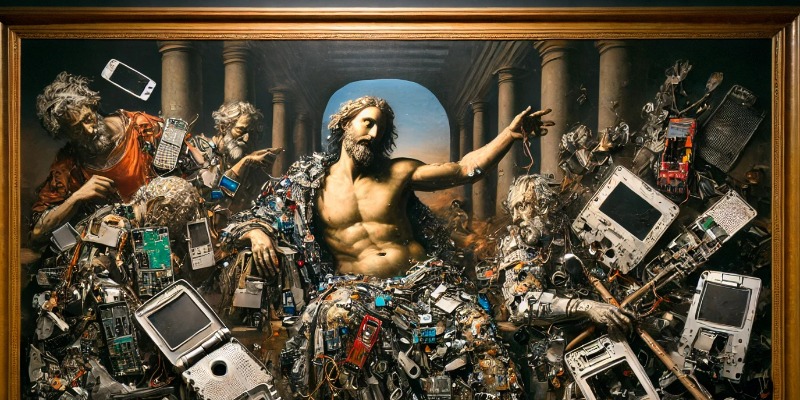
In this digital artwork, the artist uses materials from electronic waste (RAEE) to reinterpret a classic Caravaggio painting.
The artwork depicts iconic figures and scenes through an assemblage of printed circuit boards, broken wires, obsolete mobile phones, and other technological components, which, although clearly fragments of waste, are arranged with care that evokes the compositional precision of the master of chiaroscuro.
The drama of the scene is amplified by the classic theatrical lighting typical of Caravaggio, with the interplay of light and shadow emphasizing the decayed and obsolete nature of the electronic objects.
The visible brushstrokes add depth and texture, suggesting a dialogue between ancient painting traditions and today's throwaway technology world.
Meaning and message of the artist
The artist seeks to express a profound dialogue between past and present, between classical art and contemporary culture.
The use of RAEE, a symbol of our hyper-technological and consumerist era, raises a central question: what is the legacy of our technological civilization?Just as classical art immortalized the beauty and drama of human life, this composition of electronic waste suggests that the future of our cultural heritage could be a heap of obsolete scraps.
The artwork invites reflection on planned obsolescence and the transience of modern technologies, in stark contrast to the timelessness of works of art.
The choice to depict waste materials in a classical frame forces us to confront our environmental impact and the idea of a future marked by what we leave behind: a trail of waste that tells a story of squander.
Through the evocation of Caravaggio's dramatic composition, the artist communicates a message of social and environmental critique, where the beauty of the past clashes with the decay of the present.
The interplay of light and shadow becomes a metaphor for the dualism between technological progress and its consequences, suggesting that even in the darkness of our waste, there is hidden beauty, but it may be too late to recover it if we continue to ignore our responsibilities.
© Reproduction Prohibited