- The quiet revolution of automation in Amazon warehouses
- From the word "automation" to "advanced technology": the language of control
- The price of efficiency: thirty-five cents to replace a human being
- Work and Identity: The Invisible Labor of Digital Capitalism
- Technological unemployment and new social inequalities
- Work as memory: the ritual of a disappearing gesture
- The false collaboration between man and machine in Industry 4.0
- Towards a new digital social contract for the algorithmic age
Between Efficiency and Technological Unemployment, the Future of Work Risks Becoming a Memory Managed by Machines
by Marco Arezio
There will be no strike, no protest march marking the next industrial revolution. No banners, no slogans. This transformation does not shout — it calculates, measures, replaces. It is a silent, invisible process, encoded in strings of software. It is the revolution of algorithms — the new form of power redefining the very concept of human labor.
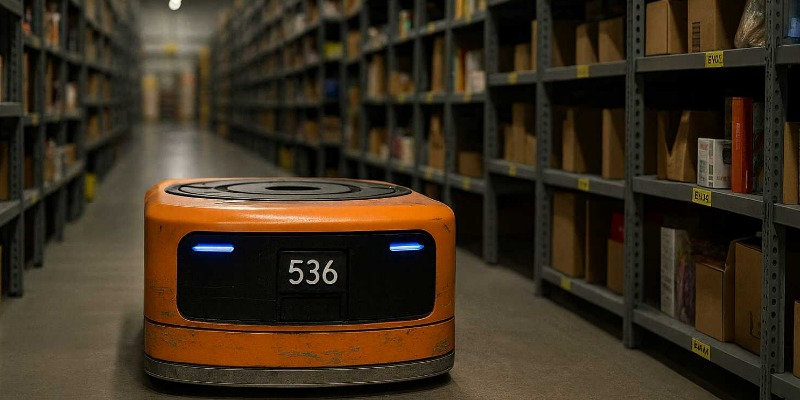
Amazon — the giant founded by Jeff Bezos, a global symbol of logistics and digital commerce — has announced a “rationalization” plan that will involve over 600,000 workers by 2027. It is not called a mass layoff, but a “technological optimization”: a polite expression meaning that manual labor — that of warehouse workers, pickers, and associates — is destined to disappear. No more hands packing boxes, no more footsteps between the shelves.
In their place, a new breed of collaborative robots — the so-called cobots — programmed to move with grace, efficiency, and an artificial semblance of empathy. A replacement that unfolds not only in factories, but within the culture of work itself.
The New Semantics of Automation
“Automation” and “artificial intelligence” are now words that inspire more fear than progress. Too cold, too menacing. That is why, in the internal language of major corporations, softer expressions are preferred: “advanced technology,” “process rationalization,” “operational flow optimization.”
Yet behind this softened vocabulary lies a structural shift: technological unemployment. According to projections, Amazon will invest over the next decade to replace more than half a million jobs with automated systems — saving an estimated 30 cents on every package delivered. Thirty cents: the price of humanity erased by an efficient algorithm.
The Invisible Toil of the New Capitalism
Working in Amazon warehouses is already an experience at the edge of human endurance. Time regulated by sensors, paths optimized to the centimeter, breaks reduced to the bare minimum, total performance control. And yet, in this new industrial model, even that controlled, dehumanized fatigue becomes superfluous.
The paradox is that, for many, work still represented a form of identity and social dignity. It was not merely a means of subsistence, but an act of collective participation in productive life. When the machine replaces it, it does not only erase the gesture — it erases the very sense of belonging to society.
The loss is not only economic; it is symbolic. It is the dissolution of a social pact that, for centuries, bound human beings to their own labor.
The Risk of a Post-Work Society
Some might say this evolution is inevitable progress. That machines will free humanity from repetitive tasks, paving the way for more creative and intellectual pursuits. But the issue is far more complex. Not everyone will be able to “recycle” themselves into the digital world.
Not everyone will have the training, time, or resources to adapt. Thus, while a narrow elite of engineers and analysts controls the global flow of data, millions of former manual workers risk being left behind — victims of a new form of exclusion: technological marginality.
mWe are facing a society divided between those who program and those who are programmed. Capital is no longer accumulated through labor, but through information. And data, once used to improve human work, are now used to eliminate it.The Ritual of Vanishing Work
The article that inspired these reflections evokes a powerful image: perhaps the future of work will not be work itself, but the management of its memory — a symbolic, almost ritual occupation performed before the “machine that never sleeps.” It is an image both haunting and poetic.
It depicts a society in which labor becomes remembrance, a celebration of a time when manual skill was considered value, not inefficiency.
We might imagine museums of human labor, where children will watch videos of workers assembling, carrying, sorting — as we today look at black-and-white photographs of miners or 19th-century workshops.
The human gesture, once the backbone of the economy, becomes an emotional archive —a relic of civilization.
The Illusion of Human-Machine Collaboration
Corporations strive to reassure us: robots will not replace people — they will assist them. They will be collaborative, “gentle,” even “empathetic.” But true collaboration requires balance, and in this case, balance does not exist. The algorithm decides the timing, the routes, the workloads. The human being, at best, intervenes when the machine stops. The risk is to transform the worker into a passive guardian of technology — a peripheral figure within the production system, an emergency operator in the cycle of the autonomous machine.
Collaboration thus becomes a rhetorical illusion, a comforting narrative designed to mask a reality that is, in fact, substitution.
Toward a New Digital Social Contract
The future of labor cannot be entrusted solely to the criterion of efficiency. We need a new ethic of progress — a social contract regulating the relationship between technology, dignity, and employment.
This means redistributing the benefits of automated productivity through measures such as universal income, shorter working hours, or compulsory digital training. Machines must work for humanity, not against it.
But to achieve this, politics must learn to understand the language of technology without being dominated by it — and culture must restore meaning to work, even in a world that progressively reduces its necessity.
Conclusion: The Algorithm and the Soul
When a machine takes a human’s place, it does not merely replace a function — it occupies a symbolic space.
The automated warehouse is not only a site of logistics, but a social laboratory where we measure the value of human existence against perfect efficiency.
The challenge, then, is not to stop technology — an impossible task — but to restore the human being’s ethical centrality in its use.
Because the machine never sleeps, but it also never dreams.
And perhaps it is precisely in dreaming, in imperfection, in slowness and empathy, that the most authentic essence of human labor resides.
© All rights reserved