




- Plastics recycling: industrial evolution and the strategic role of recycled polymers
- Post-industrial plastics and technopolymers: raw material quality and process criticalities
- Post-consumer plastic recycling: waste variability and defect control
- From recycled granules to finished products: transformation, limits and performance
- Recycled plastic film: process instability and technical solutions
- Recycled PVC: formulations, stabilization, and production issues
- Defects in recycled plastic products: causes, prevention, and industrial analysis
- Technical skills and know-how as a competitive factor in plastic recycling
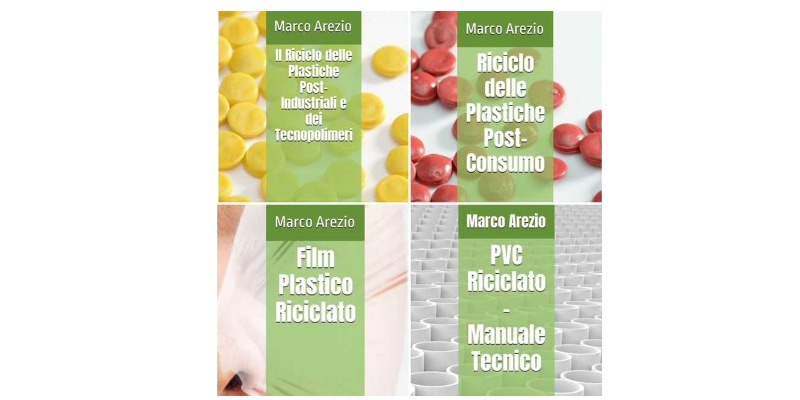
Recycling of post-consumer and post-industrial plastics, engineering plastics, plastic films, and recycled PVC: four technical manuals on processing, defects, quality, and industrial applications
In the current industrial context, plastics recycling has long transcended its emergency and regulatory dimension to become an autonomous, complex, and highly strategic technological field. Companies operating in the processing of recycled polymers face daily challenges of quality, repeatability, cost, and performance that can no longer be addressed with approximate or purely theoretical approaches.
This series of four technical manuals on recycled plastic polymers was created to address this need: to provide practical tools, based on industrial experience, capable of guiding the reader through the entire recycling chain, from waste raw materials to the finished product, with constant attention to defects to avoid and the technical choices that determine the success or failure of a production process.
The volumes address four key areas of modern recycling: post-industrial plastics and engineering plastics, post-consumer plastics, recycled plastic films, and recycled PVC. Each manual is conceived as a stand-alone yet coherent text, creating a coherent and comprehensive vision of industrial plastics recycling.
Recycling of post-industrial plastics and engineering plastics
The handbook on post-industrial plastics and engineering plastics addresses a segment often perceived as "simple" but which, in industrial practice, presents technical challenges that are far from trivial. Production waste, while more homogeneous than post-consumer waste, conceals pitfalls related to batch variability, the presence of residual additives, cross-contamination, and cumulative thermomechanical degradation.
The book provides an in-depth analysis of the selection, regeneration, and transformation methods of these materials, with a specific focus on engineering plastics, which require advanced skills and detailed knowledge of the material's behavior over time. It shows how improper recycling management can negate the intrinsic value of high-performance polymers, while a knowledgeable technical approach allows for the production of reliable, competitive, and industrially sustainable recycled compounds.
Recycling of post-consumer plastics
The manual on post-consumer plastic recycling addresses the most complex aspects of the circular economy of plastics. Here, the raw material is never neutral: it is the result of consumer behavior, collection systems, sorting technologies, and mechanical treatments that profoundly impact the material's final characteristics.
The text guides the reader in understanding the direct relationship between waste origin and recycled granule quality, analyzing phenomena such as color variability, odors, polymer contamination, and oxidative degradation.
Particular attention is paid to the technical limitations of post-consumer recycled materials and the distinction between unavoidable structural defects and defects that can be avoided through appropriate process and formulation choices.Recycled plastic film
Plastic film is one of the most sensitive applications for the use of recycled raw materials. Even minimal variations in granule quality can result in process instability, surface defects, breakages, or poor dimensional consistency.
This manual systematically addresses the entire recycled film supply chain, from material collection and preparation to extrusion and processing. The text delves into the role of filtration, densification, production recipes, and the balance between mechanical performance and industrial costs. It clarifies how many defects attributed to machinery or equipment actually stem from an incomplete understanding of the behavior of recycled material during the filming process.
Recycled PVC – Technical Manual
The manual dedicated to recycled PVC is the most specialized text in the entire series. PVC is a polymer highly dependent on its formulation and additives, and its recycling requires a radically different approach than other plastics.
The book provides an in-depth analysis of issues related to thermal stability, compatibility between different formulations, management of plasticizers and fillers, and typical defects in finished products such as fragility, discoloration, deformation, and mechanical decay. The manual is intended as a technical guide to avoiding structural errors that, in the case of PVC, can compromise entire production lines and generate high costs.
A technical series for the conscious recycling industry
What all four manuals have in common is a pragmatic, industrial approach to plastic recycling. Recycled materials are neither idealized nor simplified, but analyzed for what they truly are: a raw material with specific limitations, but also with great potential if properly understood and managed.
This series is aimed at recyclers, processors, production technicians, quality managers, designers, industrial managers, and salespeople who wish to transcend a superficial view of recycling. The volumes demonstrate how the quality of the final product depends not only on the raw material, but above all on the technical expertise with which it is selected, treated, and transformed.
In a market increasingly oriented towards sustainability but also industrial profitability, these manuals represent a solid technical reference for those who want to build real and lasting value starting from recycled plastic polymers.