- The evolution of urban planning towards circular models
- Recycled materials and structural reuse: principles of sustainable engineering
- Bridges and road infrastructure in a circular economy
- Architecture and construction of closed-loop buildings
- Urban pavements with recycled aggregates and drainage systems
- Life cycle analysis and structural sustainability indicators
- European regulations and technical guidelines for the reuse of materials
- Towards a resilient city: synergies between engineering, urban planning and the environment
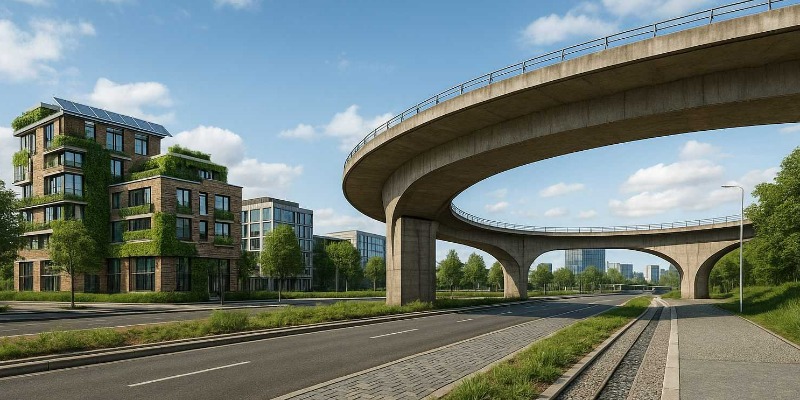
Bridges, Buildings and Pavements Made with Regenerated Materials and Systematic Structural Reuse Strategies Represent the Core of the New Circular Urban Engineering
by Marco Arezio
Over the past two decades, urban design has undergone a profound conceptual transformation. The traditional idea of the city as a sum of buildings and infrastructures growing linearly has been progressively replaced by a paradigm based on the circular economy applied to engineering and urban architecture.
Today, the sustainable city is no longer just the one that reduces emissions or uses renewable energy, but the one that closes material cycles, regenerates the built environment, and limits the consumption of virgin resources.
At the center of this vision lies the design of circular structures and infrastructures, where bridges, buildings, and pavements are rethought as dynamic systems capable of being born, transformed, and regenerated continuously.
The Evolution of Urban Design Toward Circular Models
The concept of sustainable urban design has evolved from mere energy efficiency to the integrated management of material and resource flows. The goal is no longer simply to build in a “green” way, but to ensure that every urban element—from foundations to facades, from bridges to roads—becomes part of a circular ecosystem.
This systemic approach implies multidisciplinary design, in which urban planners, civil engineers, architects, and materials scientists collaborate to define strategies for reuse, disassembly, and planned structural recycling from the conceptual stage. In this perspective, sustainability is not an external attribute but an intrinsic characteristic of the project.
Regenerated Materials and Structural Reuse: Principles of Sustainable Engineering
The technical foundation of circular design relies on the use of regenerated, recovered, or reusable materials with certified mechanical performance.
Among the most significant examples:
- Recycled concrete with aggregates from controlled demolition
- Regenerated steels from industrial scrap or ship dismantling
- Polymeric composites reinforced with natural or recycled fibers
- Regenerated laminated wood, treated for bridges and lightweight decks
Structural reuse, understood as the recovery and redesign of existing load-bearing elements, represents one of the most advanced frontiers. Beams, pillars, arches, or bridge segments are analyzed using FEM models and non-destructive testing before being reintegrated into new constructions.
This process achieves an average 30–50% reduction in raw material use and a significant cut in CO₂ emissions associated with material production.
Bridges and Road Infrastructures in the Circular Economy
Bridges—symbols of connection and progress—are also laboratories of circular innovation.
The new generation of modular bridges is designed to be disassembled, transported, and reused in other territorial contexts. Some European initiatives (such as ReCreate and CinderCE) apply the principle of “design for disassembly” even to large infrastructures, enabling the reuse of prefabricated segments and the selective replacement of damaged components.
In addition, the use of geopolymer concretes and recycled steels drastically reduces the environmental impact of the life cycle of the structure while enhancing durability in extreme conditions.
These practices not only extend the lifespan of infrastructures but introduce a new concept of flexible infrastructure, adaptable to climate change and evolving urban needs.
Architecture and Construction of Closed-Loop Buildings
In the urban construction sector, circularity translates into closed-loop buildings, where every component is designed to be separable, upgradable, and reusable.
Modular facades, prefabricated structural panels, and reversible joints enable selective demolition and reintegration of materials into the production cycle.
In this context, digitalization—through Building Information Modeling (BIM) and urban Digital Twins—plays a strategic role, allowing materials to be tracked and their mechanical behavior predicted over time, paving the way for predictive management of the built environment.
The ultimate goal is a regenerative architecture, capable of returning more resources than it consumes.
Urban Pavements with Recycled Aggregates and Draining Systems
Pavements represent a large portion of urban surfaces and are now the focus of circular innovations aimed at:
- Using regenerated asphalts (RAP)
- Employing recycled aggregates from controlled demolitions
- Developing geopolymer and fly ash-based binders
- Designing permeable pavements that enhance urban drainage and mitigate heat island effects
In some experimental projects, combining thermoreflective and regenerated materials has led to surface temperature reductions of 6–8°C in summer, improving urban comfort and reducing adjacent building energy demand.
Thus, pavements evolve from functional surfaces into active environmental technologies.
Life Cycle Analysis and Structural Sustainability Indicators
A truly circular approach requires quantitative assessment of the environmental, economic, and social benefits of adopted solutions.
LCA (Life Cycle Assessment) and LCC (Life Cycle Cost) are fundamental tools to measure the impact of materials and construction methods.
Indicators such as Global Warming Potential (GWP) and Energy Payback Time enable comparisons between different structural alternatives.
Furthermore, integrating LCA analysis with BIM digital models allows the creation of dynamic databases for continuous sustainability monitoring, extending the concept of efficiency across the entire lifespan of a structure.
European Standards and Technical Guidelines for Material Reuse
The European Union, through directives such as the Waste Framework Directive (2008/98/EC) and the Green Deal, has set clear targets for the recovery and reuse of construction materials.
Recent standards—EN 15804 and EN 15978—define the criteria for Environmental Product Declarations (EPD) and the evaluation of building performance from a life-cycle perspective.
Many European countries are also introducing national regulations on structural reuse, allowing the integration of recovered components in new projects, provided mechanical certification and traceability are ensured.
This regulatory framework supports the transition toward a secondary materials market with high engineering value, positioning Europe as a global leader in sustainable urban design.
Toward the Resilient City: Synergies Between Engineering, Urban Planning, and Environment
The circular city is not merely an aggregation of eco-friendly techniques but a complex ecosystem where infrastructures, green spaces, energy systems, and mobility interact in dynamic balance.
Urban resilience—the capacity to adapt and regenerate after extreme events or environmental crises—depends on the structural and circular quality of its constituent elements.
Modular bridges, demountable buildings, draining pavements, and recycled materials are the building blocks of a systemic vision, where technology becomes an ally of urban life, safety, and environmental sustainability.
Only an interdisciplinary approach, grounded in scientific knowledge, technological innovation, and environmental responsibility, can foster a new generation of resilient, circular cities, capable of combining progress with respect for resources.
© All Rights Reserved