- Role of process oils in synthetic rubber manufacturing
- From fossil fuel tradition to bio-based alternatives
- Vegetable oils: chemical structure and potential
- Compatibility of renewable oils with SBR and BR
- Bio-based oils for NBR and EPDM: challenges and results
- Rheological and mechanical properties of sustainable compounds
- Oxidative stability and chemical modifications of natural oils
- Environmental and industrial perspectives of renewable process oils
A technical analysis of sustainable alternatives to mineral oils in the rubber industry
by Marco Arezio
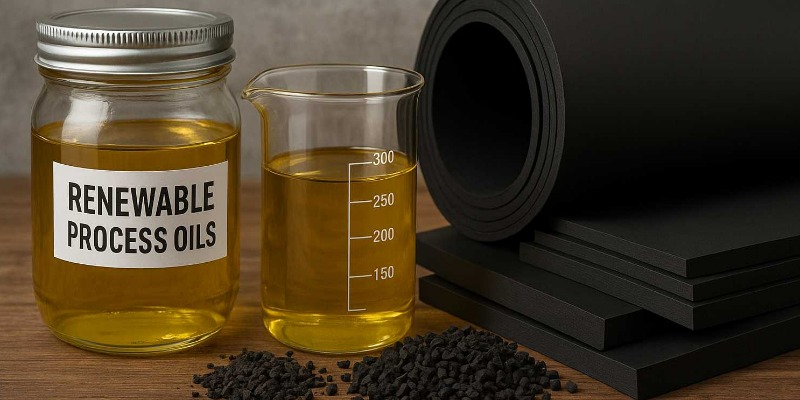
In the synthetic rubber industry, process oils are an invisible yet crucial element. These oils do more than simply make compounds more workable: they influence their dynamic properties, mechanical strength, and even environmental sustainability.
For a long time, production relied almost exclusively on petroleum derivatives, particularly aromatic and paraffinic oils, whose effectiveness had been proven over decades of use. However, European regulations, combined with growing environmental awareness, have prompted a structural rethinking of the sector.
This is where interest in renewable process oils, derived from vegetable oils or biomass, comes from, which promise to combine technical compatibility and environmental responsibility.
Characteristics of traditional process oils
Mineral oils used as plasticizers and fluidizers have always ensured excellent compound processability and good interaction with elastomers such as SBR, BR, NBR, and EPDM. Their primary role is to reduce viscosity during mixing, promote the dispersion of reinforcing fillers, and modulate the mechanical properties of the final product.
However, the presence of polycyclic aromatic compounds (PAHs), considered toxic and regulated by European directives, has made it urgent to seek safer and less impactful solutions. The transition from fossil-based to bio-based is therefore not only a technological improvement, but also a necessary response to environmental and regulatory constraints.
Origin and types of process oils from renewable sources
Academic research in recent years has explored numerous sources for the production of alternative oils. Natural vegetable oils, such as soybean, rapeseed, palm, or sunflower, constitute the most readily available group. Alongside these are synthetic esters derived from fatty acids, obtained through transesterification processes, which ensure greater thermal stability.
Currently in the experimental phase are derivatives of lignin or biomass pyrolytic oils, along with plasticizers produced from agro-industrial byproducts such as glycerol or citric acid. The common feature of all these oils is their renewability and biodegradability, but the challenge remains achieving performance comparable, in terms of durability and compatibility, to that offered by their fossil-based counterparts.
Compatibility with synthetic rubbers
The compatibility of an oil with an elastomer depends largely on the polarity of the molecules and their ability to interact with the polymer chain. Laboratory tests have shown that low-polarity esters derived from vegetable oils are effective with hydrocarbon-based rubbers, such as SBR and BR.
In EPDM compounds, hydrogenated and long-chain oils have improved dynamic performance by reducing hysteresis. For more polar elastomers, such as NBR, functionalized fatty acid esters have proven more suitable, capable of interacting with nitrile groups and improving oil resistance. Compatibility is therefore not uniform, but varies depending on the chemical nature of the elastomer and the degree of polarity of the plasticizer.
Mechanical and rheological properties
A key aspect concerns the properties that process oils impart to the compound.
Renewable oils reduce Mooney viscosity to a similar extent as mineral oils, making the compounds processable without significant compromises.Mechanical tests showed that elasticity and tensile strength remained comparable, while some functionalized esters even improved tear resistance.
In applications such as tires, a positive effect has been observed in reducing rolling resistance, which translates into greater energy efficiency. Experimental data therefore confirm that replacing fossil oils with renewable alternatives does not necessarily lead to a decline in performance; in fact, in some cases, it leads to measurable benefits.
Thermal and oxidative stability
While rheological and mechanical performance appear promising, stability remains a critical issue. Natural vegetable oils, characterized by unsaturated chains, are particularly vulnerable to oxidation, a phenomenon that can lead to material hardening and a reduction in product shelf life.
To address this problem, targeted chemical modifications are used: partial hydrogenation to saturate the double bonds, epoxidation to increase thermal resistance, or esterification processes to stabilize the molecule. At the same time, the addition of specific antioxidant packages extends shelf life and ensures consistent performance over time. Scientific research is currently focused on strengthening these aspects, thus bridging the gap with conventional mineral oils.
Environmental and industrial implications
From an environmental perspective, the introduction of bio-based process oils represents a significant step forward. Their reduced toxicity, biodegradability, and the possibility of being derived from industrial byproducts give these oils a superior environmental profile compared to fossil-based derivatives. However, the analysis cannot stop at direct impact alone: the overall impact must be assessed, considering land use, water use, and potential conflict with the food supply chain.
For this reason, cutting-edge research is focusing on oils obtained from non-food crops or agro-industrial waste, thus avoiding unwanted competition. From an industrial perspective, the adoption of renewable process oils opens up long-term prospects: reduced dependence on fossil fuels, alignment with European regulations, and the possibility of building more resilient value chains.
Conclusions
The transition from fossil-based process oils to those derived from renewable sources is not just a trend, but a strategic necessity. Academic research has already demonstrated their compatibility with various elastomers and their effectiveness in terms of processability and mechanical properties. Crucial issues, such as oxidative stability and industrial standardization, remain unanswered, but solutions are well underway and promise to make renewable oils competitive on a large scale. In the coming years, these alternatives are expected to become increasingly widespread, with benefits for both the environment and industry, in a process that combines technical performance and sustainability.
© Reproduction Prohibited