- Industrial graphite recycling: origins and nature of waste
- Pretreatment and selection of graphite residues in the recovery process
- Thermal and chemical purification techniques of waste graphite
- Quality standards and technical requirements for recycled graphite
- Industrial applications of recovered graphite
- Economic and environmental benefits of graphite recycling
- European regulations and certifications in the recycled carbon sector
- Technological innovations in the recovery and reuse of industrial graphite
Recycling Waste Graphite: Purification Methods, Industrial Reuse, and Economic and Environmental Benefits
by Marco Arezio
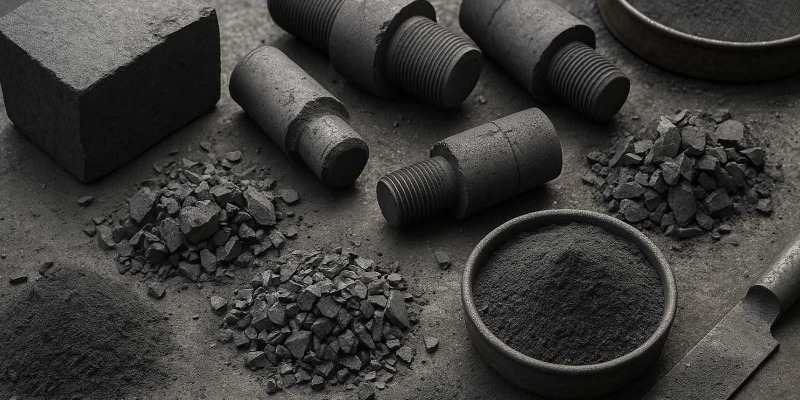
Graphite was originally introduced as a premium material for metallurgical and high-temperature mechanical processes, but its processing inevitably gives rise to residues. These are not homogeneous wastes; rather, they consist of a variety of forms and compositions that reflect the complexity of the operations from which they come.
Ultra-fine powders generated by the release agents used in milling, fragments removed during the shaping of electrodes, carbon deposits formed through erosion inside electric furnaces, residues captured by extraction systems—all these materials make up the wide spectrum of graphite waste. Each category carries its own set of impurities—technical oils, metal oxides, ceramic particles, refractory residues—requiring a recycling approach capable of adapting to a raw material that, although always graphite, changes appearance depending on its production history.
Pre-treatment Technologies and Selection of Graphitic Residues
To initiate an effective recovery process, discarded graphite must first undergo a phase of “reordering.” Slurries from release agents must be dried to give the material the correct consistency for processing; flakes and dry powders, on the other hand, are crushed and calibrated into specific grain sizes. At this stage a silent but fundamental selection takes place: magnets, induction separators and densimetric tables remove unwanted metals, sands, oxides and all the components that could compromise later purification steps. It is a process of subtraction and cleaning, designed to give the material a degree of uniformity and to prepare it for the operations that will restore its technical nature.
Thermal and Chemical Purification of Recycled Graphite
Purification is the heart of graphite recycling: a phase in which the material is pushed to its limits to recover its original quality. Thermal purification involves extremely high-temperature treatments, often exceeding 2,500 °C, in controlled atmospheres where metallic impurities volatilize or react into separable compounds. The heat not only cleans the material, but also improves its crystalline structure, making the recovered graphite closely comparable to electrolytic graphite.
The chemical alternative relies on the reactivity of strong acids and bases: immersion in hydrofluoric, sulfuric or alkaline solutions selectively removes everything foreign to carbon, leaving the graphite intact. At times—especially when dealing with very fine powders—mineral flotation is employed, adapted from mining processes, allowing graphite, with its hydrophobic nature, to separate naturally from non-carbonaceous components. At the end of this journey, the material becomes once again an industrial resource, ready for a new production cycle.
Quality and Technical Standards of Recovered Material
The value of recycled graphite depends not only on its purity, but also on the ability of the process to ensure consistent technical properties. Grain size must be stable, electrical and thermal conductivity measurable and predictable, and the absence of oils and metals rigorously certified. In many cases, companies rely on specific ISO protocols or sector standards that define parameters such as crystallinity, residual impurity percentage, or ash content.
A graphitic material that meets these criteria becomes a true industrial asset, competitive with virgin graphite not only from an environmental standpoint but also in terms of performance.Industrial Applications of Recycled Graphite
Once recovered and purified, graphite re-enters various production chains. In some cases, it is used directly in the manufacture of new electrodes, blended in calibrated ratios with virgin graphite. In others, it becomes a solid lubricating agent—fine, resilient, and ideal for high-temperature pastes or technical sprays. Recycled powders are often used in milling or casting release agents, especially where cost-effective yet high-performance solutions are sought.
In the metallurgical world, it serves as a reducing agent in metal briquettes, while in the refractory industry it contributes to the production of crucibles capable of withstanding extreme thermal shocks. Finally, a portion of recovered graphite finds its way into conductive materials for electrical components or—when purity levels allow—into blends destined for battery anodes, a sector eager for high-performance carbon and increasingly open to alternative sources.
Economic and Environmental Benefits of Graphite Recycling
The advantages of graphite recovery are evident at the industrial scale: reduced disposal costs, more stable pricing in an unpredictable global market, and decreased dependence on suppliers of critical minerals. Yet the environmental benefits are even more significant. Recycling graphite means reducing the demand for extraction processes—often carried out in ecologically fragile regions—lowering emissions associated with the production of synthetic graphite, one of the most energy-intensive materials, and fostering a circular carbon supply chain in which graphite is no longer treated as waste but as a performance carrier. In a production landscape increasingly attentive to sustainability, these dynamics take on strategic importance.
European Regulations and Certifications for Recycled Material
The recycling of graphite is governed by numerous regulatory frameworks. Companies must comply with REACH requirements for chemical management, industrial emission standards for high-temperature treatments, and various norms defining the quality and safety of recycled materials—especially when used in lubricants or high-temperature technologies. Many producers also adopt voluntary environmental certifications, such as EPDs or ISO 14021, which allow them to communicate the reduced impact of the recovered material transparently. Traceability is essential in this sector: it demonstrates that the graphite life cycle is managed responsibly and in accordance with European directives.
Innovation and New Frontiers in Waste Graphite Recovery
Research is rapidly expanding the boundaries of graphite recycling. Plasma technologies for ultra-fast purification, electrochemical systems that eliminate the need for hazardous acids, advanced micronization techniques for the battery sector, and equipment capable of capturing and reusing milling dust in real time—all these developments contribute to making waste graphite an increasingly valuable resource. High-energy-intensity industries view these innovations with growing interest, aware that the future will demand materials that are reliable, sustainable, and, above all, renewable.
© Reproduction Prohibited