- The end-of-life challenge of civil aircraft
- Dismantling and material separation strategies
- Titanium recovery between costs and opportunities
- Aeronautical aluminum: recycling and new industrial applications
- The complexity of reusing carbon fiber composites
- Environmental impacts and emissions reduction in aircraft recycling
- New business models and specialized supply chains in the sector
- Future prospects for sustainable civil aviation
- A concrete case: dismantling and recycling of an Airbus A320
Innovation, circular economy, and new industrial challenges for the responsible management of aeronautical materials
by Marco Arezio
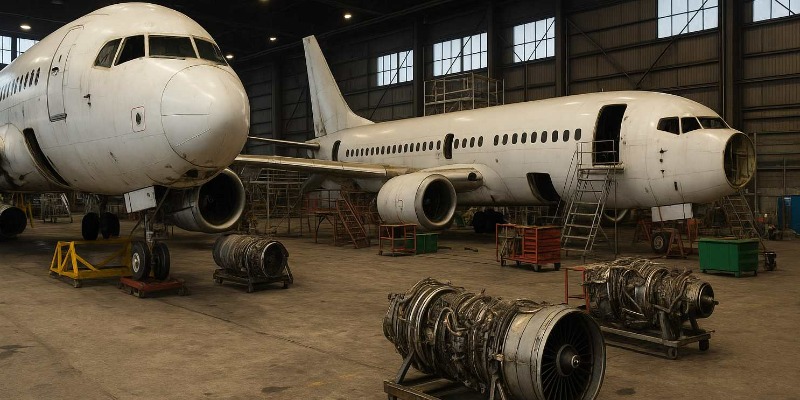
Every year, hundreds of civil aircraft reach the end of their operating life. Airlines, driven by technological advances, engine obsolescence, and increasingly stringent environmental regulations, decide to replace outdated aircraft with more efficient models.
But what happens to decommissioned aircraft? Aircraft disassembly and recycling is now crucial not only from an environmental perspective, but also from an economic one, as it involves high-value materials such as titanium, aluminum, and carbon fiber composites. End-of-life management is no longer seen as a problem to be outsourced, but rather as a new industrial and business opportunity.
Dismantling and material separation strategies
The process of dismantling an aircraft is extremely complex: a single commercial aircraft contains millions of components, including wiring, electronics, skins, and load-bearing structures. The first phase involves decontamination: residual fuels, hydraulic fluids, oils, and potentially hazardous substances are removed. This is followed by selective disassembly, which allows the reusable parts (engines, avionics, landing gear) to be separated from those intended for recycling. This is where the ability to properly manage metals and composites comes into play: a task that requires advanced cutting, shredding, and separation technologies to preserve the quality of the materials.
Titanium recovery: costs and opportunities
Titanium is a strategic element in aeronautics due to its mechanical strength, light weight, and corrosion resistance. It is used in critical parts such as landing gear, engines, and load-bearing structures. However, its primary production cost is very high, both in terms of energy and cost. Hence the importance of recycling.
Dismantling and remelting aeronautical titanium not only reduces procurement costs but also limits the environmental impact of its extraction. The main challenge remains the need to preserve the material's metallurgical properties: processes such as vacuum remelting or advanced separation techniques are essential to ensure quality standards suitable for reuse in high-performance applications.
Aeronautical Aluminum: Recycling and New Industrial Applications
Aluminum is the most abundant material in aircraft structures. From the fuselage to the wings, this metal offers lightness and workability, characteristics that have made the spread of mass air travel possible. Recycling aircraft aluminum is one of the most established sectors: the metal can be remelted infinitely without losing its properties. However, the challenge lies in the purity of the alloys.
Many aircraft components are made from special alloys containing elements like copper, zinc, or magnesium, which must be handled with extreme precision to avoid quality degradation. Recovered aluminum is used not only in the aircraft industry, but also in the automotive, shipbuilding, electronics, and advanced packaging sectors.
The complexity of reusing carbon fiber composites
While titanium and aluminum have well-established recycling chains, carbon fiber composites still pose one of the most difficult challenges. These composites, designed to reduce aircraft weight and increase fuel efficiency, have a hybrid structure in which the fibers are embedded in thermosetting polymer matrices. Separating the fibers from the matrix is not easy: the thermal and chemical processes tested so far allow the recovery of fibers of lower quality than the original ones.
However, new frontiers are opening up, with controlled pyrolysis and solvolysis techniques that allow the extraction of nearly intact fibers, reusable in sectors such as luxury automotive, sports equipment, and wind turbines. The economic potential is enormous, considering the ever-increasing demand for lightweight, durable composites.
Environmental impacts and emissions reduction in aircraft recycling
Beyond its economic value, recycling aircraft materials has a significant environmental impact. Recovering titanium or aluminum requires a fraction of the energy required to produce them from scratch. This translates into a substantial reduction in CO₂ emissions. In the case of composites, sustainable management avoids the risk of highly chemically complex waste being dumped in landfills, reducing the long-term impact on soil and water. Furthermore, careful aircraft disassembly allows for the safe handling of hazardous substances, such as hydraulic fluids containing toxic substances or coatings containing heavy metals. This integrated approach transforms recycling from a waste disposal practice into a concrete tool for decarbonizing aviation.
New business models and specialized supply chains in the sector
The aircraft disassembly and recycling sector is generating new value chains.
Specialized companies offer integrated services that include material assessment, certified disassembly, recycling, and remarketing. Airlines, for their part, can generate financial returns by reselling reusable parts and high-quality materials. Dedicated industrial centers have emerged in Europe and the United States, true hubs where decommissioned aircraft are processed with high traceability standards. This model, if extended globally, could help reduce dependence on primary raw materials and increase the resilience of industrial supply chains.Future prospects for sustainable civil aviation
Looking to the future, civil aircraft recycling will not only be a technical necessity, but will become an integral part of airlines' and manufacturers' sustainability strategies. New generations of aircraft are already being designed with greater attention to material recyclability.
At the same time, European and international regulations are imposing extended producer responsibility criteria, pushing for a circular economy approach. Titanium, aluminum, and composites therefore represent not only a technical legacy of the past, but a strategic resource for the future. The challenge will be to transform every decommissioned aircraft from bulky waste into an urban mine of advanced materials, capable of fueling a new industrial and sustainable era.
A concrete case: dismantling and recycling of an Airbus A320
Certified European dismantling hubs (for example, those affiliated with AFRA, Aircraft Fleet Recycling Association) regularly handle narrow-body aircraft such as the Airbus A320 and Boeing 737, which make up the majority of the global fleet. These aircraft, with an operating empty weight of about 41–42 tonnes, represent the most common reference scenario for assessing the technical and economic sustainability of aircraft recycling.
Material composition
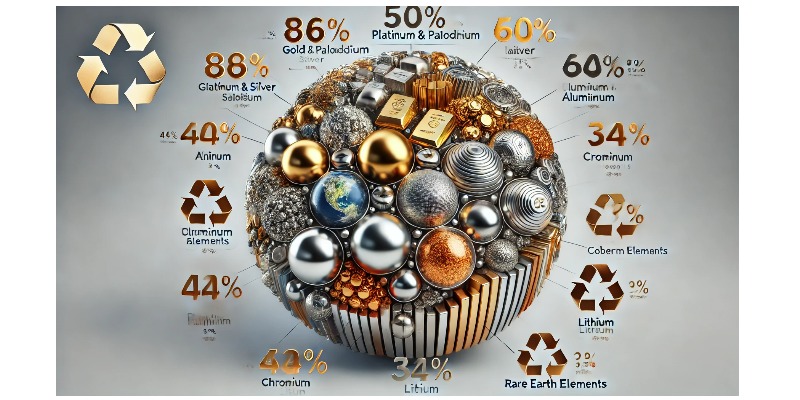
- Aluminum: 65–75% of total mass (27–30 tonnes).
- Titanium: 6–7% (2.5–3 tonnes), present in structural parts and engines.
- Carbon fiber composites: 7–10% (3–4 tonnes), mainly in wings and panels.
- Other materials (steel, copper, plastics, fluids): 10–15%.
Recovered material revenues
- Aluminum: around 23–25 tonnes effectively remeltable after technical yield → average value €35,000–40,000.
- Titanium: 2–2.3 tonnes separable → value ranging from €12,000 to €45,000 depending on alloy and market.
- Recycled carbon fiber: 2.5–3 tonnes processable → value €13,000–60,000, depending on fiber quality.
The total direct revenue from materials alone, under realistic conditions, ranges between €60,000 and €140,000 per aircraft.
Operating costs
Consolidated estimates report a dismantling, decontamination, and recycling cost for a narrow-body aircraft between €100,000 and €250,000, depending on location, level of automation, and local environmental regulations. Fluid decontamination and disposal of hazardous components weigh significantly on this figure.
Role of part-out
Economic balance is not guaranteed by materials alone, which rarely cover costs. The real driver of profitability is part-out:
- CFM56 engines from an A320, even near the end of their operating life, can generate revenues between €500,000 and €1.5 million depending on remaining hours and market demand.
- Landing gears, avionics, seats, and interiors have secondary but steady value, adding several tens of thousands of euros.
Overall balance
A dismantling and recycling operation for an A320 carried out in a standard European hub involves:
- Direct costs: ~€150,000 (average between decontamination and processing).
- Material revenues: ~€100,000.
- Part-out revenues: €200,000 to over €1 million, with strong variability linked to engine condition.
In conclusion, without the market for reusable components the operation would risk a loss or barely cover its costs. With active part-out, however, dismantling an Airbus A320 proves not only environmentally sustainable but also economically positive, making the aircraft recycling chain a concrete and profitable industrial reality.
© Reproduction Prohibited