- Dimensional reduction of technopolymers: principles and operational criticalities
- Design of shredders for technical plastics: shredded material quality and dust control
- Separation of metals in WEEE streams: technologies and industrial performance
- Management of dust and non-plastic residues in technical regrinds
- Technopolymer cleaning: friction, immersion and dry cleaning systems
- Moisture control in hygroscopic polymers: from post-wash to advanced drying
- NIR optical classification and densimetric separation for technical polymer families
- Regeneration extrusion and compounding: screw profiles, degassing, filtration and creation of the new granule
Pretreatment, Contaminant Separation, Washing, Classification and Extrusion: How a High-Performance Recycled Technical Compound Is Born
Essay. Recycling of Post-Industrial Plastics and Engineering Polymers. Chapter 4: Advanced Processing of Recycled Engineering Polymers
4.1 From Collection to Mechanical Pretreatment: Turning Waste into a Treatable Flow
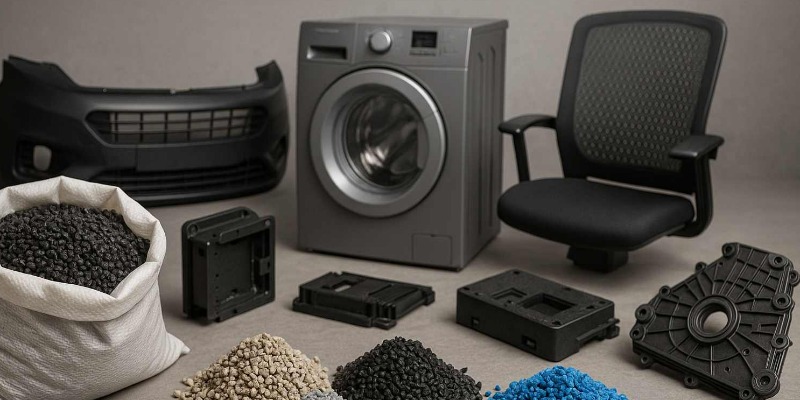
When a recyclable engineering polymer reaches the plant, it never enters in the form of “raw material” in the classic sense. It arrives as a heterogeneous residue of a previous process: complete components from obsolete stock, off-spec parts from a recent production run, dismantled WEEE parts, bumpers and dashboards from car dismantling, appliance housings, scrap from the internal lines of a converter. Each of these objects is an assembly, not a pure material. The recycler’s first objective is therefore to redefine the physical form of the waste, turning it from a complex object into a treatable granular flow.
The process almost always begins with a coarse size-reduction stage. Slow-speed shredders, equipped with robust knives and wide cutting chambers, handle bulky components such as bumpers, dashboards and large appliance housings. The action is neither fine nor selective at this stage: the aim is to reduce volume, break three-dimensional shapes, eliminate cavities and extreme thicknesses. The material leaving this phase appears as flakes of centimetre size, often accompanied by metallic inserts still embedded in them, rubber fragments, and residues of foams or adhesives.

At this stage, plant design must take into account not only production requirements, but also the mechanical stresses to which the engineering polymers are subjected.
A shredder sized solely according to robustness risks generating an excessive amount of dust, especially with brittle or filled materials. This dust, in addition to representing a potential loss of useful material, significantly increases the surface area exposed to oxidation and, in the case of hygroscopic polymers, to moisture absorption. Conversely, too mild a reduction leaves pieces that are excessively large, complicating subsequent sorting and grinding stages....© Reproduction Prohibited