




- Chemical Structure and Sensitivity to Degradation: The Basis of Engineering Plastics Recycling
- ABS, ASA, SAN and MABS: How Styrenic Resins Behave in Technical Recycling
- Polycarbonate and PC/ABS: Moisture Management, Chain Extenders and Blend Stability
- Polyamides PA6 and PA66: Regeneration, Humidity and the Role of Glass Fiber
- Reinforced Polyamides: Fiber Length Recovery Strategies in Compounding
- PBT and Technical Polyesters: Hydrolysis, Self-extinguishing and Regeneration of Thermal Properties
- POM, PMMA and Technical Elastomers: Recycling of Sensitive, Optical or High-Elasticity Polymers
- High Performance Resins and Cross-Section Parameters: Crystallinity, Hygroscopicity and Molecular Weight
From ABS Behavior to PC Stability, from Moisture Management in Polyamides to the Regeneration of Flame-Retardant PBT
Essay. Recycling of Post-Industrial Plastics and Engineering Polymers. Chapter 2: Families of Engineering Polymers and Their Behavior in Recycling
2.1 Technical ABS and Related Styrenic Resins
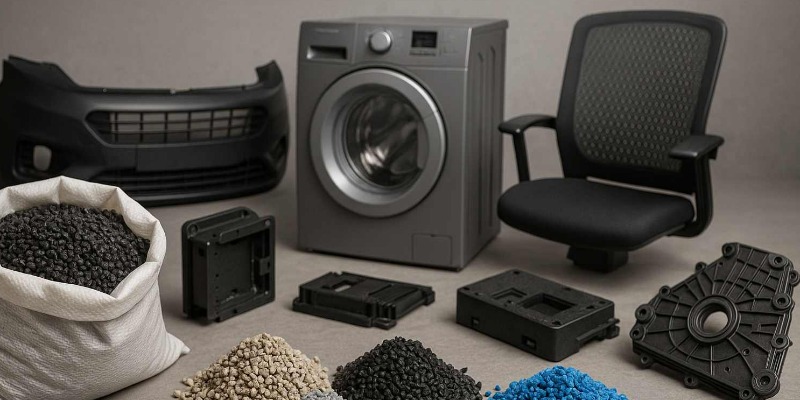
In the world of engineering polymers, ABS represents one of the most emblematic materials linking industrial design with performance. Its terpolymeric nature—featuring a rigid styrene–acrylonitrile matrix embedding a butadiene-based rubber phase—allows it to combine stiffness, good surface finish and impact resistance. In sectors such as automotive, home appliances, technical furnishings and electronics, ABS is often the primary candidate when a polymer is required to withstand moderate impacts, maintain a paintable or textured aesthetic surface, and deliver consistent processability in injection molding.
In post-industrial recycling, the main criticality does not concern the rigid matrix, which tolerates thermal cycles reasonably well, but rather the elastomeric phase. Butadiene is chemically fragile, sensitive to oxidation and temperature. Each time ABS is melted, it is exposed to a combination of heat and oxygen which, if not controlled, breaks the chains of the rubber phase, causing a progressive loss of toughness. This phenomenon manifests not only as a visible color change—the yellowing typical of oxidized styrenics—but also as a deeper alteration of impact behavior, which can suddenly become more brittle.

The advantage of post-industrial ABS streams, however, lies in the fact that their quality is known.
The recycler is aware of the specific ABS grades involved: platable materials for galvanic treatments, mineral-filled versions, UV-stabilized grades for semi-outdoor applications, flame-retardant grades for electrical devices. This knowledge allows the regeneration process to be calibrated with a level of precision impossible to achieve in post-consumer flows. Parameters such as cylinder temperature, residence time, screw profile and stabilizer selection are adjusted specifically to minimize further degradation of the butadiene phase....© All rights reserved