




- Why Focus on Elastomer Recycling
- Characteristics and Criticalities of Vulcanized Materials
- Importance of Devulcanization in a Circular Economy
- Devulcanization Methodologies: Overview and Benefits
- Mechanical Devulcanization: Technology and Limitations
- Chemical Devulcanization: Selectivity and Sustainability
- Microwave Devulcanization: How It Works and Why It's Effective
- Ultrasonic Applications and Supercritical Fluids: Innovative Solutions
- Sector Research: Data and Future Developments
- Perspectives and Conclusions: Towards an Effective Recycling of Elastomers
Discover How to Reduce Environmental Impact and Restore the Properties of Vulcanized Polymers with Advanced Circular Economy Strategies
by Marco Arezio
When we talk about elastomers, we refer to a wide family of polymeric materials capable of undergoing significant elastic deformations and then returning to their original shape, thanks to a cross-linked chemical-physical structure. This feature makes them extremely useful in a broad range of applications: from the automotive industry (for instance, in tire and gasket production) to construction (insulation, coatings), as well as medical devices, toys, and electronic components. On the other hand, it is precisely this cross-linked nature—especially in the case of vulcanized rubber, in which the cross-linking is irreversible—that makes end-of-life recycling particularly challenging.
In recent years, with growing interest in sustainability and the circular economy, substantial effort has gone into identifying viable ways to reuse waste elastomers, thereby avoiding landfill disposal or incineration. Both industry and academia have dedicated increasing resources to developing strategies aimed at reducing the environmental impact of elastomers while maximizing the recovery of secondary raw materials. One key process in this context is known as “devulcanization,” which involves breaking the sulfur (and sometimes carbon-sulfur) bonds responsible for cross-linking, thus restoring part of the original processability of the material.
However, the challenge is both vast and complex: on one hand, there are high volumes of rubber production and consumption (both natural and synthetic), and on the other, there are technical processing difficulties combined with increasingly stringent regulations on emissions and the use of potentially hazardous chemicals. The possibilities for improving the sustainability of the supply chain therefore lie in technological innovation and a strategic vision that spans the entire life cycle of the material—from the initial design (design for recycling) to post-use recovery.
Environmental Benefits of Elastomer Recycling: Why Focus on Devulcanization
Elastomer recycling is part of a broader context of ecological transition and circular economy. Avoiding landfill disposal not only reduces the consumption of natural resources (such as virgin rubber, which is obtained from raw materials that are often non-renewable or otherwise limited) but also curtails CO₂ emissions and other pollutants. Unlike incineration, which does allow partial energy recovery, the option of recovering the polymeric material opens up far greater opportunities.
Devulcanization techniques, in particular, make it possible to recover significant portions of the mechanical properties of the polymer, so that the recycled material can be employed in applications requiring high-quality performance. A devulcanized elastomer—if properly formulated—can be blended with a virgin matrix to create new technical articles in a cycle that can be repeated in a virtuous manner.
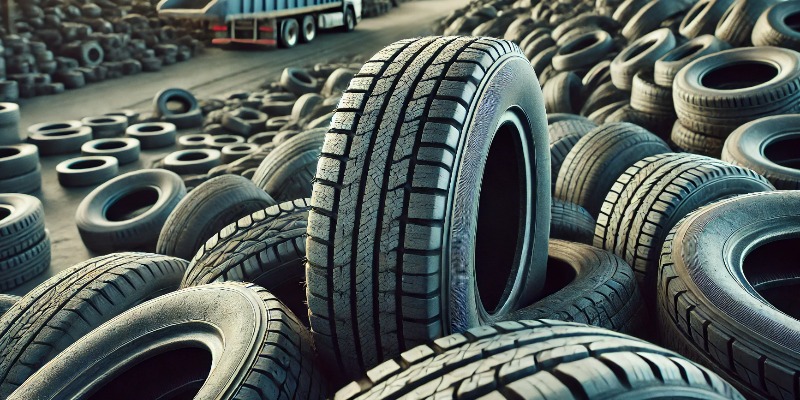
From an environmental impact assessment perspective, numerous international studies underscore the advantages of devulcanization over other recovery methods. Life Cycle Assessment (LCA) methodologies have shown that, although energy and chemicals are consumed, the CO₂ balance often remains positive compared to traditional disposal strategies. Moreover, the potential reduction in waste is of particular interest, as otherwise these materials would add to the burden on landfills and, in the case of end-of-life tires, pose additional risks of pollution and safety hazards (e.g., tire fires).
Main Challenges in Elastomer Recovery and Recycling: From Cross-Linking to Process Selection
One of the most significant hurdles in elastomer recycling relates to the inherent nature of the material. When rubber undergoes vulcanization—a process typically based on the use of sulfur or other cross-linking substances—chemical bridges form that permanently connect the polymer chains. This cross-linking ensures that the rubber maintains its elastic properties even under mechanical stress, but it makes it difficult to separate and “readapt” the polymers once the product reaches its end of life.
From a recycling standpoint, the critical issues to address include:
Compatibility among different materials: Many elastomeric products consist of blends of different rubbers or contain additives and reinforcing agents (such as carbon black, silica, oils, antioxidants). The presence of these components can complicate the recycling process.
Thermal and chemical stability: The high temperatures required by some devulcanization processes can lead to thermal degradation of the polymer chains, generating unwanted by-products and reducing the mechanical properties of the recycled material.
Economic feasibility: Investing in devulcanization plants and technologies needs to make sense from a market perspective. If the cost of recycled material is too high compared to virgin material, the industry might opt for the more economical, though less sustainable, route.
Nevertheless, both regulatory and social pressures toward low-impact environmental solutions favor the research and development of increasingly efficient methodologies. Many countries also offer incentives or impose legal requirements that encourage companies to invest in these processes. In some European regions, for example, there is a requirement to recover a high percentage of end-of-life tires, creating market opportunities for devulcanization technologies.
Devulcanization Techniques: How to Recycle Elastomers Effectively
Devulcanization is a process aimed at breaking the cross-linking bonds in vulcanized rubber, restoring the polymer to a certain “fluidity” and the ability to form new products. This operation must be carried out carefully to limit the degradation of the main chains: the goal is not to destroy the polymer but to selectively act on the bonds that make it excessively rigid and non-workable.
Over the years, several solutions have been proposed—often used in combination—depending on the type of elastomer and the desired outcome:
Mechanical Devulcanization
In mechanical devulcanization, waste rubber is subjected to high shear forces, typically in extruders or mills. The combination of mechanical shear and increased temperature promotes the rupture of some cross-link bonds. Although it is relatively straightforward, this method is not always highly selective: in addition to sulfur bonds, the main polymer chains may also be damaged, compromising some of the final mechanical properties.
Chemical Devulcanization
Another route is to use selective chemical agents—such as organic disulfides, amines, or phosphorus-based compounds—designed to break S-S (sulfur-sulfur) or C-S (carbon-sulfur) bonds. With a good formulation, the polymer network can be “opened” without excessively affecting its structure. However, using these reagents requires caution, as cost, toxicity, and by-product disposal must be considered.
Thermal Devulcanization
Exposing elastomers to high temperatures is a more traditional solution in which heat breaks the cross-linking bonds. This process is fairly widespread but requires careful control of process parameters to prevent excessive thermal degradation. In some cases, it is combined with chemicals or additives to enhance its effectiveness.
Microwave Devulcanization
In recent years, microwave technology has garnered interest due to its ability to selectively heat cross-linked areas containing sulfur. Carbon black, often present in elastomers, also acts as a microwave absorber, facilitating the process. This technique can be more energy-efficient and more selective than conventional thermal methods, though it requires specialized facilities and initial investments.
Ultrasonic Devulcanization
Selective breakage of sulfur bonds can also be achieved via ultrasonic waves, which exert cavitation effects and create localized micro-stresses that disrupt the cross-linked network. The process can occur, for example, in an extruder equipped with an ultrasonic system, but the high cost of this technology has so far limited its large-scale adoption.
Devulcanization with Supercritical Fluids
Some research has shown that using supercritical carbon dioxide (scCO₂) or other supercritical fluids can inflate the polymer structure and facilitate selective bond breakage. This technology is appealing for the low environmental impact of the fluids used (especially in the case of CO₂), but it requires complex, high-pressure equipment and precise control of process parameters.
Sector Studies on Elastomer Recycling: Data and Global Outlook
Various organizations, including the European Tyre and Rubber Manufacturers’ Association (ETRMA) in Europe and the Rubber Division of the American Chemical Society in the United States, regularly publish data and analyses on rubber production volumes and the state of recycling. Globally, the consumption of natural and synthetic rubber exceeds tens of millions of tons per year, with sustained growth rates, especially in emerging markets.
A significant portion of this consumption is tied to tire production, for which recycling and recovery are frequently addressed with specific policies. For instance, the European Union mandates the recovery and recycling of a substantial percentage of end-of-life tires, thereby promoting mechanical grinding, pyrolysis, and, increasingly, devulcanization processes. Many companies have invested in creating actual rubber regeneration plants aiming to achieve properties similar to virgin rubber.
According to the latest reports, when carefully designed, devulcanization methods can achieve a recovery of mechanical performance ranging from about 50% to beyond 70–80%, depending on the type of rubber and the combination of agents used. This means that a substantial portion of elastomer can be reintroduced into production cycles, yielding clear advantages in terms of raw material conservation, energy savings, and overall emissions reduction.
The scientific community regularly publishes studies in journals such as Polymer Degradation and Stability and the Journal of Applied Polymer Science, exploring both the strict chemical-physical aspects of devulcanization and the economic and regulatory frameworks. Research particularly focuses on developing “green” reagents and hybrid technologies (e.g., microwaves combined with chemical or mechanical agents) to further improve efficiency and selectivity.
Conclusions on Sustainability and the Future of Elastomer Recycling
Research and innovation in the field of elastomer recycling—and particularly the development of increasingly effective devulcanization techniques—play a crucial role in the transition toward a circular economy model. The rubber industry, given its strategic importance and high production volume, faces a pressing challenge: reconciling growing demand for elastomeric products with the urgent need to reduce environmental impact.
Devulcanization stands out as one of the most promising methods for giving new life to vulcanized rubber products by recovering part of the material’s original properties. However, it is essential to continue investing in research to refine process selectivity, limit the use of hazardous substances, and achieve mechanical performance ever closer to that of virgin products.
In parallel, designing “easily recyclable” elastomers—from the choice of cross-linking agents to less problematic additives—could prove pivotal, making the entire product life cycle more sustainable. Legislative, economic, and social pressures toward environmental accountability will likely accelerate this transition. In the coming years, we can expect increased collaboration among rubber producers, research centers, and universities, all striving to develop cutting-edge technologies.
This evolution will not only affect industry professionals but also consumers, who may soon find themselves choosing among rubber products manufactured with varying percentages of recycled material. Actively supporting this shift means promoting more responsible resource use, reducing environmental impact, and contributing to a market that is more aware and respectful of the ecosystem.
Ultimately, elastomer recycling through devulcanization techniques appears destined to become a fundamental pillar of a more sustainable production system. With advancements in research, knowledge-sharing, and the implementation of more eco-conscious regulations, we can witness the gradual transformation of the rubber sector into a circular supply chain, able to recover and reuse resources, significantly reducing both waste and CO₂ emissions.
© Reproduction Prohibited