- Evolution of the global recycled plastics market in 2024
- Far Eastern and Indorama: Asian leadership in PET recycling
- Veolia and SUEZ: Europe's circular materials management
- American excellence between HDPE and recycled PP
- New realities in the sector: advanced chemistry and circular startups
- From mechanical recycling to molecular recycling: the chemical revolution
- European rules, Asian investments and international strategies
- Circular economy, ESG, and the quality challenge for 2030
Global Leaders of 2024 and the Race Toward a More Sustainable Chemistry
by Marco Arezio
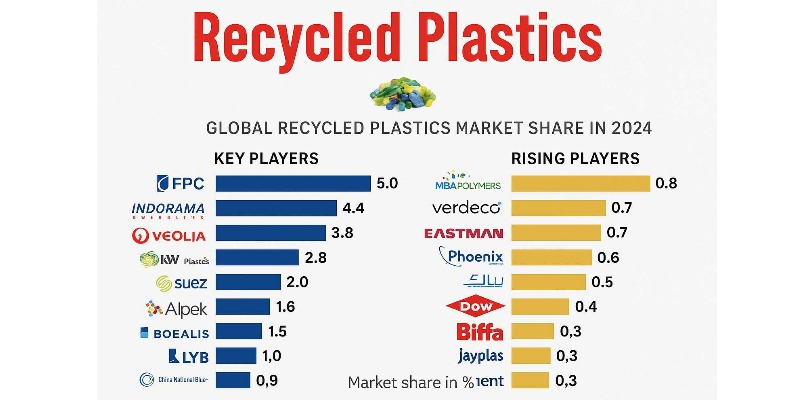
In 2024, the global market for recycled plastics reached a historic turning point. It is no longer a niche sector but a strategic pillar of the global materials industry. The chart illustrates a dynamic landscape where the giants of traditional chemistry coexist with innovative startups and new players driving the green transition.
Market percentages do more than show revenue shares: they sketch an industrial geography in motion, one that shifts investments, technologies, and environmental responsibilities from one continent to another.
Asian Leadership: Far Eastern and Indorama, Two Faces of an Empire
At the top of the list stands Far Eastern New Century, with a 5% share. It is the flagship of Asia in PET recycling—a Taiwanese giant that, over the past decade, has integrated collection, depolymerization, and the production of recycled fibers for textiles and packaging. Its strength lies not only in production capacity but in industrial vision: transforming billions of bottles into resources while maintaining a transparent environmental balance sheet.
Close behind, with 4.4%, is Indorama Ventures, the Thai multinational present in over thirty countries. The company has redefined the concept of PET recycling—not as a secondary activity but as a fully integrated part of the global value chain. Its facilities in Europe and North America demonstrate how post-consumer plastics can become certified feedstock for new industrial cycles.
The success of these two Asian companies reveals that innovation does not originate solely in Western laboratories. Today, Asia is the true engine of industrial recycling, with automated plants, digital waste traceability, and optical sorting processes capable of separating materials with over 99% precision.
Europe’s Environmental Powerhouses: Veolia and SUEZ, the Infrastructure of Circularity
With a 3.8% share, Veolia Environnement remains the emblem of Europe’s blend of industry and environmental policy. Its sorting and plastic regeneration platforms are a model of public-private collaboration, feeding the growing demand for recycled materials in packaging, construction, and the automotive industry.
Just behind, SUEZ (2%) continues to play a crucial role as an integrated environmental service provider. Its strength lies not in the volume of materials processed but in the quality of management and constant monitoring of supply chains. Together, Veolia and SUEZ embody Europe’s circular economy philosophy: every waste stream must find a new function, and every plant must operate within a closed-loop system.

American Excellence: KW Plastics and PolyQuest
Across the Atlantic, KW Plastics (2.4%) and PolyQuest (1.5%) represent American pragmatism applied to recycling.
Based in Alabama, KW Plastics is the largest recycler of HDPE and PP in the United States, specializing in the recovery of industrial containers and household bottles. Quietly but steadily, it supplies raw materials to some of the world’s most sustainable packaging producers.
PolyQuest, on the other hand, focuses on enhancing PET through an engineering-driven approach aimed at performance consistency. Its motto says it all: “same performance, less impact.”
In this segment of the market, the main challenge remains standardization—ensuring that recycled materials have reliable technical properties and can be used on an industrial scale without compromising quality.
The New Players: Where Chemistry Meets Vision
Alongside the major names, the chart highlights a new generation of companies: MBA Polymers (0.8%), Verdeco (0.7%), Eastman (0.7%), Phoenix Technologies (0.6%), SABIC, Dow, Biffa, Covestro, Jayplas, and Altium.
These organizations differ in origin and size, but they share a single goal: to turn waste into value—not out of obligation, but out of industrial vision.
MBA Polymers is emblematic of this evolution. Founded to recover plastics from electronic and automotive waste, it has developed advanced separation and purification technologies that yield high-performance regenerated materials.
Verdeco, with plants in Italy and the United States, stands out for producing food-grade recycled PET, the result of continuous innovation toward molecular purity.
Meanwhile, Eastman, a historic name in American chemistry, has taken the route of molecular recycling—breaking polymer chains into monomers identical to those derived from fossil sources. This is the frontier of chemical recycling, where plastic is literally reborn.
The Chemistry of the Future: Beyond Mechanical Recycling
Today, discussing recycled plastics no longer means talking about grinding and remelting. The new frontier is molecular recovery chemistry, in which plastic is broken down into its fundamental components and rebuilt without quality loss.
This approach—merging materials science with process engineering—is already industrial reality. Companies like Eastman, Borealis, and LyondellBasell are investing billions of dollars in depolymerization and controlled pyrolysis plants, aiming to reduce carbon footprints by up to 60% compared to conventional production.
The difference from the past lies in scale: what once was experimental is now economically viable, thanks to regulatory incentives, extended producer responsibility policies, and rising demand from major consumer brands.
Regulation, Incentives, and the Geopolitics of Recycling
Europe leads the regulatory transition, setting minimum recycled-content thresholds for packaging and bottles. The new PPWR (Packaging and Packaging Waste Regulation) mandates that by 2030 every package must contain at least 30% certified recycled plastic.
Asia, in contrast, responds with infrastructure investment: China, though limiting waste imports, is building an increasingly efficient domestic recycling network; India and Thailand are emerging as manufacturing hubs for regenerated thermoplastics.
In the United States, market forces drive the change—large corporations in the beverage, automotive, and cosmetics sectors are adopting voluntary sustainability goals, making recycling both a reputational and economic strategy.
ESG Investment and the Language of Green Finance
The year 2024 also marked the moment when finance fully recognized the value of recycling. ESG funds now view the regenerated plastics sector as a frontier of clean, measurable growth.
Major chemical companies that once produced only virgin resins are converting their facilities into urban bio-refineries, capable of processing waste and generating high-quality secondary raw materials.
This transformation is no longer peripheral—it is rewriting the very language of industry. Sustainability is no longer a marketing label but a line item on corporate balance sheets.
Toward 2030: The Challenge of Quality and Global Balance
Projections suggest a 7–8% annual growth rate for the recycled plastics market through 2030. Yet the real challenge is qualitative: producing recycled materials that can fully replace virgin ones without functional limits.
Added to this is a significant geopolitical issue—the concentration of recycling infrastructure in just a few regions, creating major imbalances in capacity between Europe, Asia, and Africa.
For the circular economy to become truly global, international agreements will be needed to harmonize rules, certifications, and traceability systems.
Conclusion: From Waste to Resource — A Change of Paradigm
The picture of 2024 reveals an industrial world that, though moving at different speeds, has decisively embraced regeneration.
Plastics are no longer the symbol of pollution, but a testing ground for collective responsibility: transforming what was once waste into something durable, valuable, and sustainable.
Behind every percentage in the chart lies a vision—the vision of a future where matter does not end, but begins again.
© Reproduction Prohibited
Chart by Pristine Market Insights