- Polyoxymethylene (POM): origins and technical properties
- Why POM can replace metals in automotive
- Advantages of virgin POM in automotive applications
- Recycled POM: opportunities and limitations in automotive components
- Practical applications of POM instead of metals in modern cars
- Criticalities and limits of replacing metals with POM
- Selection criteria between virgin POM and recycled POM in the automotive industry
- Sustainability and future: the role of POM in green mobility
When and How Polyoxymethylene (POM), Both Virgin and Recycled, Can Truly Replace Metals in Next-Generation Cars
by Marco Arezio
In recent decades, the automotive industry has undergone a radical transformation in its approach to materials, design, and production processes. At the heart of this silent revolution lies a challenge that goes far beyond simple technical innovation: building lighter, more efficient, and more sustainable cars, without compromising on safety or reliability.
In this context, polyoxymethylene (POM)—in both its virgin and recycled forms—has emerged as an increasingly central player and a valid alternative to metals traditionally used in automotive manufacturing.
Choosing to replace steel and aluminum with high-performance polymers like POM is not just a matter of weight reduction or cost savings. It is a strategic step that involves sustainability, design freedom, and new ways of thinking about product life cycles. Understanding when and how this polymer can effectively take over the functions of metals means delving into an analysis that considers chemical and physical properties, industrial needs, regulations, and, now more than ever, principles of the circular economy.
Why POM? The Origins of a Technical Choice
Introduced to the market in the 1960s, polyoxymethylene—also known as acetal or polyformaldehyde—was immediately recognized as one of the first plastics capable of approaching the performance of metals. Its highly regular and crystalline chemical structure imparts a set of qualities rarely found in other polymers: notable mechanical strength, rigidity, dimensional stability even in humid environments or under variable temperatures, and an extremely low coefficient of friction. The result is a material with a much lower density than metals like steel or aluminum, yet suitable for precision applications where metal components would traditionally have been chosen.
However, the real revolution of POM does not end with its intrinsic properties. Its ease of processing via injection molding allows manufacturers to produce complex components in a single production phase, drastically reducing the costs and time typical of metal machining. This design freedom, together with the possibility to integrate multiple functions into a single part, explains why POM has become so attractive to the automotive industry.
From Weight Reduction to Design Freedom: Advantages in the Automotive World
Replacing metals with virgin POM in modern cars primarily means lightening the vehicle: every kilo saved translates into lower fuel consumption and reduced emissions, a fundamental aspect for compliance with increasingly strict environmental regulations. But weight reduction is only the tip of the iceberg.
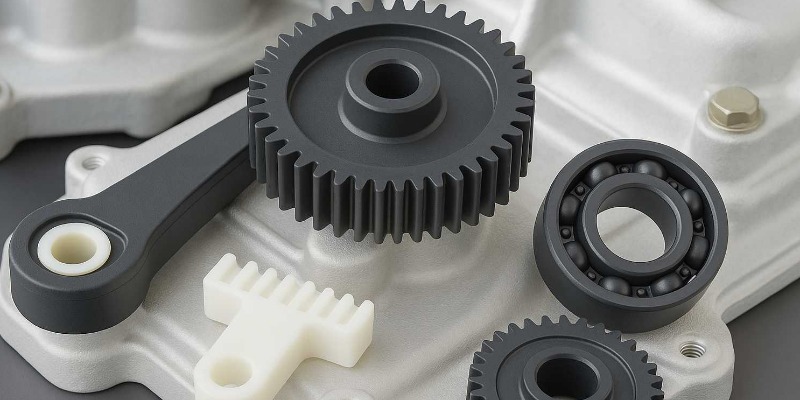
Thanks to its inherent self-lubrication and its resistance to wear and sliding, POM is frequently used to make gears, cogwheels, bushings, and all those components in vehicles subjected to repetitive movement, friction, and small stresses. In these contexts, this technical plastic often performs better than metals, eliminating the risk of corrosion, reducing the need for external lubrication, and contributing to quieter operation.
Another strategic aspect of POM in automotive is related to its insulating properties: unlike metals, polyoxymethylene does not conduct electricity—a valuable characteristic for the safety and reliability of many onboard electronic systems and wiring. In addition, POM’s chemical resistance to fuels, oils, and industrial fluids makes it ideal for use in critical environments, where corrosion is a constant threat to metal alloys.
From a production perspective, the ability to manufacture complex-shaped parts without subsequent assembly reduces both the number of necessary pieces and the risks of defects due to tolerances and mechanical play. This is why, in many cases, automotive manufacturers choose POM for all parts where geometric precision, chemical inertness, and dimensional stability are top priorities.
Where Metal Remains Irreplaceable
Despite its numerous advantages, there are contexts in which POM—even in its most advanced versions—must give way to metals. This occurs, for example, in the presence of very high temperatures: steel and aluminum withstand thermal stresses that would quickly take POM outside its ideal operating range (typically between -40°C and +120°C).
Similarly, where high static loads, superior rigidity, and a reliable response to very intense fatigue cycles are required, metals still guarantee levels of safety and durability that technical polymers cannot yet match. Not to mention that surface treatments such as welding, painting, or galvanizing remain strengths of metal alloys in many body or structural applications.
Still, while there are areas where metal is indispensable, the range of automotive components where POM can be used is rapidly expanding, driven by advances in reinforcement techniques (such as glass fibers) and continuous innovation in production processes.
The Frontier of Recycled POM: Between Circular Economy and Technical Reliability
In recent years, increasing environmental awareness and mounting pressure to reduce the ecological impact of the automotive industry have led to a rise in the use of recycled POM.
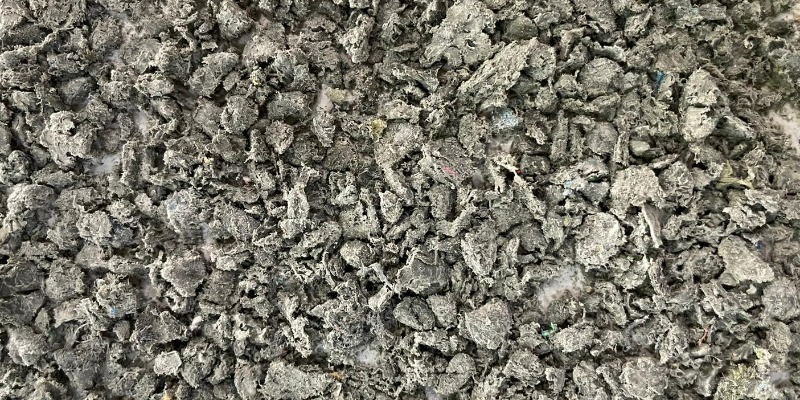
This material, obtained mainly from manufacturing scraps and, to a growing extent, from post-consumer recovery, is a fundamental piece in the journey toward a circular economy.Using recycled POM means reducing the extraction of fossil raw materials and cutting down on the amount of waste to be disposed of, without necessarily sacrificing performance. If the recycling process is well managed and material purity is ensured, many of the mechanical and physical properties remain comparable to those of virgin POM. Unsurprisingly, in less critical applications—such as supports, guides, clips, covers, small levers, and interior components—recycled POM is being increasingly adopted.
From an economic point of view, polyoxymethylene recycling allows automotive manufacturers to lower costs, optimize resources, and respond to market demands and regulations, which impose ever-higher quotas of recycled materials in next-generation vehicles. However, it is essential to pay close attention to the end use: if the stresses are high or particularly tight tolerances are required, virgin material often remains the preferred choice.
Concrete Applications: POM in Action Inside the Car
In practice, there are numerous examples where both virgin and recycled POM have already successfully replaced metal. Notable examples include the gears in windshield wiper motors, cogwheels in seat adjustment systems, bushings in automatic transmissions, cable supports, and dashboard fastening brackets. POM is also now the standard for fuel pumps, carburetor bodies, and many valves, thanks to its resistance to hydrocarbons and dimensional stability even in the presence of humidity and temperature variations.
Many interior control levers, knobs, buttons, and decorative elements are now made from polyoxymethylene, not only for its processability and the ability to obtain smooth surfaces and customized colors but also for its capacity to resist wear and aging without oxidizing or fading. In such cases, the use of recycled POM makes it possible to maintain high performance while simultaneously reducing the environmental impact of the entire production cycle.
When to Choose Virgin POM and When to Opt for Recycled
The decision between virgin and recycled POM is often guided by a careful assessment of operating conditions. Where high mechanical strength, dimensional stability, and safety are required—such as in transmission gears, structural components, or parts subjected to heavy loads and repeated cycles—the virgin version provides the best guarantees.
On the other hand, for all low-risk and lower-stress components, recycled POM is more than adequate, especially if certified and traceable throughout the supply chain. Increasingly, automotive companies are opting for a combination of the two solutions: using recycled material where possible, reserving virgin for the most critical applications, thereby maximizing both production efficiency and the overall sustainability of the vehicle.
Future Prospects: POM Between Sustainability, Innovation, and Design for Recycling
Looking to the future, the replacement of metals with POM exemplifies how the transition to sustainable mobility also depends on material choices. The integration of increasing amounts of recycled polyoxymethylene in next-generation vehicles is no longer just an option, but a necessity dictated by the market, regulations, and, above all, environmental urgency.
The most promising prospects come from ongoing innovation: new purification techniques, advanced separation processes, and the ability to reinforce POM with fibers or additives are expanding the range of potential applications, bringing the polymer ever closer to performance levels once exclusive to metals.
The challenge today is to truly close the circle of the circular economy: to design components that are easy to recycle, to promote collection and recovery at end-of-life, and to ensure that the quality of recycled POM is such that it can be reused even in high-value applications. In this way, replacing metals will be not just about weight or performance, but the concrete symbol of a new era in industrial design—one where innovation and sustainability truly go hand in hand.
© All Rights Reserved
Sources
Celanese, Polyplastics, BASF – POM technical datasheets
“Lightweight Solutions for Automotive Industry: Metal Replacement with POM” – Automotive Plastics (2023)
Plastic Europe – Polyoxymethylene: Technical Guide
Society of Plastics Engineers (SPE) – Papers on POM recycling
“Metal Replacement in Automotive Components Using Engineering Plastics”, Journal of Polymer Engineering (2022)
Circular Economy in the Automotive Sector: State of the Art – European Commission (2021)
OEM Applications for Recycled Engineering Plastics – Automotive World (2023)