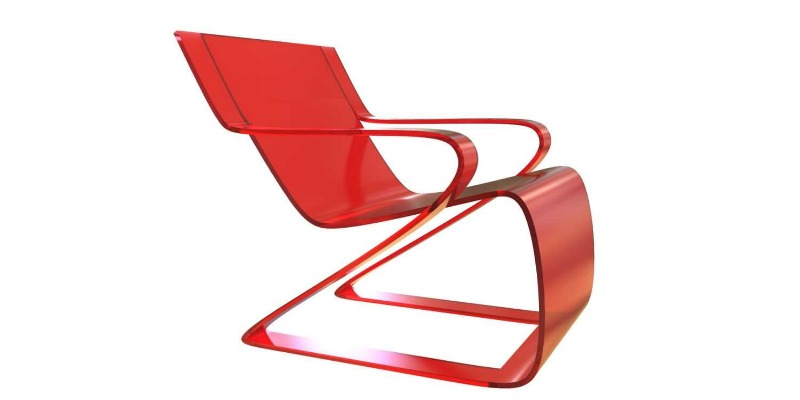





- What is PMMA plastic polymer
- What are the characteristics of PMMA
- How PMMA is worked
- Applications of PMMA
- How to recycle PMMA
PMMA characteristics, processes, applications and recycling systems
PMMA, or Polymethylmethacrylate, is a thermoplastic resin belonging to the group of technopolymers, obtained from the polymerization of methacrylate (MMA).
It is commonly considered an acrylic glass, as it boasts a better transparency than traditional glass, so much so that in many applications it has been replaced by PMMA.
The history of PMMA began in 1938 when in Germany, by Otto Rohm, the first product called plexiglass was placed on the market.
As we said, it has the evident characteristic of transparency, but it can maintain, unlike glass, also an excellent mechanical resistance, which is achieved thanks to different polymeric compounds, so much so that it is also used for the production of safety glass.
What are the characteristics of PMMA
• density: 1.18 - 1.19 gr / cm3
• melting temperature Tm: 105-160 ° C
• glass transition temperature Tg: 80-105 ° C
• good rigidity
• mechanical strength
• high impact resistance and hardness.
• good tensile strength
• good compression and bending values
• high UV stability
• excellent resistance to aging
• sensitivity to scratches and abrasions
• good weather resistance
• excellent optical properties, clarity and transparency
• excellent electrical properties
• good thermal resistance
• chemical resistance to salts
• resistance to aliphatic hydrocarbons
• does not resist chlorinated hydrocarbons, concentrated acids, nitro and paints
How PMMA works
Polymethylmethacrylate can be processed through extrusion and thermoforming, which represent two processing systems for traditional plastics.
There is a third one, called by pouring, which is normally used for the production of PMMA sheets, using an acrylic paste, called "syrup", obtained pre -polymerizing the MMA monomer in a reactor by stirring.
PMMA Applications
Polymethylmethacrylate has a very wide range of applications, in different sectors and with countless products that we could summarize below:
Construction
sheets for doors and windows
unbreakable windows
skylights
bathtubs
shower trays
shower enclosures
cabins for medical use in general
elements of pools
sinks
honeycomb sheets for greenhouses
Lighting
outdoor luminous signs
traffic signs
advertising plates
bright letters
illuminated plaques for instructions
Transport sector
car lights
reflectors
speedometer discs
warning triangles
flashing lights
windshield for aircraft and space uses
Medical sector
filters
parts of dialysis equipment
containers for blood
orthopedic applications
dental prostheses
cosmetic packaging
lenses
Electrical and electronics industry
switches
command buttons
optical memorizers
CD and DVD
displays for mobile
fiber optic elements
How to recycle PMMA
The recycling of Polymethylmethacrylate begins with the collection and selection of end-of-life products or scraps of industrial processes, differentiating them according to the color so to create homogeneous sources between them.
At this point there are two recycling systems: the mechanical one, like a normal polyolefin, and the chemical one, which aims at the depolymerization of PMMA.
Using mechanical recycling, the material to be recycled is ground into suitable dimensions for subsequent use and reintroduced into production, for example slabs, through the thermal process induced by an extruder.
Using chemical recycling, the PMMA waste will undergo a depolymerization process, which consists in the dissociation of the molecules of the material to be recycled.
After appropriate purification, MMA is generated, which, through a polymerization reaction, gives life to the new 99% pure rPMMA polymer.
The cycle is completely zero impact, as the process is carried out in a closed circuit and all the by-products of this chemical process are reused within the production cycle .
The disadvantage of chemical recycling is that at the end of the process there will be a less translucent rPMMA, having a high recycling cost and an important energy consumption.
Common trade names for PMMA
Acridite
ACRYLITE
Acryvill
Altuglas
Amanite
Cyrolite
Green Cast
LuciteOptix
Oroglas
Perspex
Plexiglas
R-Cast
Setacryl
Crylux
TrespexZylar
Automatic translation. We apologize for any inaccuracies. Original article in Italian.