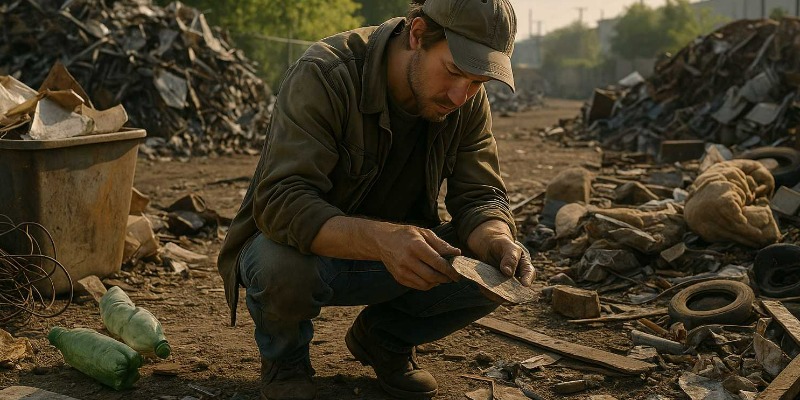
This chapter explores the concrete origins of recycled materials for art, taking us back to the places where discarded matter is born, mutates, and awaits a new opportunity. Streets, with their ephemeral fragments, reveal the rapidity of urban consumption; landfills demonstrate the collective dimension of excess; factories narrate labor through production waste; homes preserve intimate scraps, charged with memories.
As the artist moves through these landscapes, she learns to see what others ignore: the hidden energy of discarded objects. Collecting thus becomes a critical, meditative, and sensorial gesture, a way to interrogate society through its material traces. Each chosen fragment is not merely a residue, but the possibility of a new narrative, a different future for what was left behind.
A Journey into the Origin of Waste and the Artistic Search for Materials that Reveal How We Live
Essay. New Material. Chapter 10: Geographies of Recycling Across Streets, Landfills, Factories and Homes
Seeking material means, above all, learning how to see. Not seeing as we usually do—distractedly—but seeing as someone who knows that every object, every fragment, every residue contains a story, an origin, a context. Before becoming part of an artwork, recycled material is a piece of the world, a trace of how we live. Recycling is not born in laboratories or studios: it is born outside, on the streets, on the edges of cities, in factories, in abandoned spaces or in private homes where unused things slowly settle in silence. It is in these places that the artist learns to recognize what has value, what carries a voice, what can be transformed.
The geography of waste is not random. Each place generates a different type of residue, a material that reflects the specificity of that environment. Streets, for instance, produce immediate, frenetic waste marked by speed. Objects found on asphalt—a cracked bottle, a worn screw, a piece of plastic deformed by heat—bear witness to the fast life that passed over them. Here, material does not settle: it passes through. It is matter that has known urgency, unpredictability, instant abandonment. Artists who gather materials in the streets must be quick, attentive, able to seize what appears only for a few hours or days. In cities, waste is fleeting: what appears today is gone tomorrow, absorbed by the logic of cleaning, sweeping, reorganizing.

Landfills, on the other hand, are landscapes of saturation.
Here, waste is no longer individual, but mass: mountains of compressed, stratified, accumulated material with no hierarchy. There is no longer the delicacy of the single item, but the power of a collective excess. The landfill is a magnified mirror of our habits: everything we chose not to repair, everything we consumed in excess, everything we removed from our sight still lives there, in a horizon that seems endless....