- What does neo-medievalism mean in contemporary culture?
- Why the Middle Ages are still fascinating today: symbols and imagery
- Modern Medieval Fashion: Between Gothic Aesthetics and Sustainability
- The Renaissance of Medieval and Folk Music in the Pop Scene
- Medieval-Inspired Festivals and Communities in Europe and Around the World
- Slow life and craftsmanship: living today according to medieval values
- Neo-medievalism as a reaction to technological saturation
- The Middle Ages reinterpreted: between fantasy, history and the need for identity
Discover the Phenomenon of Neo-Medievalism: A Cultural Trend Reviving Medieval Aesthetics, Sounds, and Values in Fashion, Music, and Lifestyle
by Marco Arezio
In the heart of a society dominated by algorithms, instant notifications, and increasingly pervasive artificial intelligence, an unexpected cultural movement is emerging: neo-medievalism.
This growing trend is rooted in a romantic and selective rediscovery of the Middle Ages.
However, it is not simply a historical revival or nostalgic fascination—it is a true counter-narrative, offering an antidote to today’s ultra-connected, hyper-technological world.
Neo-medievalism expresses itself in various, often surprising ways: from fashion to music, from fantasy literature to everyday life, even through entire communities inspired by the values and aesthetics of the medieval era.
But why the Middle Ages, exactly? And what does this phenomenon say about our time?
The Fascination of the Middle Ages: Aesthetics, Symbols, and Myth
In contemporary collective perception, the Middle Ages are no longer viewed solely as a time of war, famine, and superstition. Instead, the era has become a symbolic container of “alternative” values in contrast to the present: community, craftsmanship, spirituality, nature, and individual heroism.
This idealization—also shaped by chivalric literature, modern fantasy, and successful cinematic productions—has generated a shared imaginary where Gothic cathedrals, shining armor, and modal melodies offer a captivating escape from contemporary alienation.
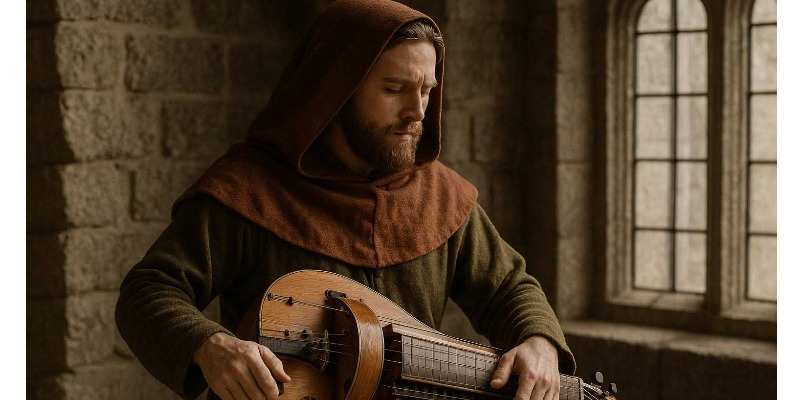
Aesthetically, neo-medievalism draws on familiar elements: velvets, chainmail, heraldic symbols, runes, hunting horns, illuminated manuscripts, and musical instruments like the hurdy-gurdy and psaltery. In fashion, there is a growing trend toward clothing inspired by the Middle Ages, reinterpreted with natural fabrics and cuts reminiscent of monks, pilgrims, or knights.
Music That Tells of Ancient Times
The phenomenon resonates powerfully in music as well. Bands such as Faun, Wardruna, Corvus Corax, and the better-known Dead Can Dance have contributed to the creation of a neo-medieval sound that blends ancient instruments with electronic tones and ethereal atmospheres.
Medieval music—or rather its contemporary reinvention—becomes the soundtrack for a generation in search of the sacred, the ritual, and epic, collective storytelling, far from the frantic rhythms of pop and mainstream.
At festivals such as the Wave-Gotik-Treffen in Leipzig or Italy’s Castello Festival, audiences immerse themselves in a world where identity is rebuilt through ancestral symbols, historical costumes, and age-old songs and dances.
Even video games, with sagas like The Witcher, Dark Souls, and Kingdom, kingdom Come Deliverance, reinforce this imagery, offering immersive worlds where the medieval dimension is reimagined through artistic, philosophical, and social lenses.

Living Like in the Middle Ages: Between Slow Life and Reenactment
Yet neo-medievalism goes beyond aesthetics. In some cases, it becomes a true philosophy of life.
In a world that pushes for automation and artificiality, there is a growing interest in artisanal practices such as hand weaving, leatherwork, Gothic calligraphy, and beekeeping using traditional methods.
The concept of slow life is closely tied to this rediscovery: living slowly, reconnecting with the long time of creation, valuing direct relationships, and syncing with the natural rhythm of the seasons.
There are communities—especially in Northern Europe and the United States—that draw on medieval values in their social organization as well, proposing models based on communal living, gift economies, and self-sufficiency.
It’s not a return to barbarism, but rather a silent—and sometimes poetic—critique of an over-industrialized modernity.
The answer to technological saturation
But what really drives a growing number of people to look to the Middle Ages as a reference model? At the base there is a technological saturation that generates disillusionment and weariness. The promise of an increasingly connected, efficient and digital future clashes today with the reality of an anxious, isolated society, often lacking strong symbolic references.
Neo-medievalism therefore represents a form of cultural resistance. Not so much a rejection of technology in itself, but a desire for balance. A need to recover elements of concreteness, manual skill, transcendence and ritual that contemporaneity has often sacrificed on the altar of productivity.

An imagined, but significant, Middle Ages
It must be said that the Middle Ages that inspired this movement are often a romantic invention, a period reconstructed more in dreams than in history books. But this does not reduce its symbolic value. After all, every era builds its own past to suit its own needs. And today, in a present that runs too fast, the Middle Ages appear as a distant but reassuring time, in which to rediscover what modernity has left behind.
From this perspective, neo-medievalism is not a simple passing fad, but a profound signal of an ongoing cultural change. A return to the origins that, paradoxically, could help us imagine a more humane future.
Conclusion
Neo-medievalism, with its symbolic armor and its ideal banners, reminds us that in the race towards the future it is still possible - and perhaps necessary - to look back.
Not to really go back, but to rediscover, in the past, the tools to build a more authentic present. In a world that has made the virtual its new reality, the call of stone towers, ancient melodies and shared values resounds like a bell that invites us to wake up. Perhaps it is not an escape from the modern world, but an attempt to find a lost balance.
© Reproduction prohibited