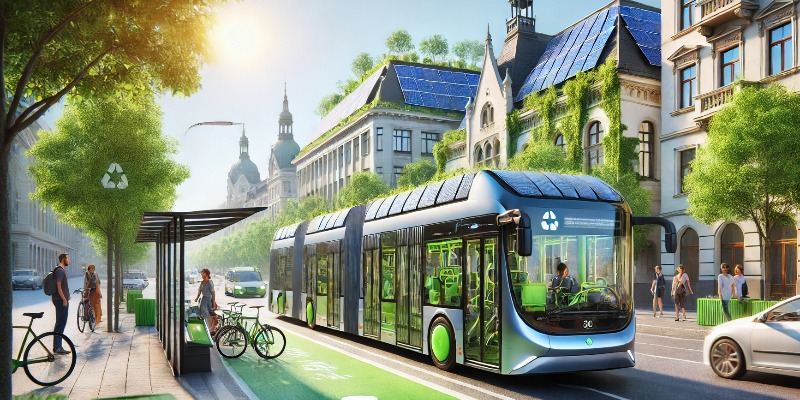





- Mobility of the Future: Circular Economy in Public Transport
- CE4CE and E-MED: Two European Projects for Sustainability
- How the Circular Economy Transforms Public Transport
- Recycled Materials and New Buses: Towards 2030
- Artificial Intelligence at the Service of Teb Trams
- Energy Efficiency and Waste Reduction in Transport
- Atb and the Example of Sustainable Mobility in Bergamo
- Green Transport: A Replicable Model for European Cities
Two European Projects Revolutionize Transportation by Focusing on Sustainability, Efficiency, and Technological Innovation
By Marco Arezio
Public transportation is undergoing a silent yet profoundly transformative revolution. The introduction of practices tied to the circular economy, as demonstrated by the European projects CE4CE and E-MED, is changing the way cities address the challenges of urban mobility. In this context, Atb (Azienda Trasporti Bergamo) has decided to become a leader in this transformation, striving to make public transportation more sustainable, efficient, and resource-conscious.
The essence of these projects lies in the ability to rethink not only how vehicles are used but also how they are built and managed throughout their lifecycle. Sustainability, therefore, is no longer an abstract concept but a concrete strategy taking shape through international collaboration and the use of cutting-edge technologies.
Transforming Transportation with CE4CE and E-MED
The CE4CE and E-MED projects are two shining examples of how Europe is investing in a more sustainable future. The first, CE4CE (Circular Economy for Circular Economy), focuses on reducing waste and reusing materials, promoting a circular approach that turns waste into resources. Through this program, old buses are meticulously analyzed to recover materials and components that can be reused in the construction of new vehicles, thus reducing the need for virgin resources and the volume of materials sent to landfills.
E-MED, on the other hand, focuses on sustainability by optimizing infrastructures and the vehicles themselves. One of its primary goals is to improve the energy efficiency of public transportation, reduce emissions, and ensure a more sustainable service for the cities of the future. Thanks to this project, Atb has planned to purchase 65 new buses by 2030, selecting vehicles designed to meet the highest standards of energy efficiency and environmental impact.
A New Life for Materials
One of the most innovative aspects of these projects is the approach to waste management. In a circular economy perspective, materials such as steel or plastics from old vehicles are recovered and used in the construction of new structures without compromising safety or quality.
This approach not only reduces the environmental impact of the sector but also generates significant economic savings, proving that sustainability can go hand in hand with financial efficiency.Technology and Artificial Intelligence: A New Era for Trams
Technological advancements play a key role in this transition. For instance, on the Teb tram line, artificial intelligence is used to monitor vehicle conditions in real time, predict breakdowns, and optimize maintenance operations. This type of innovation not only improves service quality but also helps reduce energy consumption and environmental impact, making public transportation an increasingly competitive alternative to private car use.
Moreover, through artificial intelligence, it is possible to analyze urban traffic flows to optimize routes and travel times, cutting energy waste and enhancing the user experience. This is a concrete example of how technology and sustainability can work together to create intelligent and forward-thinking solutions.
The Goal: Sustainable Mobility by 2030
The target is clear: by 2030, Atb aims not only to drastically reduce waste and increase the use of recycled materials in its vehicles but also to create a sustainable mobility model replicable in other cities. The company’s commitment, alongside its European partners involved in the CE4CE and E-MED projects, shows that the future of mobility cannot be separated from environmental sustainability and technological innovation.
Toward a Greener Future
Atb's participation in these European projects is not just a step forward for the city of Bergamo but a virtuous example for all urban realities aiming to embark on the path of sustainability. Reducing the environmental impact of public transportation is a complex challenge, but the results of initiatives like CE4CE and E-MED demonstrate that this challenge can be turned into an opportunity to build a greener future.
In a world increasingly aware of the urgency of tackling climate change, projects like these offer a concrete glimmer of hope. It’s not just about reducing emissions or saving resources, but about redefining the very concept of mobility, making it more respectful of the planet and future generations.
© Reproduction Prohibited