- Physical principles of the use of microwaves in wood treatment
- Wood-boring insects and damage to wooden artefacts
- Why choose microwaves for wood disinfection?
- Analysis of physical parameters in microwave treatment
- Thermal risks and humidity control in treatments
- Experimental results of the study by Ricci et al.
- Applications in cultural heritage and wood restoration
- Limitations, critical issues and future developments of microwave technology
The study analyses microwave treatments as a non-invasive method for the conservation of wooden artefacts
by Marco Arezio
The conservation of wooden heritage, both historical and functional, represents an increasingly complex challenge for restorers, conservators, and wood industry professionals. Attacks by wood-eating insects—such as anobiids, longhorn beetles, and lyctids —can structurally damage works of art, antique furnishings, and architectural components, requiring rapid, effective, and non-invasive interventions.
The study "Wood disinfestation treatments using microwaves" fits into this context, analyzing the use of high-frequency electromagnetic waves as a promising alternative to traditional techniques.
The physical principle of the microwave effect
Microwave technology exploits dielectric heating, the ability of electromagnetic waves (at frequencies around 2.45 GHz) to penetrate materials containing polar molecules—such as the water present in wood and the biological tissues of insects—inducing a uniform increase in temperature. This internal heating allows for selective and controlled temperatures to be reached that are lethal to biological pests without compromising the integrity of the artifact.
Xylophages and wood vulnerability
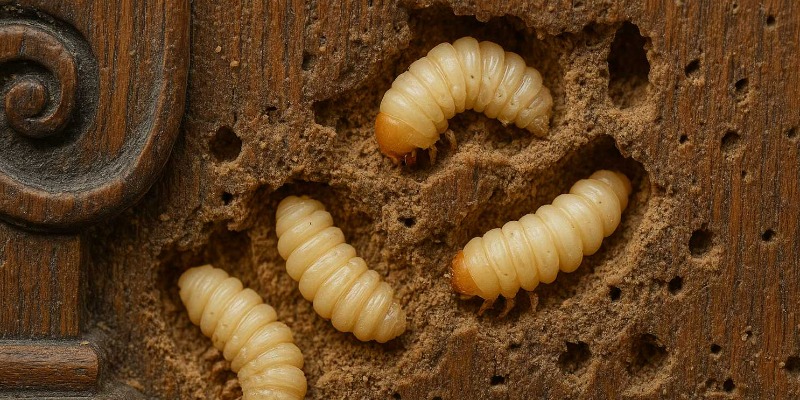
Wood-boring insects feed on the cellulose and hemicellulose present in wood fibers, burrowing into tunnels that weaken the material's structure. Infestations often develop insidiously and silently, making early detection of damage difficult. Traditionally, chemical or thermal treatments have been used, often invasive and not without side effects, both for the operator and the treated asset. Microwaves, however, offer an alternative approach that minimizes chemical interaction and optimizes thermal selectivity.
The advantages of microwaves as a non-invasive treatment
The use of this treatment highlights a series of advantages in microwave disinfestation:
- Deep and effective penetration even in solid wood;
- Thermal uniformity with respect to external heat sources;
- Absence of chemical residues, making the method compatible with the conservation of cultural heritage;
- Reduced processing times, to the benefit of productivity;
- Possibility of precise control of operating conditions (time, power, temperature, relative humidity).
In particular, the experimental approach allowed us to optimize the heating curves to maximize larval mortality without causing mechanical or aesthetic alterations in the wooden substrate.
Physical and thermal parameters to be monitored
One of the most delicate aspects of microwave treatment is managing heat distribution. Dielectric heating is not always uniform, especially in the presence of knots, cracks, or defects that alter the local density of the material. Furthermore, the moisture content of the wood significantly influences energy absorption. The team of researchers behind the system worked on experimental models and thermal simulations to avoid hot spots that could char the surface or cause deformation.
A protocol was thus developed in which the target temperature for eliminating insects is around 55-60°C for a few minutes, a parameter considered lethal for the larvae but tolerable for the wood.
The role of humidity: a crucial variable
The water content of wood plays a key role in the effectiveness of the treatment. Dry wood, with a moisture content of less than 10%, is more difficult to treat because it is less sensitive to dielectric heating. Conversely, moist wood risks overheating too quickly, potentially damaging the structure. It is therefore essential to calibrate the microwave power according to the wood species, water content, and thickness of the wood. In the study, the researchers integrated wireless thermal probes and IR thermography systems to monitor internal temperature trends in real time.
Experimental data and analysis of results
The researchers' experimental work involved wood samples infested with Anobium punctatum larvae. Tests demonstrated 100% larval mortality even with short-term treatments (about 3–5 minutes) at moderate power (700–1000 W), with no visible damage to the wood structure. Subsequent mechanical and microscopic analysis confirmed the stability of the treated wood's physical properties. Furthermore, FTIR spectroscopy highlighted the absence of significant chemical changes in lignin and cellulose, demonstrating the method's gentle nature.
Applications in cultural heritage: a new frontier
One of the most promising areas for microwave technology is the conservation of wooden cultural heritage, such as altars, frames, antique chairs, wooden statues, and historic architectural beams. In these contexts, it is essential that the treatment does not alter the color or surface finish of the material. The method's effectiveness, combined with its selectivity and compatibility with indoor environments, makes it an ideal tool for on-site intervention, avoiding the need to dismantle or transport the work.
Critical issues and future developments
Despite the positive results, the study highlights some critical issues. First, the need for specific equipment, which is still not widely available on the market. Furthermore, operator training is key to avoiding application errors. Finally, safety regulations regarding electromagnetic wave emissions require shielded environments and specific controls. However, the prospects for integration with smart sensors and automation systems open up very interesting scenarios for rapid, safe, and documentable treatments, even on a large scale.
Conclusions
Microwave wood disinfestation appears to be a mature, promising technology that respects the treated material. Thanks to the study by Stefano Ricci and colleagues, we now have a solid scientific basis for developing innovative and sustainable practices in the restoration and maintenance of wooden artifacts. This method combines physical precision, respect for the material, and biological efficacy, contributing to a new culture of conservation.
© Reproduction Prohibited