




- What would daily life be like without plastic?
- The domestic challenge: living in a plastic-free house
- Transport and mobility without synthetic materials
- Smartphones and plastic-free technology: what really changes
- Plastic-free medicine: between safety and slowdowns
- Food storage without plastic containers
- Plastic-free cars and vehicles: impact and consequences
- Clothing and furnishings without synthetic fibres and components
How Would Daily Life Change If Plastic Were Completely Eliminated?
by Marco Arezio
Imagining a world without plastic is not easy. Plastic is a material that has revolutionized nearly every aspect of our daily lives—from the kitchen to transportation, from medicine to communications. Eliminating this material entirely would mean facing practical challenges and unexpected difficulties, often underestimated.
In this realistic account, we explore—through the everyday lives of Elena and Matteo—what real changes would result from a forced return to the materials used before plastic became widespread. Their experiences offer tangible insights for personal reflection: would it truly be sustainable to live without plastic?
The Domestic Challenge
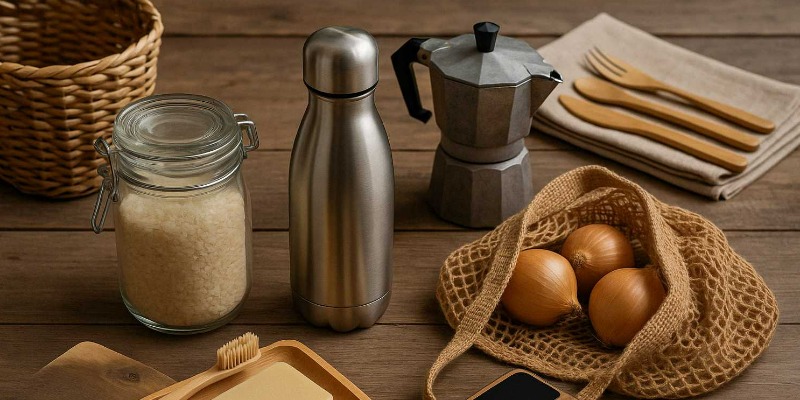
Elena watched the aluminum moka pot hiss on the induction stove, trying to ignore the annoyance caused by the longer coffee prep time since plastic capsules had disappeared. They had tried compostable alternatives, but none proved as practical or economical as the old capsules.
Home appliances, now free of plastic components, presented numerous inconveniences: the refrigerator was heavier and consumed more energy due to thermal insulation made from less efficient natural materials like cork and pressed plant fibers.
Even the internal containers and shelves, made of glass and metal, were fragile and required extra care in daily use. Opening the fridge, Elena carefully grabbed a heavy glass bottle of milk, trying not to drop and shatter it—a mishap that had occurred more than once—further highlighting the practical difficulties of this imposed transition.
Mobility and Transportation
Matteo left early to cycle to work, pedaling with difficulty due to natural rubber tires, heavier and less reliable than synthetic ones. Punctures were frequent, especially in the cold, forcing him to always carry a repair kit—an added daily inconvenience.
Elena, boarding the tram to the office, clearly noticed the impact of the change. The seats, padded with plant fibers, were worn out, uncomfortable, and sometimes emitted unpleasant odors on humid days.
Paper tickets, without their usual plastic protective coating, quickly deteriorated and became nearly unreadable within a few hours. Even the shelters at the stops, now made entirely of metal and glass, offered little protection from the sun and were freezing in winter and scorching in summer, increasing passenger discomfort.
Communication and Technology
Elena handled her smartphone with extreme care, protected by a sturdy leather case that made it difficult to use the glass screen—noticeably more fragile and prone to cracking.
She knew that, without plastic, smartphones had changed dramatically: printed circuits on ceramic or metal substrates, electrical insulation using natural or mineral-based materials, and waterproof seals made of natural latex or wax made these devices highly sensitive to humidity and temperature changes.
All of these factors significantly increased production complexity and operational fragility, resulting in high maintenance costs and drastically limiting their distribution and economic accessibility.
Medicine and Safety
In the hospital where Matteo worked as a nurse, the difficulties were especially severe. Syringes, catheters, and transfusion bags—now made of glass or natural latex—had made every procedure significantly slower, more delicate, and riskier.
Sterilizing and carefully managing medical materials took longer and required more complex techniques. Constant concerns about accidental breakage, content loss, and contamination risks led to the implementation of extremely strict health protocols. Staff had to attend frequent training courses, further increasing daily stress, responsibility, and inevitably, operational costs for the healthcare facility.
Food Preservation
At home, even the kitchen had become a real challenge. Glass and metal containers were heavy and fragile, difficult to handle especially when full or frozen. Freezing food became problematic, as natural rubber seals deteriorated quickly with frequent use and the intense cold of the freezer.
Furthermore, the absence of airtight plastic containers made storing delicate or easily perishable foods more difficult, increasing the risk of food waste. Elena sighed every time she had to store leftovers or prepare meals for freezing, longing for the lightness, safety, and convenience of a simple plastic container.
Vehicles and Sustainability
In both private and public transportation, the consequences were evident. Cars, now built exclusively with components in metal, glass, and natural fabrics, were heavier and less energy-efficient. The biggest challenge was the tires: made from natural rubber reinforced with plant fibers, they were less wear-resistant, less safe when braking, and more prone to punctures.
Additionally, building critical components like dashboards and electrical insulation without plastic added complexity, making vehicles more expensive and less safe.
Clothing and Furniture
Clothing had also undergone a radical change. Synthetic fabrics like polyester, nylon, elastane, and acrylic had disappeared, forcing the fashion industry to rely exclusively on natural fibers such as cotton, linen, wool, silk, and hemp.
While more breathable, these materials were less durable and more sensitive to weather conditions. Clothes tended to shrink, lose shape, or fade more easily, requiring delicate washing and frequent repairs.
The absence of technical fabrics made it difficult to produce sportswear and waterproof clothing: raincoats were made of waxed canvas or treated wool—heavier and less effective. Shoes and accessories were sewn with leather, felt, or wood—more expensive and less durable.
Home furnishings reflected this transformation. Chairs, tables, and shelves were made from solid wood, metal, or woven materials, but the absence of plastic joints and coatings made furniture heavier, less modular, and harder to move or adapt to different spaces.
Cushions were filled with carded wool or vegetable fiber, requiring more complex maintenance than synthetic foams. Sofas, while elegant in their simplicity, offered less comfort and deformed easily. Even rugs and curtains were made of coarse natural fibers, harder to clean and less resistant to time and light.
Home Technology
Home technology had also lost much of the practicality people were accustomed to. Cables and insulation, now made from natural materials like natural rubber, waxed cotton, or woven plant fibers, were noticeably bulkier, less flexible, and highly vulnerable to wear, moisture, and heat.
Their maintenance required constant care, as they were more prone to breakage and accidental short circuits, making it complicated—and often frustrating—to use computers, electronic devices, or manage a reliable home network.
Conclusion
At the end of the day, Elena and Matteo sat in silence, worn out by a daily routine that had become more complex and less convenient. The unspoken question was clear in their eyes: was it truly possible—and sustainable in the long run—to live completely without plastic?
It was a reflection every citizen would have to face, personally and intimately, quietly evaluating the sustainability and sacrifices demanded by such a radical choice.
© Reproduction Prohibited