- Smart lighting: how to reduce consumption at home
- LED bulbs and light quality for energy saving
- Efficient household appliances: choosing and using new models
- Stand-by and hidden consumption: how to eliminate them easily
- Thermal insulation and fixtures: interventions that make the difference
- Smart heating and cooling: comfort and savings
- Home photovoltaics and storage batteries: advantages and solutions
- Sustainable habits in the family: small gestures, big impact
From good habits to smart solutions: how to cut consumption, reduce costs and live better every day within your own four walls
by Marco Arezio
Energy saving has become, today more than ever, a priority. The awareness of how much each single choice inside our home can impact bills and the environment is growing, pushing us towards a new way of living: more attentive, more sustainable, more intelligent. It is not about depriving ourselves of comfort, but about learning to live it differently, choosing solutions that combine efficiency and well-being.
The journey towards a greener home starts with attention to detail, the adoption of innovative technologies, and above all with small habits that, over time, become a lifestyle. This guide takes you step by step through advice, strategies and technological solutions, to reduce consumption without sacrificing the quality of domestic life.
Smart Lighting: From LED to Home Automation, the First Step Towards Savings
Lighting is one of the easiest aspects to optimize to obtain immediate and concrete savings. The arrival of LED bulbs has revolutionized the sector: they consume up to 80% less than traditional incandescent bulbs, last tens of thousands of hours and produce less heat, improving both safety and the quality of light in environments.
But today the real innovation comes from smart lighting: light bulbs and systems that connect to wireless networks, controllable via apps, voice assistants or sensors.
You can program lights to turn on and off based on time or presence at home, adjust the intensity of the light depending on activities (a warm light for relaxing in the evening, a colder one for cooking or studying), and even choose from millions of colors with a simple tap on your smartphone.
Another fundamental aspect is the quality of the light. Choosing light bulbs with a high color rendering index (CRI) helps to avoid visual fatigue and enhance the real colors of the house. Choosing the right color temperature makes every room more welcoming: a warm light (2700-3000K) in the living room and bedroom promotes relaxation, a neutral light (4000K) is perfect for the kitchen and bathroom.
Integrating home automation allows you not only to control each light point remotely, but also to monitor consumption in real time and identify any waste. In addition, motion sensors in passageways, such as corridors or entrances, prevent lights from being left on unnecessarily, reducing waste automatically and discreetly.
New Generation Appliances: Efficiency, Intelligence and Savings
After lights, the big players in domestic energy consumption are household appliances. The new generation of refrigerators, washing machines, ovens and dishwashers are designed to offer maximum performance with minimum energy expenditure.
The first rule to really save is to choose highly efficient devices, recognizable by the new European energy label (from 2021, from A to G). A refrigerator in class A, for example, consumes even half of one in class D. But it is not just a question of class: today the appliances are equipped with sensors and intelligent algorithms that adapt cycles, temperatures and times based on the real load, avoiding unnecessary waste.
Smart washing machines and dishwashers precisely measure water and detergent, automatically adjust cycle times, and can be programmed to run during times when energy is cheapest or when solar panels are producing the most.
Modern refrigerators monitor internal temperature and humidity, alerting you if the door is left open too long, and managing compressor cycles more efficiently.
Another invisible enemy in the home is standby consumption: many appliances continue to absorb energy even when turned off, ready to be turned on quickly. Smart sockets, multi-socket power strips with a switch, or home automation systems that cut off the power to unnecessary devices help eliminate this silent waste, which can represent up to 10% of the bill.
Finally, do not underestimate the importance of maintenance: regularly cleaning the filters of washing machines, dishwashers, air conditioners and defrosting refrigerators allows them to keep efficient for longer, reducing consumption and breakdowns.
Insulation and Windows: Keeping the Heat Where You Need It
Often, real energy savings start from the very structure of the house.
Good thermal insulation of the walls, roof and floors prevents heat loss in the winter and protects from the heat in the summer, reducing the need to turn on heating or air conditioning.Replacing old window frames with double or triple glazed windows, equipped with high-performance seals, eliminates drafts and improves living comfort.
Even small changes, such as sealing cracks and installing thermal curtains, can make a significant difference, especially in older homes. Insulating your home not only cuts costs, but also increases the value of your property and improves your quality of life.
Smart Heating and Cooling: Comfort and Savings All Year Round
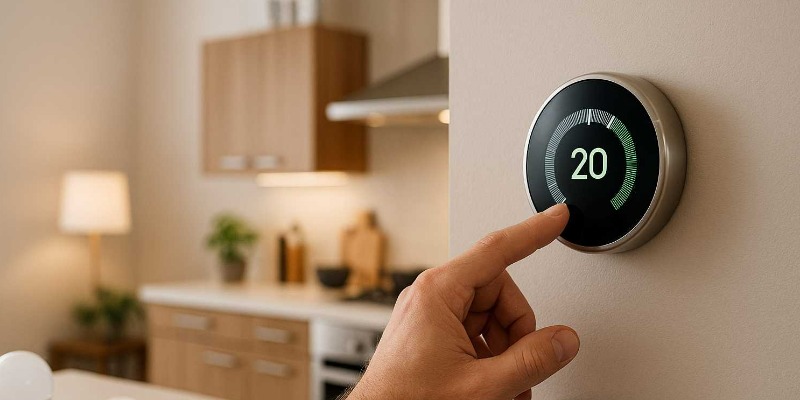
Heating and cooling often represent the largest share of household consumption. Here, technology offers increasingly advanced solutions: from smart thermostats to chronothermostats, from digitally controlled radiators to high-efficiency heat pumps.
Smart thermostats learn from the habits of those who live in the home, adjust the room temperature in a personalized way and allow remote control via app.
A well-managed system can lower your bill by 20-30% without sacrificing comfort. Furthermore, setting lower temperatures during the night or when the house is empty, or using solar screens in the summer, are simple measures that drastically reduce consumption.
Photovoltaic and Home Automation Solutions: The Ever Smarter Home
The real revolution came with integrated home automation and the possibility of producing clean energy on your own. Home photovoltaic systems, combined with storage batteries, allow you to self-produce energy and use it when you need it most, cutting costs and reducing dependence on the electricity grid.
Home automation management is not limited to just lights or appliances: you can monitor consumption in real time, program each appliance based on solar production or the most convenient rates, remotely check the status of the systems, receive notifications and suggestions to optimize energy use.
The Power of Habit: Involving the Whole Family
A truly sustainable home is born from a series of small daily gestures, shared and participated in by everyone. Involving the family in energy saving challenges, rewarding virtuous behaviors, keeping track of monthly consumption and learning together about new technologies transforms energy saving into a lifestyle.
Reading, informing yourself, and comparing yourself with those who have already made this transition makes it easier to overcome resistance and choose the right path towards sustainability together.
Conclusion: Every Gesture Counts
Saving energy at home does not mean giving up comfort, but choosing to live it in a more intelligent and responsible way.
From simple light bulb replacement to integrated smart home management, every action helps reduce costs, improve comfort and protect the environment. Investing in energy savings means investing in the quality of life, today and for the future.
Three Recommended Books to Learn More About Energy Saving
The House Without Bills – Complete manual with concrete strategies to reduce (or eliminate) bills through practical and innovative solutions.
How to Save on Bills – A volume full of immediate and accessible suggestions, designed for those who want to start changing without excessive investments.
Energy and the Future – An overview of new technologies and energy policies, perfect for those who want to understand how the world of energy efficiency works at 360 degrees.
© Reproduction prohibited