- How passive thermoregulation works in buildings
- The role of radiant heat in energy management
- Common materials for passive cooling and heating
- The importance of the atmospheric transmission window
- Differences between horizontal and vertical surfaces in heat emission
- Polyvinyl fluoride and plastics: new frontiers for sustainable construction
- Comparison between innovative thermal coatings and white paints
- Environmental and social benefits of passive thermoregulation
A Princeton University study reveals how plastics and common materials can improve the energy efficiency of buildings, reducing summer and winter consumption in a cost-effective and passive way
by Marco Arezio
In an era in which climate change is making living comfort increasingly critical, research conducted by Princeton University, in collaboration with UCLA, opens up new scenarios in the sustainable building sector. The object of the study is not a futuristic technology or an exotic material, but the rediscovery of the thermal properties of commonly available materials — such as plastic — capable of regulating radiant heat in a passive, sustainable and, above all, economic way.
The Discovery: Common Materials with Heat-Reflecting Properties
The heart of the discovery lies in the ability of some materials, already widely used in construction or easily available, to reflect or emit radiant heat at certain wavelengths. This behavior, if exploited correctly, can generate a double beneficial effect: cooling buildings during the summer months and retaining heat in the winter months, without resorting to active systems such as air conditioning or boilers.
The physics behind this technology is simple but often overlooked: radiant heat —the energy component transmitted in the form of electromagnetic waves—accounts for a significant portion of the heat exchange between a building and the outside environment. It’s the heat we feel when the sun shines directly on us or when we approach a heated surface. Traditionally, curtains, blackout windows, or white roof paint are used to counteract it. But the real innovation proposed by the Princeton team lies in the ability to regulate radiation through smart but accessible materials.
How the passive mechanism works
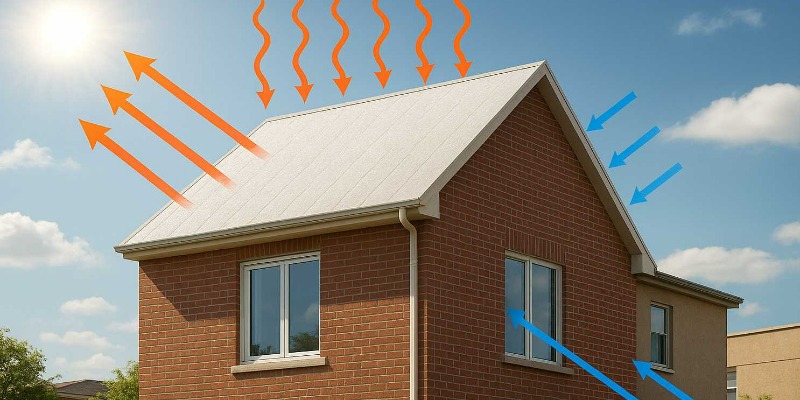
Professor Jyotirmoy Mandal , who led the project, highlighted how it is possible to modify the optical properties of building envelopes to modify their interaction with infrared radiation. The main difference lies in the direction in which the heat is emitted: towards the sky or towards the ground. When radiant heat is directed upwards, it can be dispersed into space through a very specific region of the infrared spectrum, known as the “atmospheric transmission window” (narrowband). In contrast, when heat propagates at ground level, it does so across the entire infrared spectrum (broadband), making it much more difficult to disperse.
Here’s the key takeaway: If you cover the exterior surfaces of buildings (like walls and windows) with materials that selectively interact with the narrowband, you can effectively emit heat into the sky during the day, providing passive cooling. At the same time, you reduce the heat absorption from surrounding surfaces—roads, sidewalks, other buildings—that typically contribute to the so-called urban heat island effect.
Technical difficulties and innovative solutions
Traditionally, roofs are the easiest part to make reflective, because they face upward and thus favor radiative exchange with the sky. However, vertical surfaces — such as walls and windows — are more exposed to thermal radiation from horizontal sources (such as the ground), making heat management much more complex. This is where Princeton research makes a difference: by using common materials that interact intelligently with infrared radiation, vertical surfaces can be prevented from overheating in the warm months, without compromising insulation during the winter.
Among the materials that are candidates to revolutionize green construction is polyvinyl fluoride (PVF), already used in many exterior coatings.
Research shows that, with some optical modifications, this material can be made selectively reflective in the narrowband and transparent or absorbent in the rest of the spectrum, thus obtaining an optimized management of thermal radiation.An advantageous energy comparison
One of the most relevant aspects of the study is the comparison between the effectiveness of the new coatings and traditional techniques. Mandal and colleagues calculated that the energy benefits offered by these common materials are comparable to those obtained by painting roofs and facades white, but with much lower costs and greater flexibility of use. While white paints have a predominantly summer function, selective materials can modulate thermal behavior even during the winter, making them useful all year round.
Furthermore, large-scale production of these coatings could leverage existing industrial infrastructure, accelerating their adoption without requiring massive investments in new facilities or technologies.
Social and environmental impact of technology
The potential impact of this discovery goes well beyond improving the energy efficiency of buildings in industrialized countries. According to Mandal, one of the system's main benefits is its climate equity. Buildings in warmer geographic areas, often in low-income communities with limited access to active cooling, could greatly benefit from this low-cost, passive technology. The ability to reduce indoor temperatures without consuming electricity is crucial in a context of global warming, resource scarcity, and rising heat-related mortality.
The mechanism is completely passive: it does not require power supply or sophisticated maintenance, and can easily adapt to both new and existing buildings. This makes it one of the most promising solutions for urban climate adaptation, especially in densely populated and vulnerable regions.
Future prospects: towards a new climate-friendly building
The contribution of the research is not limited to a simple applicative discovery, but opens new avenues for the climatic design of buildings. In the near future, the choice of cladding materials may no longer be based only on aesthetics and durability, but also on their spectral response to infrared radiation.
Instead of relying on increasingly complex energy systems, it will be possible to exploit the natural physics of the environment to obtain living comfort with minimal resources. The sustainability paradigm therefore shifts from "consuming less energy" to "not having to consume it at all", thanks to design strategies that integrate scientific knowledge and everyday materials.
Conclusions
The study conducted by Princeton University represents an important step towards the adoption of more sustainable, accessible and efficient building solutions. It shows how innovation does not always pass through the invention of new materials, but also by reinterpreting the properties of existing ones. Plastics, fluoropolymers and other common materials could transform from simple building components to protagonists of the energy revolution of buildings.
If adopted on a large scale, these heat-reflecting materials could drastically reduce the energy needs of buildings, reduce greenhouse gas emissions and contribute to a more resilient, democratic building industry, ready to face the climate challenges of our century.
© Reproduction prohibited