In the fifth chapter of the saga "Investigation at St. Peter", the reader is transported on a journey full of tension, mystery and moral choices in the heart of 14th-century Europe. Brother Elara, determined to deliver confidential documents that could change the fate of the Church, crosses a wintry and hostile Italy, between snowy lands, bustling cities and mountain passes threatened by spies and bandits.
Accompanied by a few trusted companions, he challenges physical and political obstacles along a path marked by dark plots and cover-ups. As his mission takes him to Avignon and then back to Rome, Elara finds himself facing pressure, ambushes and moral dilemmas that call into question the relationship between truth, power and faith. With dense and visionary writing, the chapter intertwines medieval history, suspense and ethical reflections, placing at its centre a question that is still relevant today: is it right to keep silence to protect order, or is it necessary to risk everything to bring out the truth?
In the heart of the winter of 1365, Brother Elara braves snow, deceit and occult powers to carry to the Pope the proof of a traffic in sacred relics
Investigation at Saint Peter’s. The Road Home. Chapter 5
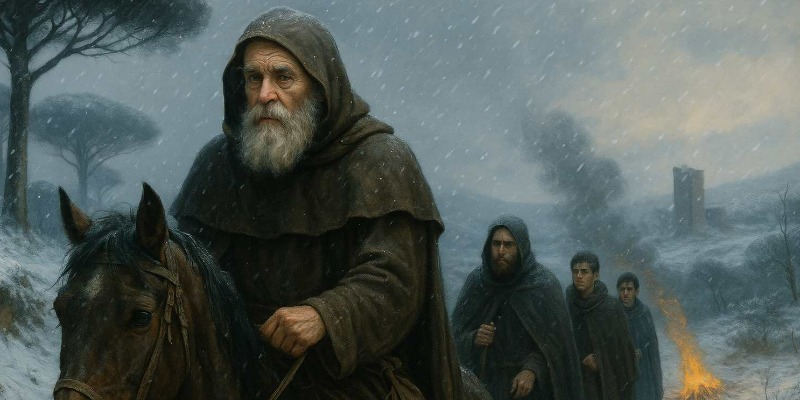
On 27 December 1364 the northern outskirts of Rome lay white beneath the night’s hail. The frozen crust crackled under Brother Elara’s horse, while the tramontana wind whipped spirals of icy dust beyond the pines that lined the Via Cassia. The Eternal City, behind him, was already dissolving into a bluish haze. Ahead, the road north tightened like a thread drawn between naked hills, abandoned watch‑towers and farmsteads where peasants burned brush‑wood to chase away the foul air.
His company was small: Johannes de Bern and Corrado of Lodi, survivors of the Lateran’s shadows; Brother Felice, a sharp‑tongued Franciscan; and a young Tuscan clerk, Niccolò dei Galgani, sent by Cardinal Colonna to deliver ciphered dispatches to the Bishop of Pistoia. They had to ride fast yet stay unnoticed: too many of Petrus Alamanni’s spies—though their master now sat in chains—still roamed free, and the captive treasurer had left orders that could bite even from prison.
In Elara’s saddlebag, wrapped in waxed canvas, lay the seized account‑books: decisive evidence, he hoped, for Pope Urban V to reform the guardianship of relics and—so they prayed—to place the Apostolic Camera under collegiate oversight.
At dusk they reached Sutri, a town cupped inside an Etruscan amphitheatre. The podestà granted them a corner of a stable; the fire kindled between cart‑wheels barely warmed them. Cleaning his blade, Corrado whispered, “Father, the worst war was not in Rome. It will be out here on the road, with no torches to show us where.” Elara nodded: the border between justice and vengeance could tighten in any dive, in any snow‑choked pass.
On 30 December they sighted the cliff of Orvieto, the cathedral streaked with alabaster and basalt, lapped by copper‑coloured clouds. A throng of French pilgrims bound for the Jubilee had camped there for days; the square seethed with carts, healers and vendors of miraculous wafers. Elara recalled, with a jolt, the echo of the thwarted theft: had the Clavis Capitis Custodes obtained Peter’s skull, the piazza would today be a bonfire of heresies.
They lodged in the Hospice of Saints Severus. During the Mass of Saint Silvia, Brother Felice noticed a Breton merchant wearing a ring engraved “C C C”: the same triple‑C Elara had seen on an altar in the Catacombs of Priscilla. They followed him into the crypt; the man—calling himself Ronan of Brest—carried beneath his cloak a belt reliquary filled with bone‑dust he peddled as pulvis Petri et Pauli.
Ronan tried to flee; Corrado slammed him to the paving. They discovered parchments in southern French: delivery orders for relics to the “Convent of the Broken Bridge, Paris,” signed Frater Marcus Hermeticus—the very name that had surfaced months earlier in the Montpellier manuscript. Proof that, though the Italian branch was severed, the network was recycling the trade beyond the Alps.
Elara gave him a choice: “Truth—or the gallows.” Weeping, the merchant confessed a courier awaited them in Bologna to collect “three minor skulls”—prelates of the Ottonian age—slipped somehow out of Roman vaults. Plainly someone within the Curia was still rifling coffins, selling the “less conspicuous pieces” to avoid uproar.
Decision swift: they would detour to Bologna, though the Apennine route in winter was a trap of snow and brigands. Elara sent Niccolò off with the papal dispatches on a shorter way—Florence–Pistoia–Lucca. “The Church,” he said, “is saved by divergent roads; should we fall, the documents will survive.”
On 4 January 1365 the little band left the Val di Paglia at a chalk‑coloured dawn. Frozen clods broke the horses’ breath. They reached Radicofani, Ghino di Tacco’s fortress, now watched by Florentine gendarmes: the taverns sold wine spattered with lees and rumours of captains. One—Messer Alberigo da Barbiano—learned that “an English friar with golden books in his pouch” was crossing the pass. He offered two men‑at‑arms as escort; Elara thanked him and refused: he preferred a known risk to one disguised as help.
Between Abbadia San Salvatore and the Cornata Pass snow struck at noon—a white, dense wall that swallowed the mule‑track beneath indistinct backs of rock. Johannes’s tallow torch struggled to stay alight. At midnight they found shelter in a deserted charcoal‑burner’s hut. The frost felt like vices on their skulls: ironic, Elara thought, for men chasing skulls these many months.
In troubled sleep Brother Felice heard the wind intone a psalm backwards. Morning revealed wolf tracks circling the hut in the snow, yet no human print. Still, the sense of eyes spying from behind the beeches clung to them all.
On 10 January they descended to Bologna, smelling of wet wood and meat broth. The towers leaned like giant metacarpals against a leaden sky. The university reliquary of San Procolo had housed bishops’ bones for centuries, but whispers in the cloisters said certain caskets had mysteriously lightened in recent months…
They traced the courier to a room above the Spezieria dei Tre Draghi. An adolescent pock‑marked lad, Luchino, insisted he carried “ancient weapons” to Paris for Lombard jewellers. Rifling his chest they indeed found arms—daggers, dismantled pikes—but under a false bottom lay three skulls wrapped in blue cloth, one still caked with mud. Luchino cried he knew nothing; he was paid not to ask.
Elara understood: the bone traffic used unwitting couriers, hiding skulls amid ironmongery. Thus, farther north existed not only a buyer but a full distribution web. “To push the hunt further means crossing the frontier and torching an entire market,” Johannes warned.

That night, in a cellar on Via delle Moline, the friar‑investigator convened a council.
He unrolled a map of Europe: Bologna—Piacenza—Milan—Pavia—Savoy—Rhône Valley—Avignon—Paris. Rings of a serpent. Caput regis, lumen mundi sounded an evergreen threat.“If we do not sever the head, another will grow,” Elara concluded. “Yet sometimes slitting a monster’s throat claims more lives than waiting for it to starve.”
Then Corrado voiced the question burning for days: “What will you really do with that proof? Bring palaces down because they sell skull‑caps?”
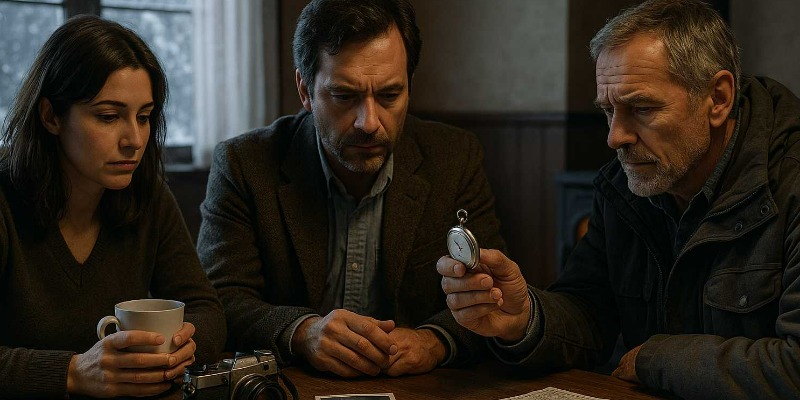
Elara lifted his lens, catching the flame. “I shall deliver them to the Pope. The rest is not mine.” But in his heart he was not wholly certain.
They set out on 11 January, along the ice‑bound Via Emilia. At Fiorenzuola, at sunset, a bridge over the torrent Arda, mown away by the water, forced them to ford. That moment the pursuers struck: five riders in light armour emerged from the woods, bows drawn. Their leader—a woman in an uncrested helm—shouted in Provençal, “Leave the chests or become walking skeletons!”

Buy the book in PDF in English
© Reproduction prohibited