- The Origins of Hydroponics: A Journey Through Time
- Hydroponics and Productivity: An Efficient Cultivation System
- Environmental Benefits of Hydroponics: Water Saving and Sustainability
- The Economic Benefits of Hydroponics
- Successful Hydroponics Projects Around the World
- Hydroponics in Urban Areas: Vertical Solutions for Green Cities
- Hydroponics and Drought: A Solution for Arid Regions
- The Future of Hydroponics: Innovation and Sustainability in Agriculture
How Hydroponics is Transforming Global Agriculture through Innovation, Sustainability, and Food Security in Drought-Affected Areas
by Marco Arezio
Agriculture has always been the foundation of human civilization, but with the growing global population and increasing environmental challenges, it has become evident that traditional farming methods are no longer sufficient.
This is where hydroponics comes in, a technique that is revolutionizing the way we produce food.
This soil-less cultivation method offers not only a sustainable alternative to conventional agriculture but also a response to the climate crises and water scarcity that affect many regions of the world.
The Roots of Hydroponics
Hydroponics may seem like a modern invention, but its roots go far back in time. The earliest forms of soil-less cultivation can be traced to the ancient civilizations of Babylon and Egypt, where rudimentary water cultivation techniques were already being used.
However, hydroponics as we know it today was formally introduced in the 20th century, thanks to the work of Professor William Frederick Gericke, who in 1937 demonstrated the possibility of growing plants on a large scale using only water and nutrients.
Since then, the technique has continuously evolved, refining itself and adapting to modern needs.
The Productive Benefits of Hydroponics
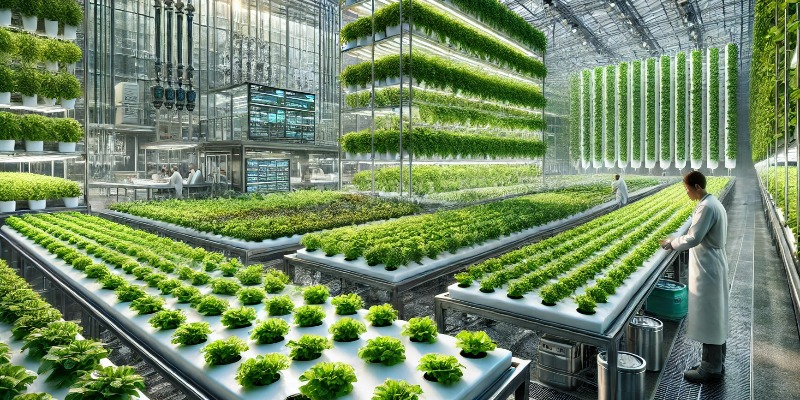
One of the most surprising aspects of hydroponics is its extraordinary production efficiency. In a hydroponic system, plants receive exactly the nutrients they need, directly to their roots, allowing them to grow faster than with traditional methods.
This ability to fully control growth conditions translates into accelerated growing cycles and higher yields.
Moreover, hydroponics makes optimal use of space. Without the need for soil, plants can be grown in vertical structures, utilizing every available inch. This is particularly advantageous in urban areas, where space is limited but the demand for fresh food is high.
The ability to grow year-round, regardless of external conditions, makes this system extremely productive and reliable.
Environmental Benefits: A Sustainable Solution
In addition to its productive advantages, hydroponics also presents numerous environmental benefits, making it an ideal choice for sustainable agriculture.
One of the most significant advantages is the reduction in water consumption. In a hydroponic system, water is recirculated, drastically reducing waste and evaporation. In some cases, up to 90% less water is used compared to traditional irrigation methods.
Hydroponics also reduces the use of pesticides and chemical fertilizers. Since the growing environment is controlled and isolated, the risk of infestations is lower, allowing for the reduction or elimination of harmful chemicals.
This not only has a positive impact on the quality of the final product but also on the environment, preventing soil and groundwater contamination.
Furthermore, hydroponics eliminates one of the main problems of traditional agriculture: soil erosion. Without the need for soil, the degradation of arable land is avoided, preserving natural resources for future generations.
Economic Benefits: A Profitable Future
From an economic standpoint, hydroponics offers significant advantages, especially in a context of increasing food demand and limited resources.
The ability to automate much of the cultivation process reduces labor costs, making hydroponics a competitive solution even in terms of expenses.In addition, high yields and faster production cycles translate into higher profits per hectare compared to traditional agriculture. This is particularly relevant in areas where agricultural land is scarce or expensive.
Hydroponics also offers greater resilience to climate shocks, ensuring stable and predictable production, regardless of external climate variations.
Hydroponic Projects Around the World: Success Stories
Around the world, several hydroponic projects are demonstrating the potential of this technology. A prime example is Edenworks in New York, a company that integrates hydroponics with aquaponics, producing fresh food for the local community with a reduced environmental impact.
This project shows how hydroponics can be combined with other sustainable techniques to create even more efficient agricultural systems.
In Singapore, Sky Greens has developed a vertical farming system using rotating towers to grow hydroponic vegetables. This project maximizes the limited space in the city-state, demonstrating that hydroponics is an ideal solution for densely populated urban areas.
Another noteworthy example is AeroFarms in the United States, one of the largest indoor vertical farming systems in the world. Using advanced hydroponic techniques, AeroFarms manages to produce vast amounts of food with minimal water and space consumption, while also reducing CO2 emissions through local cultivation.
In the Middle East, where drought conditions are particularly severe, Desert Control is using hydroponics to turn desert areas into fertile land. This project represents an example of how hydroponics can be a vital solution for regions affected by water scarcity.
Hydroponics in Drought-Affected Countries: A Solution for the Future
For countries affected by drought, hydroponics represents a concrete hope. Water scarcity and soil degradation are making traditional farming increasingly difficult in many regions of the world, but hydroponics offers a viable alternative.
Thanks to its water efficiency and ability to produce food without soil, hydroponics could radically transform agriculture in these areas.
In the future, the expansion of large-scale hydroponic systems could not only ensure food security in drought-stricken regions but also stimulate the local economy, reducing dependence on food imports and creating new job opportunities.
Moreover, the further development of hydroponic technologies, such as integration with renewable energy sources, could make this solution even more accessible and sustainable.
Conclusion
Hydroponics is not just an innovative solution for modern agriculture, but it also represents a concrete response to global challenges of sustainability, food security, and climate change.
With its potential to transform agricultural practices, especially in regions affected by drought, hydroponics could play a key role in the future of global agriculture, contributing to building a more resilient, efficient, and sustainable food system.