- Marble Scraps: From Waste to Resource for Industry and Design
- How Marble Scraps Are Transformed: From Block to Dust
- Building and Construction: The Role of Recycled Marble in Building Materials
- Chemical and Environmental Industry: Applications of Calcium Carbonate
- Agriculture and Livestock: Recycled Marble for Soils and Animal Feed
- From Paper Industry to Paints: The Use of Marble Scraps in Industrial Production
- Design and Furnishings: How Recycled Marble is Revolutionizing the Industry
- The Future of Marble Recycling: Towards a More Sustainable and Innovative Industry
A New Value for Marble Waste Through Recycling
By Marco Arezio
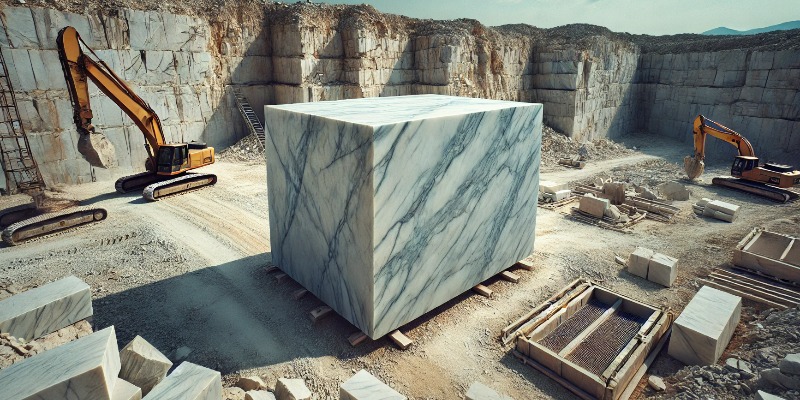
The marble industry has always been admired for its ability to transform a natural material into works of art and elegant surfaces. However, behind the beauty of this sector lies a less-known reality: marble extraction and processing generate a massive amount of waste. Defective blocks, cut-off fragments, damaged slabs, and fine powders accumulate in quarries and workshops, often without finding a useful application.
For years, these waste materials have been seen as a problem, involving high disposal costs and significant environmental impact. Today, however, things are changing. Thanks to a more sustainable approach and technological innovation, marble waste is becoming a valuable resource for various industries, reducing waste and giving new life to a material with unique characteristics.
From Blocks to Powder: The Second Life of Marble

Depending on their shape and size, marble waste can be recovered and transformed into useful materials for multiple applications.
Large blocks that do not meet quality standards can be refined and cut into tiles, flooring, or decorative surfaces. Smaller fragments, on the other hand, are crushed and used as aggregates in the production of construction materials.Even marble powder, once considered a mere processing residue, has found new applications thanks to its high calcium carbonate content. This element is widely used in various industrial sectors, from chemicals to cosmetics, from paper production to eco-friendly paints.
The marble recycling industry is now a growing reality, with more and more companies experimenting with innovative ways to integrate these materials into their production chains. The result is a more efficient and sustainable system where every scrap becomes an opportunity.
The Countless Applications of Recycled Marble
One of the industries benefiting the most from marble waste reuse is construction. Crushed marble granules, obtained from stone processing residues, are used to improve the strength of concrete and mortars while reducing the consumption of natural sand and gravel. Additionally, marble fragments are employed in terrazzo flooring and composite surfaces, combining aesthetics with sustainability.
But the contribution of recycled marble is not limited to the construction sector. The chemical industry has also found valuable uses for this material. Calcium carbonate, derived from marble powder, is used to enhance the quality of plastics, resins, and paints. Its ability to increase product resistance and durability makes it a valuable ingredient, helping to reduce the use of synthetic materials and lower production costs.
Another area where marble waste is making a difference is environmental purification. Calcium carbonate can neutralize acidic substances in wastewater and industrial exhaust gases, contributing to pollution reduction. Additionally, more companies are using recycled marble in filtration systems to improve potable water quality.
From Agriculture to Cosmetics: A Versatile Application
Agriculture has also found a valuable ally in recycled marble. Marble powder is used to adjust soil acidity, improving plant nutrient absorption and promoting healthier crop growth. Furthermore, calcium carbonate is incorporated into natural fertilizers, fostering more sustainable farming with reduced dependence on synthetic chemicals.
The livestock industry also benefits from marble reuse. Calcium carbonate is an essential component in animal feed, promoting bone development and overall health.
But that’s not all. In recent years, recycled marble has also found applications in the cosmetics sector. Thanks to its fine and delicate structure, marble powder is used in exfoliating products, offering a natural alternative to microplastics, which are gradually being phased out from skincare products. It is also found in toothpaste, where it provides a gentle abrasive action that helps maintain natural tooth whiteness without damaging enamel.
From Design to Furnishings: The Appeal of Recycled Marble

Beyond industrial and environmental applications, recycled marble is gaining popularity in the world of design and interior furnishings. Many designers are exploring new ways to integrate marble waste into their projects, creating unique and sustainable home accessories.
Composite surfaces, for instance, are one of the most exciting innovations in this field. By mixing marble fragments with eco-friendly resins, durable and visually appealing materials can be created, ideal for kitchen countertops, tables, and wall coverings. Even in lighting and small design objects, recycled marble is becoming a distinctive element, used to create lamps, vases, and decorations with a striking visual impact.
This renewed interest in recycled marble shows that design can be not only beautiful but also sustainable. The idea of repurposing a material that would otherwise be wasted is gaining momentum, transforming the very concept of luxury into something more responsible and innovative.
Towards a More Sustainable Future
Marble waste recycling is one of the most promising solutions for reducing the environmental impact of the extraction industry while simultaneously creating new valuable products. The fact that a material once considered waste can become a strategic resource for construction, chemicals, agriculture, cosmetics, and design proves that innovation and sustainability can go hand in hand.
More and more companies are adopting a circular approach to production, demonstrating that marble recovery is not just an ecological choice but also a winning economic strategy. The future of marble is no longer just in quarries but also in laboratories and recycling processes, where creativity and technology are redefining how we use this precious stone.
The marble industry is changing its face: from a high-impact sector, it is becoming an example of innovation and sustainability. And with it, our vision of luxury and design is also evolving, increasingly looking to the future with an ecological and responsible perspective.
© Reproduction Prohibited