- The Burst of the China PV Bubble
- Overproduction and Domestic Energy Surplus
- Effects of Overcapacity on Chinese Manufacturers
- Global Impact on Solar Panel Markets
- The State of the German PV Market
- Policy Responses in the United States and Europe
- Future Prospects and Innovative Solutions
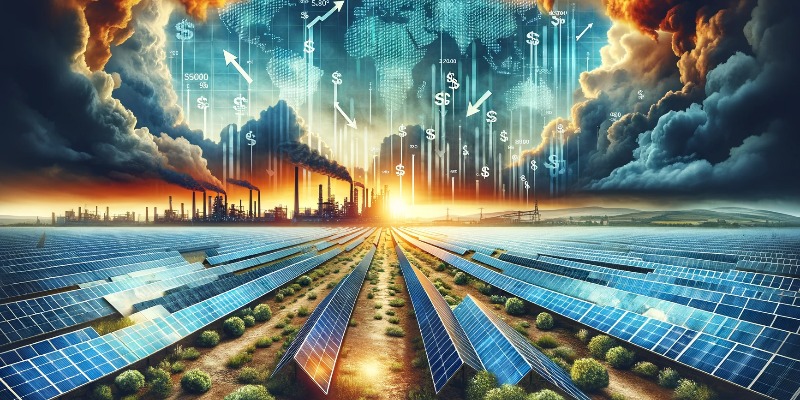
An excess of solar panels has caused a price collapse and market saturation, putting producers and countries around the world in difficulty
by Marco Arezio
In recent years, the photovoltaic sector in China has experienced exponential growth, leading to an oversupply of solar panels.
This overproduction has generated a global surplus, causing solar panel prices to fall internationally.
While the expansion of renewable energy production capacity is a positive step toward the energy transition, the market is now in a difficult situation, with the United States and the European Union asking Beijing to limit its production capacity.
Overproduction and Domestic Energy Surplus
China has installed such a large number of solar panels that it has created an energy surplus that the country is unable to store.
In response to this situation, Chinese authorities have started withdrawing some subsidies for the sector, attempting to slow the pace of new installations.
However, in the first quarter of 2024, solar panel installations in the Beijing region grew by 33% compared to the previous year, following a boom of 154% in the same period in 2023. This uncontrolled growth is the result of accelerated industrial expansion in recent years.
Impact on Producers and the Global Market
Chinese producers are also feeling the effects of overcapacity. Longi Green Energy Technology, the world’s largest solar cell manufacturer, has announced the layoff of thousands of workers due to price drops and oversupply.
This surplus has led to an influx of solar panels into markets outside Asia, triggering a global domino effect that has halved solar module prices in Europe within six months.
China dominates the global solar panel market, with production costs significantly lower than those in the United States and Europe. Chinese producers manufacture solar panels at costs ranging between 16 and 18.9 cents per watt of generating capacity, compared to 28 cents for U.S. companies and 24-30 cents for European firms.
The Situation in Germany
Germany is also facing a similar phenomenon. In 2023, the country installed a record capacity of 14,280 MW of solar energy, almost double the amount installed in 2022.
Total installed solar capacity reached 81.
7 GW, far exceeding the country’s average energy demand of 52.2 GW.This excess capacity has led to a reduction in energy prices, with values in some cases turning negative. Germany’s electricity grid, like China’s, is struggling to handle the excess solar energy, raising the possibility that producers may no longer be able to sell surplus energy, limiting themselves to self-consumption.
Political and Strategic Responses
In the United States, President Joe Biden has announced an increase in tariffs on bifacial photovoltaic panels, which until now were not subject to safeguard tariffs under Section 201 of the Trade Act of 1974.
The new tariff on solar cells (whether assembled in modules or not) will rise from 25% to 50% in 2024, but the impact of these measures may be limited.
In Europe, two investigations are underway into Chinese solar panel manufacturers suspected of receiving illegal state subsidies.
Several countries, including Italy, are launching new solar panel production, but there is a risk that Europe could replace its dependence on Russian gas with a new dependence on Chinese green technology.
Future Prospects
The best solution to address the current crisis seems to be focusing on quality and technological innovation.
Investing in advanced technologies and improving the efficiency of solar panels could help mitigate the negative effects of overproduction and stabilize markets.
In the long term, technological innovation could make a difference, ensuring a sustainable energy transition and balancing the supply and demand of renewable energy.
Conclusions
The explosion of the photovoltaic bubble in China represents a complex phenomenon with global implications. The overproduction of solar panels has created a surplus that has driven down prices and put producers under pressure.
While the push toward renewable energy is positive, a more balanced approach is needed to avoid overproduction crises.
Countries must collaborate to find solutions that ensure a sustainable energy transition, while reducing dependence on individual suppliers and promoting innovation in the renewable energy sector.
© All Rights Reserved